Fourth of July Fireworks Rules Vary Across Coastal Alabama
Fire officials across Mobile and Baldwin counties are reminding residents that fireworks rules differ sharply from city to city ahead of the Fourth.
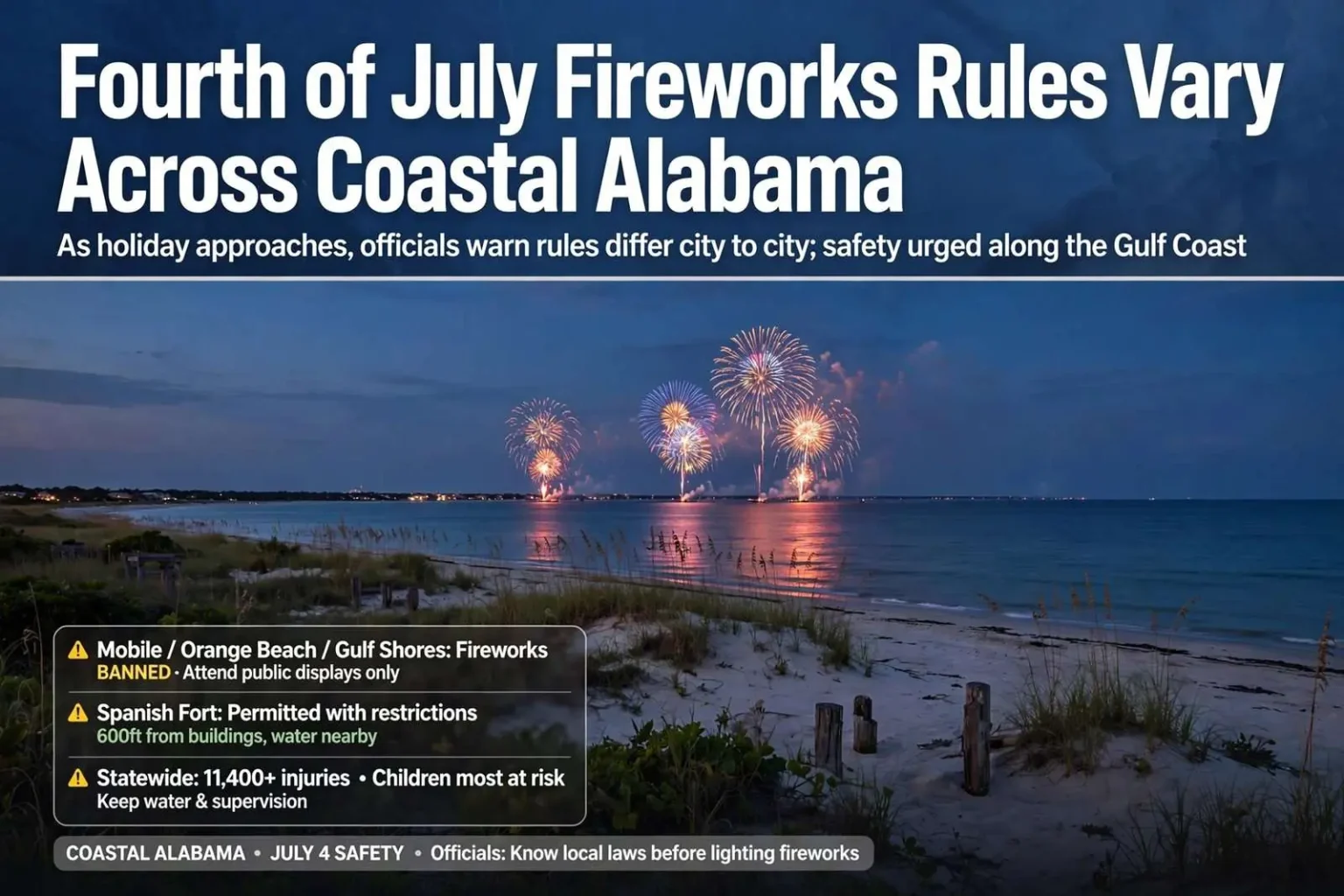
As Fourth of July celebrations approach, fire officials across the Gulf Coast are urging residents to think twice before lighting their own fireworks, warning that rules on where and how they can be used vary widely from one South Alabama city to the next. The patchwork of local ordinances means that a backyard display that is perfectly legal in one jurisdiction can bring a citation a few miles down the road — and officials want residents to know the rules before they light the fuse, not after.
The stakes are more than legal. Nationally, fireworks send thousands of people to the emergency room every year. A federal safety study found roughly 11,400 fireworks-related injuries and eight deaths in a single recent year, and local officials say most of those hurt are children under 15, with injuries commonly striking the hands, fingers, face and eyes. The devices most people consider benign — fountains, bottle rockets, sparklers — account for a large share of those injuries, particularly among the youngest celebrants.
Along the Gulf Coast, where dry summer grass, coastal breezes and crowded neighborhoods combine, fire officials treat the holiday as a season of elevated risk. A stray spark that lands harmlessly on a wet lawn in April can find a drought-parched field in late June, and wind off the Gulf can carry embers farther than backyardlaunchers expect.
The rules that apply everywhere
Steve Holmes, a public information officer with the Alabama State Fire Marshal’s office, said some basic rules apply no matter where you are: fireworks should never be discharged within 600 feet of a building or aimed at another person, both of which can result in a citation. He also recommended lighting fireworks only on a hard, flat surface rather than in a field or pasture, and being mindful of pets, since the loud pops can seriously distress animals.
The 600-foot rule surprises many residents, who assume distance requirements apply only to commercial displays. In practice it makes most suburban lots unsuitable for aerial fireworks — a mortar shell fired from a subdivision backyard almost necessarily lands within the restricted radius of somebody’s home. Lighting on a hard, flat surface, meanwhile, prevents the tipped-over cake or the sinking tube that turns a device toward the crowd, and keeps igniters out of dry vegetation where a single spark can start a grass fire that outruns a garden hose.
Holmes also had a word for the preparations that make the difference when something goes wrong: a connected garden hose or a bucket of water within reach, fireworks that misfire left alone rather than relit immediately, and spent devices doused before they go in the trash. Emergency rooms report that a significant share of fireworks injuries come from relighting duds and from handling devices that appeared finished but were still live.
Mobile and the beach cities: a flat ban
In the city of Mobile, the rules are simple: fireworks are banned outright. Mobile Fire-Rescue spokesman Steve Huffman said residents cannot legally buy, sell, make or use fireworks anywhere within city limits, and encouraged people to instead attend professionally run displays. He noted that sparklers, often assumed to be harmless, can burn at temperatures around 1,200 degrees — hot enough to melt some metals and to cause third-degree burns in an instant, which is why emergency physicians rank them among the holiday’s most dangerous hand-me-downs to small children.
The ban reflects the realities of a dense, older city: closely spaced wood-frame homes, narrow lots, and a fire department that already runs one of the busiest call volumes in the state. A single rooftop fire started by an aerial device can threaten an entire block, and the city’s experience has long been that the risk of consumer fireworks in that environment outweighs any celebration they deliver. Professional shows, staged with licensed pyrotechnicians, perimeter zones and fire crews on standby, give residents the spectacle without the exposure.
Orange Beach has a similar restriction, according to fire marshal Craig Stephenson, who said the city prohibits personal fireworks use and only permits displays handled by licensed pyrotechnics companies. Gulf Shores takes the same approach, said fire marshal George Surry, who noted that fireworks are illegal within the city unless set off by a company holding both a city assembly permit and a state license. Surry said residents sometimes ignore the rule, but doing so can still result in a citation.
The beach cities’ reasoning blends fire risk with the practicalities of a resort economy. Condominium towers, beach houses built of wood and raised on pilings, and dune vegetation that burns fast and hot line the same streets where visitors celebrate, and sea breezes shift direction without warning. Sand also misleads: it seems a safe launching pad, but soft sand lets tubes tip, and a firework that tips is a firework aimed at whatever is nearest. With the cities’ skylines full of occupied units on the July 4 weekend, officials would rather point residents toward the public displays on the water than chase stray mortars through beach neighborhoods.
Spanish Fort and the flexibility of the Eastern Shore
Spanish Fort offers residents more flexibility. Fire officials there allow consumer fireworks to be used within city limits subject to local restrictions, and they encourage the same core safety practices the state fire marshal’s office preaches: open space, distance from structures, supervision of children, and a water source at the ready. The city’s newer subdivisions and larger lots make backyard celebrations more feasible than they are in Mobile’s older neighborhoods, but officials still urge restraint in dry conditions and consideration for neighbors, veterans with post-traumatic stress and pets startled by the noise.
Why the rules differ from town to town
The variation across coastal Alabama is not accidental. Under Alabama law, the sale and use of consumer fireworks are permitted statewide, but municipalities hold the authority to regulate or prohibit them within their limits, and each city has weighed the question against its own geography, housing stock and fire history. The result is a map where legality changes at the city limits sign: a display legal in unincorporated Baldwin County or in a permissive city like Spanish Fort becomes a citation-worthy offense once the same fireworks cross into Mobile, Gulf Shores or Orange Beach.
Fire officials recommend that residents check with their city hall or fire department before buying, and read the labels on the devices themselves. Products sold at licensed stands in Alabama carry warnings and usage instructions, and using a device in a manner contrary to its labeling — tossing firecrackers, holding sparklers too close, launching tubes from hand — is itself unsafe and can compound any legal trouble that follows.
A season of heightened fire danger
The Fourth of July arrives at the point in the Gulf Coast calendar when heat has dried the landscape and afternoon thunderstorms have become hit-or-miss. Even in a normal year, dry grass in roadside ditches, vacant lots and pasture edges ignites easily, and a fire set in a field can travel faster than a person can run, driven by the same breezes that moderate the day’s heat. Fire departments across the region routinely handle grass and brush fires around the holiday, and a dry year stretches their capacity further.
That is why the officials interviewed for the holiday precautions keep returning to the same handful of themes: know the local law, choose the location deliberately, keep water close, keep children at a distance and leave the big aerial devices to the professionals. None of it diminishes the holiday; all of it protects the people and neighborhoods celebrating it.
Leaving the big shows to the pros
Across the coast, the professional displays offer what no backyard show can: devices far larger than any consumer product, fired by crews who train and license for the work, with fire and medical resources staged nearby. From Mobile Bay to the Gulf beaches, Independence Day audiences can find waterfront shows engineered for safety as well as spectacle — and fire officials note that attending one is not merely the legal option in the ban cities, but the best show available anywhere in the region.
For those who do light their own, the guidance is consistent regardless of jurisdiction: a hard, flat surface well away from buildings and dry vegetation; adults only at the point of ignition; one device at a time; and a hose or bucket at hand from the first fuse to the final dousing. The rules vary across South Alabama, but the common sense that produced them does not.
Fire officials’ closing message to the region is a simple one. Celebrate, they say — but know where you are standing when you do, because the line between a memorable Fourth of July and a trip to the burn unit, or a citation, is often no wider than the nearest city limits sign.