1,600 Tons of Rubble Became a New Fishing Reef in Mobile Bay
The Alabama Wildlife Federation built the Upper Wreck Reef between Mullet Point and the mouth of Weeks Bay, a 1.25-acre underwater structure of recycled rubble finished in time for Memorial Day weekend.
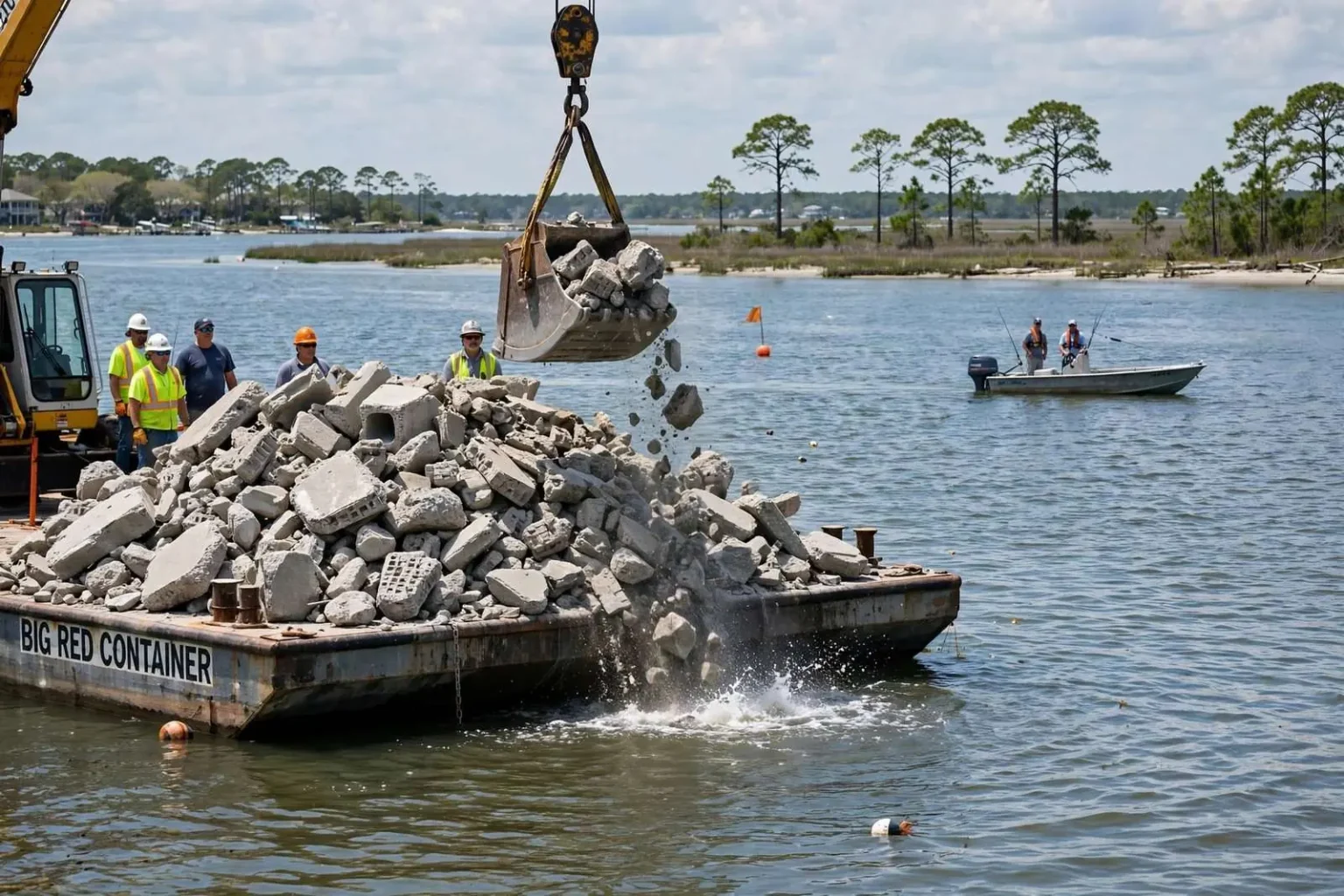
A new inshore fishing reef was constructed in Mobile Bay between Mullet Point and the mouth of Weeks Bay, finished in time for anglers to try it over Memorial Day weekend. The project, initiated by the Alabama Wildlife Federation, placed 1,600 tons of rubble and rock on the bay bottom, forming a 1.25-acre underwater structure named the Upper Wreck Reef.
The site itself was chosen with fishermen in mind. The stretch of the bay between Mullet Point and Weeks Bay sits in the heart of the Eastern Shore’s small-boat country, close enough to the Fairhope, Point Clear and Magnolia Springs landings that a family in a modest skiff can reach it, fish it and get home in a morning. Inshore structure in that area has always been scarce, and anglers who wanted reliable bottom fishing traditionally had to run well offshore to find it.
Built from recycled material
The old rubble used in the project was brought to the site by Sand & Clay and Big Red Container, and Harold Sherman of M&N of Alabama deployed it. “We are glad that the material was recycled,” said Jay Corte of Sand & Clay and Big Red Container.
The recycling angle was not incidental. Concrete rubble from demolished structures is heavy, awkward and expensive to dispose of. Dropped in the right place, in the right configuration, it becomes habitat. The reef program turned a disposal cost into a public asset. In effect, the same material that would otherwise have been buried in a landfill now sits on the bay bottom doing a second job: growing an ecosystem.
Riley Boykin Smith, the federation’s president and a Mobile resident, said the organization was “proud to be a part of enhancing inshore fishing opportunities in Mobile Bay.”
The project’s funding and labor model reflected the way Alabama’s conservation community actually works. The Alabama Wildlife Federation acts as a convener — bringing together contractors with material to move, marine science expertise, state regulators and local fishing interests — and its reef projects lean on donated or reduced-cost services from the companies involved. Barge time, crane work and material haulage are the expensive parts of any reef build, and the willingness of firms like Sand & Clay, Big Red Container and M&N of Alabama to supply them at little or no cost is what makes a 1,600-ton structure feasible for a nonprofit to deliver.
Why Mobile Bay needs help
The bay is enormous, shallow and, from a fish’s point of view, largely featureless. “Because of its flat surface and lack of cover, the Bay area attracts few fish,” as the project’s supporters described the problem. A flat mud bottom offers nothing to hide in, nothing to attach to and nothing to hunt around. Vertical structure changes everything.
“Anything that adds vertical relief quickly transforms the character of the habitat,” explained Jim Duffy of the Marine Resources Division. “Artificial reefs attract encrusting organisms like coral and sponge, and once they are established, small bait fish take up residence and larger fish are attracted. After the complete reef food web is created, the artificial reef functions as a natural reef.”
The sequence is worth following, because it explains why a pile of concrete becomes a fishing spot. In the first week, barnacles, sponges and other encrusting organisms colonize the hard surfaces. Then small baitfish and crustaceans move in for cover and food. Then larger predatory fish arrive to feed on them. Eventually a complete food web establishes itself and the structure functions as a natural reef.
For an angler, the practical translation is simple: structure concentrates fish. Speckled trout, redfish, flounder, sheepshead and the bait they feed on all respond to hard bottom in a soft-bottom bay. A reef gives trolling patterns a target, gives bottom-fishermen a coordinate to anchor on and gives families in small boats a destination that does not require a long run or expensive fuel.
Ready sooner than you would think
Anglers did not have to wait for the ecosystem to mature. “In the past, fish have been reported to begin utilizing the new reefs as early as a few days after being constructed,” said Tim Gothard, the federation’s executive director. “Memorial Day weekend would be a great time for local fishermen to try it out.”
The speed is a recurring surprise in artificial reef work. Fish are drawn to relief and shadow almost immediately, and Mobile’s bay fishermen — who watch the water closely — can tell within days when new structure starts holding bait. The full ecological maturity, with sponges, coral growths and a stable community, takes longer, but the fishing payoff arrives long before that. By deploying the reef ahead of the summer holiday weekend, the federation timed the project to the season when bay fishing traffic peaks, when families are on the water and when word of a new hotspot spreads fastest through the landings and bait shops.
Alabama’s reef tradition
Alabama has one of the largest artificial reef programs in the United States, most of it built offshore in the Gulf, where decades of deployed material have created a bottom fishery, particularly for red snapper, out of proportion to the state’s short coastline. Inshore reefs like the Upper Wreck Reef serve a different constituency. They are reachable in a small boat, by a family, without a long run through open water and without a big fuel bill. For the recreational angler out of Fairhope, Point Clear or Daphne, a productive reef within sight of shore is worth more than a distant offshore honey hole.
The offshore program’s scale is hard to overstate. Over decades, the state has permitted and encouraged the deployment of ships, bridge rubble, Liberty reef structures and other material across permitted areas in the Gulf, building an artificial reef zone that draws anglers and divers from across the region and underpins much of Alabama’s charter-boat industry. The red snapper fishery that recreationists associate with the Alabama Gulf Coast exists in its modern form largely because of that program. The inshore projects extend the same logic to water that a 16-foot skiff can fish.
What the reef means for local anglers
A 1.25-acre reef in upper Mobile Bay functions differently from a Gulf structure. Bay salinity, tides and seasonal changes mean the fish community around the reef shifts through the year, and the reef’s value changes with the seasons — a speckled trout destination in the warmer months, a bottom-fishing spot for the bait-and-predator chain that builds on any hard structure. For the commercial party boats and guide services working the bay, new structure expands the map of places that reliably produce, which is a small but real economic input for the Eastern Shore towns whose economies touch the water.
The conservation math works the other way too. Structure spreads fishing pressure rather than concentrating it on the handful of natural hard-bottom areas, and it gives juvenile fish nursery habitat in the heart of the estuary. Mobile Bay is the receiving water for the entire Mobile-Tensaw Delta, one of the most productive estuarine systems on the Gulf Coast, and every acre of functioning habitat inside the bay strengthens the system that sustains the region’s fisheries.
The organization behind the reef
The Alabama Wildlife Federation, established by sportsmen in 1935, is the state’s oldest and largest citizens’ conservation organization, a nonprofit supported by dues and donations whose stated mission is to promote conservation and wise use of the state’s wildlife and natural resources. Its programs span habitat work on private land, youth outdoor education, and projects like this one that put conservation on the ground — or, in this case, on the bay bottom — where the public can use it.
The federation’s reef initiative grew from the same sportsmen’s instinct that founded the organization: the people who use the resource are the ones who will build for it. Hunters and anglers fund and construct habitat because they want something to hunt and fish next season, and the Upper Wreck Reef is that instinct translated into 1,600 tons of concrete.
Information on Alabama’s artificial reef program was available through the state’s outdoor agency, and the federation accepted donations to the reef program. For anglers planning a Memorial Day weekend trip, the practical instruction was the simplest kind: run to the coordinates, drop a line, and see whether the fish had found the new rubble yet. By the project’s own timetable, they almost certainly had.
Reading the water at the new reef
For anglers fishing the Upper Wreck Reef for the first time, the standard inshore playbook applies. On a rising tide, fish move up onto structure to feed; on the fall, they hold in the shadow of the relief. Live shrimp or pogies worked near the bottom produce the sheepshead and flounder that colonize hard structure first, while topwater and jig presentations across the relief draw the speckled trout that patrol above it. Because the reef sits in open bay rather than a channel, anglers can work it from any direction depending on wind and tide — a flexibility that fixed-channel spots do not offer.
Courtesy among boats matters on a small inshore reef. A 1.25-acre footprint is limited water, and the unwritten rules of Alabama bay fishing — anchor off the structure, drift rather than park on top of other boats, keep wakes down in the neighborhood of other anglers — determine whether a new spot remains pleasant to fish. Reef projects like this one succeed socially as well as biologically when the anglers who find them first treat them as shared infrastructure, which has generally been the culture around the bay’s public reefs.
Long-term, the reef joins the network of inshore structure that Mobile Bay fishermen navigate by — the bridge pilings, channel edges, oyster bars and earlier reef deployments that give an otherwise flat bay its fishing geography. Each addition changes the map a little, and the federation’s stated goal of enhancing inshore fishing opportunity is ultimately measured in how many trips a year end with fish in the box and how many young anglers get their first saltwater fish within sight of home.
Between Mullet Point and the mouth of Weeks Bay, 1,600 tons of rubble that once had no better future than a landfill now holds bait, feeds gamefish and gives small-boat anglers a destination. Memorial Day weekend was the deadline the project set for itself; the fish, by every account of how these reefs develop, needed considerably less time than that.