Talk of a Special Session on Gas Royalties Set Up a Fight With Oil Lobbyists
With an industrial recruitment session no longer needed, speculation in August 2008 turned to a special legislative session on natural gas royalties, a fight expected to test the oil industry's lobbyists.
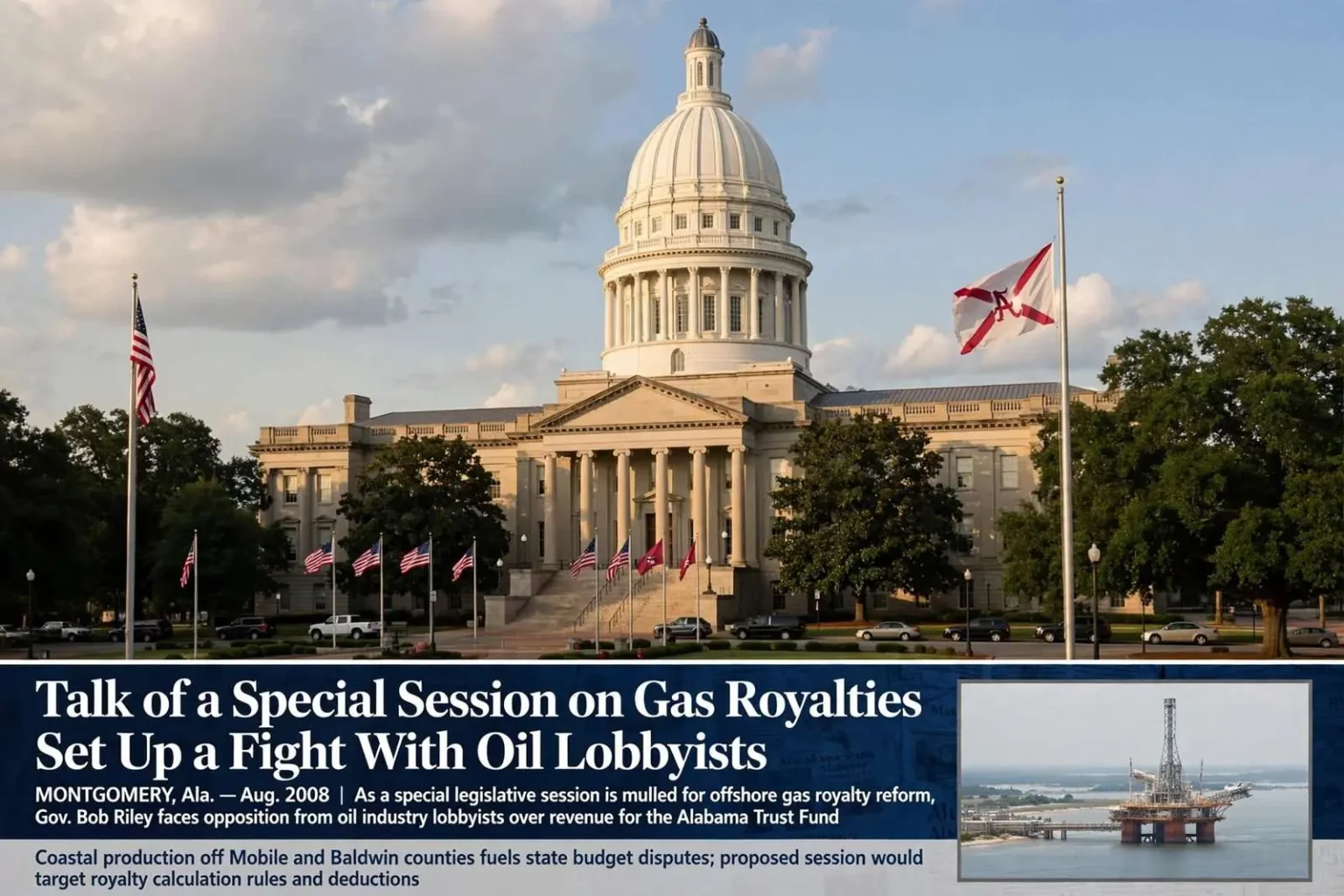
Alabama entered August 2008 with a special legislative session in search of a subject. Gov. Bob Riley had been expected to call lawmakers back to Montgomery to strengthen the state’s industrial recruitment tools. That rationale faded when Volkswagen chose Tennessee for a new assembly plant, taking the urgency — and the leverage — out of the argument.
What replaced it, briefly, was an idea that mattered more to south Alabama than almost anything else on the state’s agenda that year: a session devoted to the laws governing natural gas royalties owed to the state.
A Different Target
Former Lt. Gov. Jere Beasley, the Montgomery plaintiffs’ lawyer whose newsletter was widely read in Alabama political circles, wrote that the governor might isolate that single issue and put it before the Legislature.
“Most legislators I have talked with tell me that a session dealing with that issue will be a real test for the oil industry lobbyists,” Beasley wrote. “Those lobbyists will definitely have their work cut out on this issue.”
He framed the outcome as binary: either the lobbyists would win, or Riley and the state’s taxpayers would.
“If I were a betting man,” he concluded, “I wouldn’t put my money on the lobbyists this time.”
Beasley’s newsletter had a long history of shaping Alabama political conversation, and his read on the royalty question carried weight in part because he had watched the issue from the front lines: his firm had been involved in the litigation between the state and its biggest gas producer, and his summaries of the state’s ongoing disputes were read by legislators, lobbyists and journalists alike. His framing of the special-session idea as a straight contest — industry lobbyists on one side, the governor and taxpayers on the other — captured how the issue was understood in Montgomery, whatever the legal technicalities underneath it.
Why Royalties Were a Coastal Issue
For readers along the coast, this was never an abstract fight. Alabama’s offshore natural gas production sits off Mobile and Baldwin counties, and the royalties paid on gas drawn from state waters flow into the state treasury and, through the Alabama Trust Fund, into the general operations of state government.
How those royalties are calculated — what may be deducted for processing and transportation before the state takes its share — had already generated years of litigation between the state and major producers.
The dispute had produced one of the most famous verdicts in state history: a jury award against Exxon over gas royalties from Mobile Bay leases, a case that ran through the Alabama Supreme Court and was drastically reduced on appeal.
The stakes were enormous by the standards of Alabama’s General Fund, which in 2008 leaned on the offshore gas money in a way few other revenue sources could match. The Alabama Trust Fund had been created to manage the proceeds of the state’s settlement with oil and gas companies over offshore drilling rights, converting a one-time windfall into a permanent endowment whose earnings helped pay the state’s recurring bills. Every dollar shaved off the royalty calculation — through deductions for processing, transportation or marketing — was a dollar that did not flow into that fund or the treasury, and the companies’ accountants and the state’s lawyers had spent years arguing over exactly where those lines fell.
The geography made the politics local. The gas fields sit in state waters within sight of the Baldwin County beach communities, and the revenue questions were litigated and negotiated in Mobile courtrooms and Montgomery offices while the wells themselves ran beneath the waters of Mobile Bay and the Gulf beyond. Coastal legislators had long treated royalty policy as a district issue, much as legislators in the Black Belt treat timber or those in the Tennessee Valley treat aerospace.
The Politics of a One-Issue Session
A special session with a narrow call is a specific kind of political instrument. It limits what lawmakers may take up, concentrates public attention on a single question and denies both sides the cover of a crowded agenda.
That is precisely why Beasley expected the oil industry to work hard against one. A single-issue call on royalty law would have forced the question of deductions and calculations into the open, with a clock running and every bill on the governor’s chosen subject subject to an up-or-down vote. Lobbyists who could quietly shape a contract dispute or a court case would have faced something less comfortable: recorded votes in both chambers on whether the state was getting its fair share.
In the event, no such session materialized that year. Riley did not put natural gas royalties before the Legislature in a special call, and the state’s royalty disputes continued to be litigated and negotiated rather than legislated.
The idea’s quiet disappearance followed a familiar pattern in Alabama government. Special sessions are expensive, politically risky and called only when a governor wants something badly enough to spend the capital. With the Volkswagen prize gone, Riley had no urgent recruiting rationale; without that urgency, a fight with some of the best-funded lobbying operations in the state over an already-contested revenue stream offered more risk than reward. The royalty question returned to the courts and the contract negotiations where it had lived for years.
The Recruiting Backdrop
The original purpose of the prospective session — industrial recruitment — belonged to a well-established Alabama playbook. By 2008 the state had spent a decade and a half landing marquee manufacturers: a Mercedes-Benz assembly plant in Vance, Honda in Lincoln, a Hyundai factory in Montgomery and a Toyota engine plant in Huntsville, each secured with incentive packages negotiated by the governor’s office and approved in special or regular sessions. When a company of Volkswagen’s scale appeared to be shopping for a Southeastern site, Alabama’s machinery shifted into its familiar posture, and a special session to sharpen the recruiting toolkit would have been a routine continuation of that strategy. Tennessee’s win took that rationale away in a single announcement, and the search for a new subject — however briefly — landed on gas royalties.
It was an unlikely successor. Recruitment incentives were the governor’s comfortable territory; royalty law was contested ground where the state’s own contracts were the problem. That an idea so far outside the original purpose could be seriously floated at all said something about how much weight the offshore money carried by 2008 — enough that even a governor with no session to call was assumed to be considering a public fight over it.
An Echo That Outlasted the Session
Within two years, the relationship between Alabama’s coastal waters and its budget would be transformed again, this time by the Deepwater Horizon disaster and the settlement money that followed.
The 2008 speculation about royalties looks, in hindsight, like a late chapter in an older story: a state whose general fund leaned heavily on offshore gas at the exact moment production was declining.
For Mobile and Baldwin counties, the practical stake was simple. The rigs were visible from the beach, the revenue was real, and the question of who decided how much of it belonged to the public was, that summer, briefly on the table.
What It Meant for the Coast
The episode is worth remembering for what it shows about how south Alabama’s fiscal fortunes are decided. The money that flows from state waters is not raised by a vote of the Legislature and not collected at a register; it comes from leases, contracts and calculations that most residents never see, settled by lawyers in disputes that can run a decade. Whether the public’s share is fair depends on statute, on contract language and on how courts read both — which is why the prospect of a special session, where statute could be rewritten in the open, was treated in Montgomery as a genuine threat by the industry and a genuine opportunity by taxpayer advocates.
The years after 2008 did not bring a rewrite. Instead the state continued to defend its share case by case, and the Deepwater Horizon spill of 2010 brought an entirely new stream of coastal money — damages, penalties and settlement proceeds — with its own questions about how much belonged to the state and how it would be spent. The pattern that 2008 exposed stayed intact: Alabama’s coast produces revenue that the rest of the state government counts on, and the terms of that production are argued over continuously, mostly out of public view.
For coastal readers, the summer of 2008 remains a small but telling moment — the one time in recent memory when the royalty question nearly got its own stage in Montgomery, and the Lobby watched long enough to be glad it never did.