Jefferson County’s Debt Crisis Threatened to Poison the Well for Every Alabama Borrower
As Alabama's largest county lurched toward what would be the biggest public bankruptcy in U.S. history, financial professionals warned that bond insurers had begun blacklisting the entire state, Mobile included.
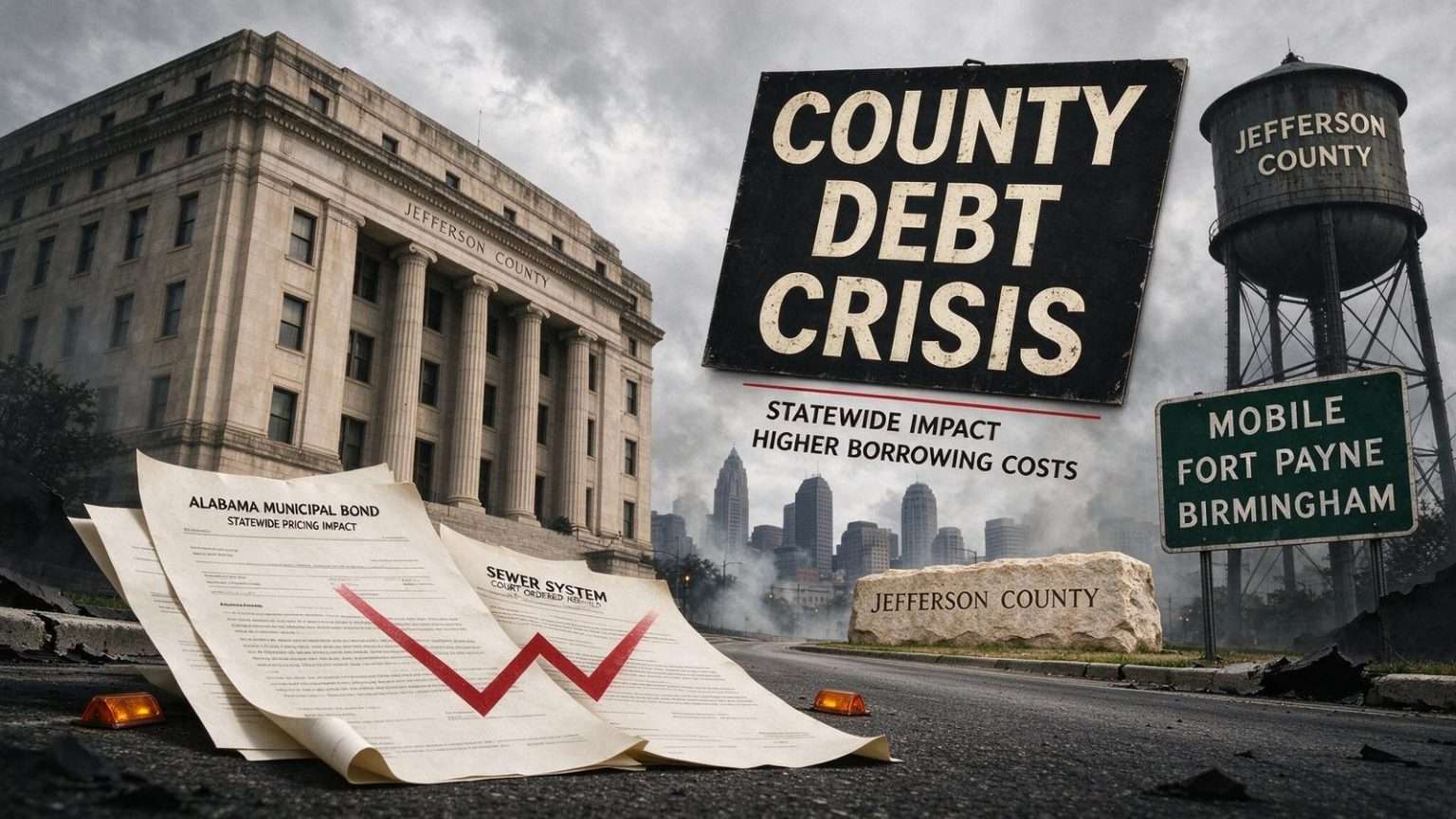
The disaster gathering over Jefferson County in the spring of 2008 was not going to stay in Jefferson County.
That was the near-unanimous verdict of the bankers, lawyers and public finance professionals canvassed about the sewer debt crisis then engulfing Alabama’s largest county — a crisis they expected to detonate within weeks and to be felt from Mobile to Fort Payne.
Jefferson County appeared to be headed unavoidably to bankruptcy court. Its distinction as the state’s most populous county was about to be eclipsed by a more unwelcome one: home to the largest public bankruptcy in United States history.
Why Mobile pays for Birmingham’s mistakes
The bond markets and the rating agencies do not draw fine distinctions. When Alabama’s largest county commits a blunder of historic proportions, every governmental body in the state — every city, every water board, every industrial development authority — finds itself explaining that it is not Jefferson County.
Public finance is a reputation business conducted at arm’s length. Municipal issuers sell their paper to institutional buyers through underwriters, and the price of that paper is set by ratings, by insurance and by the market’s accumulated impression of how issuers in a state behave. A single borrower’s failure doesn’t stay contained the way a private company’s collapse does, because the instruments are the same across issuers — the same bond insurers wrap them, the same rating methodologies grade them, and the same mutual funds and money managers hold them. What the professionals canvassed described was Alabama’s entire issuer universe being repriced for the sins of one county’s sewer system.
One observer described the practical effect on Mobile: the city had recently issued nearly $60 million in bonds and learned that two of its previous insurers had been damaged by the subprime mortgage collapse, forcing it to turn to an insurer that had not been.
“Now that insurer is not participating in any Alabama issue,” the observer said.
Mobile, he added, had itself been offered the swap or “swaption” form of financing by several firms and had declined, judging it “too big a gamble to take when interest rates were so low.”
Another put it more bluntly: “Bad not just for Jefferson County but for all public financing in the state as one bond insurer has ‘blacklisted’ all Alabama issues until this is resolved.”
The blacklist was the mechanism that turned one county’s trouble into a statewide constraint. A bond insurer that decides a state’s issuers are, for the moment, uninsurable stops wrapping new issues there — and because insured bonds are the default currency of municipal finance for smaller issuers, an insurer’s exit raises costs immediately for every water board and school system in Alabama that had counted on buying coverage. The effect lands hardest on the smallest borrowers, exactly the ones least able to market uninsured paper on their own credit.
The instrument that did the damage
What was killing Jefferson County was a structure that had been sold across the country: variable rate debt paired with an interest rate swap.
In theory it converts a floating rate into a fixed one at lower cost. In practice, it exposes the borrower to risks that only became visible when the credit markets buckled.
The mechanics are straightforward on paper. A county borrows at a floating rate — typically tied to an auction or short-term benchmark — and simultaneously enters a swap with a bank: the county pays a fixed rate to the bank and receives the floating rate in return, netting out to what looks like fixed-rate borrowing at a discount to what the county could have issued outright. The discount was the pitch, and it was real — at the time the Jefferson County sewer debt was arranged in the late 1990s and early 2000s, the structure saved the county hundreds of millions of dollars in nominal interest cost on a sewer rebuild that the federal courts had ordered.
What the discount bought was exposure. Variable-rate municipal debt of that type must be periodically remarketed — auctioned to investors or rolled to banks — and if the auctions fail, the rate resets to a punitive default rate written into the documents. Swaps, meanwhile, are two-way contracts: the county’s obligation to its bank does not shrink when its own circumstances deteriorate. And if the county ever needs to refinance before maturity, terminating the swap means paying its mark-to-market value — which, when rates moved against the county, ran to hundreds of millions of dollars on its own.
The credit crisis of 2007-08 triggered every clause at once. Auction-rate securities failed nationwide as buyers evaporated, resetting county debt to punitive rates. Refinancing options vanished as the same subprime collapse that broke two of Mobile’s insurers froze the municipal credit markets. What had been presented to the county commission years earlier as clever engineering became, in a matter of months, an unpayable structure — and the county’s sewer system, financed at roughly $3 billion in debt, was suddenly the largest distressed municipal credit in the country.
How a county got here
The sewer debt’s origin was a court order, not a speculative choice. Jefferson County’s aging sewer system had been found in violation of the Clean Water Act, and a federal consent decree obliged the county to rebuild and expand its system — an enormous capital program for a county government with no ready revenue source for it. The financing that followed was assembled across several issues in the late 1990s and early 2000s, much of it in the variable-rate-and-swap structures that Wall Street firms were marketing to public issuers nationwide, and the fees and payments that went with it.
The aftermath went beyond the ledger. Federal prosecutors pursued the officials and professionals around the financing, and the convictions and settlements that followed made the Jefferson County sewer saga the defining cautionary tale of American municipal finance in the decade. By the spring of 2008, none of that history mattered operationally: the county owed a debt structure it could not service, the ratings agencies had it on watch, and the professionals watching agreed the endgame was Chapter 9.
What bankruptcy would mean
Municipal bankruptcy is rare because it is designed to be. A Chapter 9 filing requires a state’s legal framework permitting it, an issuer that is genuinely insolvent, and — in practice — political leadership willing to accept the consequences of formal default. The number of American municipalities that have gone through it in the modern era is small, and a filing of Jefferson County’s scale would have been unprecedented: the largest public bankruptcy in the nation’s history, involving a county of roughly 660,000 residents, a court-ordered sewer system and billions in distressed debt.
The direct consequences would fall on Jefferson County — services, payroll, capital plans and a decade of restructuring negotiations — but the professionals canvassed in the spring of 2008 were describing the indirect ones, and those reached every corner of the state. A headline bankruptcy rewrites the entire state’s underwriting story: every issuer Alabama sends to market would carry the state’s new reputation in its pricing until the market’s memory faded, a process that takes years.
Mobile’s own caution
The details that emerged about Mobile were the useful part of the story — the counterexample of a city that had declined the same instruments. The city’s nearly $60 million recent issue had already run into the subprime collapse’s side effects, losing two of its bond insurers to the mortgage wreckage and finding the remaining one unwilling to write Alabama paper while the Jefferson County matter hung unresolved. And Mobile had been offered the swap and swaption structures that Jefferson County accepted and had turned them down, judging floating-rate engineering too risky in an era of low rates.
The judgment was vindicated by the county’s experience. A swaption — the option to enter a swap later — is a derivative sold for a premium, and the premium becomes a pure loss if the option expires unused. The instruments were marketed to public issuers as risk management; Jefferson County’s collapse taught the market that, in stressed conditions, they functioned as leverage. Mobile’s refusal, made years earlier on instinct, became the template other Alabama issuers pointed to.
What the crisis meant for the rest of the state
The cost of Jefferson County’s failure would be paid, in small increments, by every public borrower in Alabama. A water board in the Tennessee Valley financing a plant expansion, a school system in the Black Belt issuing bonds for a new building, a Gulf Coast industrial development authority courting a manufacturer — each would find its transaction priced with an Alabama discount until the state’s name recovered. The bond insurer’s blacklist translated directly into higher insurance costs or uninsured issuance; the ratings agencies’ scrutiny translated into more expensive due diligence; and the underwriters’ questions translated into slower, costlier deals.
The professionals’ consensus had one more layer: the state’s reputation was an asset that took decades to build and was being spent by one county’s decisions. Alabama’s issuers had historically been conservative — modest debt loads, straightforward financing, the state’s cap on county indebtedness keeping borrowing disciplined. Jefferson County’s sewer saga was the exception that would, for a season, define the rule in the eyes of the market.
By the summer of 2008, the countdown the bankers described — detonation within weeks — was the operating assumption of everyone watching the county’s finances. The only open questions were the timing, the terms and how long Alabama’s other issuers would pay for a debt they had never voted on, in a county most of them had never done business with. The answer to the last question would be measured in basis points on every bond the state sold for years afterward.