A $267 Million Federal Loan Promised Broadband to 29 Alabama Counties
Sen. Richard Shelby announced a $267 million USDA loan to Open Range Communications to bring broadband to 29 Alabama counties, including Mobile, Baldwin, Clarke, Escambia and Monroe.
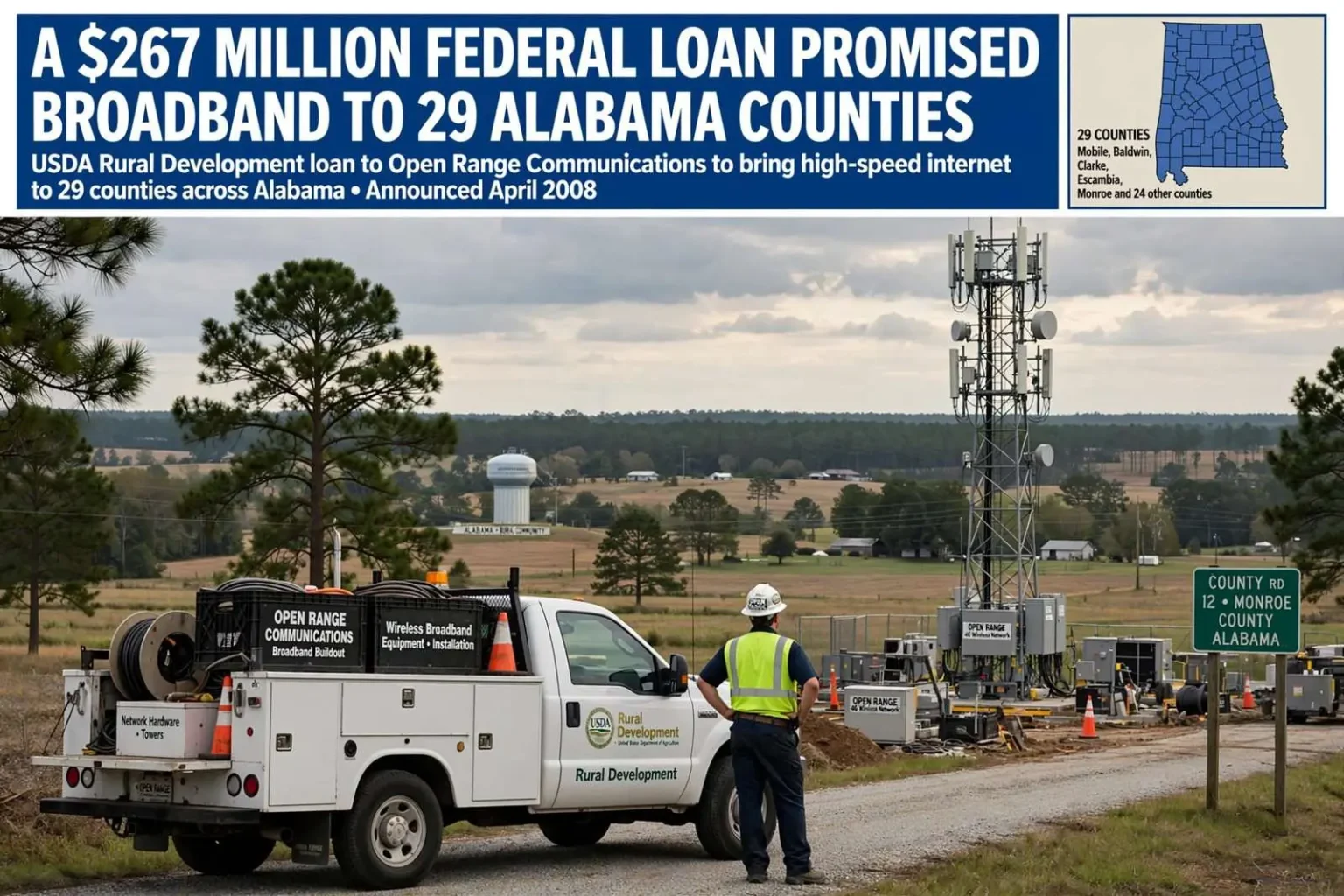
The federal government committed $267 million to a company promising to bring high-speed internet service to rural Alabama, U.S. Sen. Richard Shelby announced Tuesday, in a deal that would reach 29 counties across the state — among them Mobile, Baldwin, Clarke, Escambia and Monroe. The loan, from USDA Rural Development, went to Open Range Communications, and the announcement framed it as one of the largest single federal investments ever aimed at closing Alabama’s rural-urban technology gap.
Shelby, a Republican and a member of the Senate Appropriations Committee, framed the money as a matter of economic survival for communities that had watched broadband stop at the county line. In the appropriations system, the senior senator from Alabama sat where such loans could be noticed, shaped and celebrated, and he presented the deal as the fruit of that position.
‘Simply cannot compete’
“Communities across America that do not have access to today’s high-speed internet technology simply cannot compete in the marketplace,” Shelby said. “To expand business development and create economic opportunity in rural Alabama, we must provide our communities with access to up-to-date technology infrastructure. This loan will offer our underserved communities cutting-edge technology at an affordable rate, increasing opportunities for Alabamians in rural areas.”
The statement captured the consensus that had formed around rural broadband by 2008: high-speed internet was no longer a luxury or an early-adopter plaything but basic infrastructure, in the same category as paved roads and electric service. Communities without it lost factories that needed data lines, hospitals that needed telemedicine, and — as home schooling and distance education were beginning to demonstrate — students who needed a connection to keep pace with their coursework.
The counties named
The counties named as eligible were Baldwin, Calhoun, Chambers, Chilton, Clarke, Colbert, Covington, Dale, Elmore, Escambia, Etowah, Franklin, Greene, Jefferson, Lamar, Limestone, Marengo, Marion, Marshall, Mobile, Monroe, Randolph, Shelby, St. Clair, Talladega, Tallapoosa, Tuscaloosa and Walker — 29 counties stretching from the Tennessee Valley to the wiregrass, including both metropolitan counties and some of the state’s most rural. Residents in those counties, the announcement said, would gain access to broadband and other technologies intended to foster business development and create jobs.
That mix — Jefferson and Mobile alongside Greene and Lamar — reflected the reality that broadband coverage maps follow population density and household income, not county lines. Even Alabama’s metro counties contained large unserved pockets: the far corners of Shelby County, the black-belt fringes of Tuscaloosa, the rural reaches of north Jefferson County. Eligibility across 29 counties meant nearly every Alabamian outside a served subdivision theoretically had a path to a connection.
What it meant on this end of the state
For south Alabama, the list mattered as much for what it implied as for what it promised. Five of the 29 counties sit in the region: Mobile and Baldwin, whose populated corridors were largely served but whose rural edges — the timber country north of Citronelle, the farm roads outside Wilmer and Grand Bay, the stretches between Stockton and Perdido — were not; and Clarke, Escambia and Monroe, rural counties where a dial-up modem was still, in 2008, a common way to reach the internet.
The absence of broadband in those places was not an inconvenience. It was a constraint on what kind of business could open there, on whether a physician could transmit an image, on whether a student could do the homework that teachers had begun assuming everyone could do at home. A rural clinic that could not send an X-ray across the wire was a clinic practicing a lower standard of medicine than its urban counterpart; a student driving to the library parking lot for a Wi-Fi signal was a student competing on a tilted field.
For Mobile County’s northern and western edges, the promise was economic as much as technological. Communities along U.S. 45 and U.S. 43 had spent decades watching industry pass them by for sites closer to the port and the interstates; the argument for broadband was that the internet could move some economic geography — that a small manufacturer in Mount Vernon or a digital worker in Grand Bay no longer needed to be within a few miles of a downtown exchange to participate in the modern economy.
The scale of the project
Alabama was one piece of a much larger undertaking. Open Range aimed the project at 518 rural communities across 17 states, which the company calculated would serve more than 6 million people in over 447,000 households within five years. Beyond the connections themselves, the announcement projected job creation and new business opportunity across the 17-state footprint — construction jobs first, then the sales, installation and support positions a wireless carrier requires in every market it enters.
Open Range was leveraging the $267 million federal loan with more than $100 million from private investors, a capital structure that spread the risk between the federal credit program and Wall Street money. The loan was contingent on the company meeting the conditions of the loan agreement — a caveat worth noting in an announcement otherwise written in the confident language of a ribbon-cutting. Federal broadband loans of that era carried buildout schedules, subscriber targets and reporting requirements, and missing them could slow or strand the promised service.
A different kind of buildout
What Open Range proposed was not the trenching of fiber down every county road. The company’s model relied on wireless broadband delivered over spectrum, an approach that was, in principle, far cheaper to deploy across thinly populated territory than running cable to farmhouses miles apart. A single tower could serve households across several miles of piney woods; the same households served by wire would each have required their own drop from the nearest cable run.
That was precisely why rural development officials found it attractive: the economics of wired broadband had always been the reason rural counties went without. Telephone and cable companies built where the cost per household penciled out, and the areas between the nodes — exactly the territory covered by the 29-county list — waited for a technology that could reach them without the trenching bill. Wireless transmission, riding on spectrum licensed from the federal government, promised to be that technology.
Wireless brought its own trade-offs, of course. Speeds depended on tower placement and backhaul capacity, terrain and tree cover mattered in a way they did not for fiber, and heavy users could strain a tower’s capacity in ways city cable networks never faced. Rural subscribers of the era learned to read signal strength the way earlier generations read water pressure. Whether the model would deliver, and whether the conditions of the loan would be met, were questions that would only be answered in the years that followed.
School administrators in the eligible counties paid closer attention than most. The state’s education technology initiatives of the period — classroom computers, online testing pilots, distance-learning courses shared among small rural high schools — all assumed connections many districts did not have, and superintendents in counties like Monroe and Clarke had been making that case to Montgomery for years. A broadband buildout in their territory meant the difference between technology mandates they could meet and mandates met on paper alone.
The loan’s size ranked it among the largest rural-telecom awards of its era, and Shelby’s office noted that the federal credit would finance towers, network equipment and subscriber equipment at a scale no Alabama company could have assembled privately. For communities that had watched cable franchises and DSL nodes pass them by for a decade, the commitment of federal money was the first plausible arrival date they had ever been given.
The decade-old gap
What was announced in April 2008 was an intention, backed by federal credit, to close a gap that had been widening for a decade — and a list of counties, several of them in south Alabama, where the gap had been widest. The commercial internet had reached Alabama’s cities early and thoroughly, but the buildout maps of the dial-up era had left whole counties a phone call away from the web, and the broadband era that followed compounded the distance at the speed of light.
By 2008, the federal government had spent years treating rural connectivity as a development program in the tradition of rural electrification — the same USDA Rural Development apparatus that had wired the countryside for power in the 1930s and telephones in the decades after now administered loans for broadband. The Open Range deal was among the largest expressions of that continuity: a New Deal institution financing a 21st-century technology for the same purpose, keeping rural communities part of the national economy.
For the residents of Citronelle, Stockton, Perdido, Monroeville and Grove Hill, the announcement’s meaning would arrive slowly, tower by tower and customer by customer. But the list of 29 counties put their communities on the federal map of places worth connecting, and it declared — in the language of a $267 million loan — that the distance between a farmhouse and the future was no longer acceptable policy.