As Qualifying Closed, Career Employees Lined Up to Run the Offices They Worked In
The license and revenue commissioner races filled with insiders — a chief clerk, a longtime appraiser, a commissioner's secretary — while a former sheriff's candidate weighed one more run.
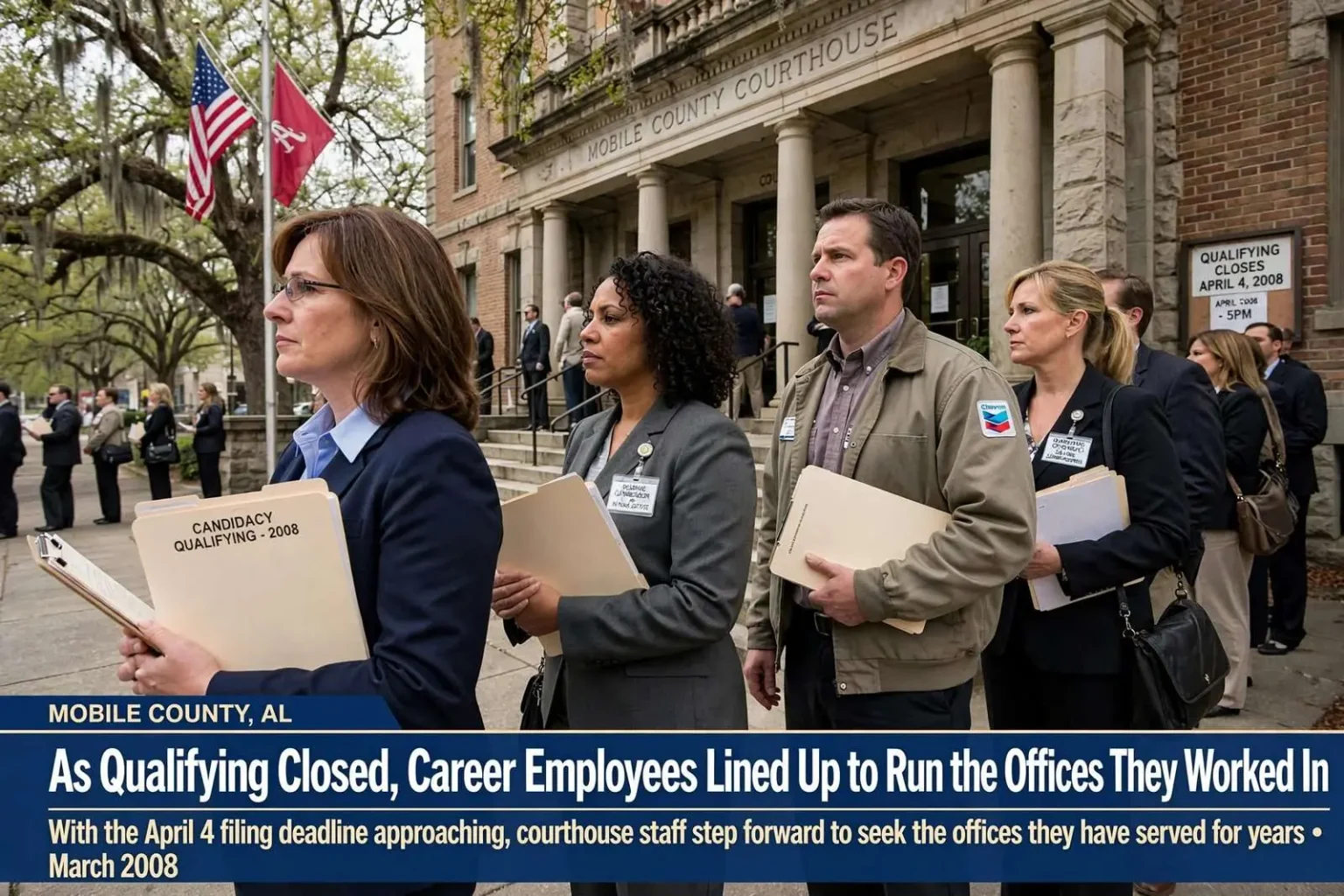
By the last week of March 2008, with the April 4 qualifying deadline days away, the shape of Mobile County’s courthouse ballot had become clear. The candidates were, overwhelmingly, people who already worked there.
Qualifying week is the quiet hinge of Alabama county politics. Long before any yard signs appear, candidates must file with their party to have their names placed on the primary ballot, and for the constitutional offices that run the courthouse — license commissioner, revenue commissioner, sheriff, probate judge, the county commission — the filing deadline is when races truly begin. The names that had surfaced in Mobile County that spring told a story about where power in the courthouse was headed, and about who felt entitled to inherit it.
The license commissioner’s race
Lori Roberts Angelo, 45, announced she would run as a Democrat for license commissioner. She had spent seven years as chief clerk in the revenue commission office, serving as the liaison who resolved problems for the public. She was the daughter of Freda Roberts, the longtime Mobile County revenue commissioner who had retired four years earlier.
Born and raised in Mobile County, Angelo attended Theodore High School, continued at Southwest State Technical College and took training for tax officials at the Auburn University Center for Governmental Services. Drawing on her revenue experience and a stint in marketing at a Houston computer company, she proposed enhancing existing services and adding new ones — self-service terminals at malls and other high-traffic locations, increased staffing, and a possible satellite office in fast-growing Saraland.
Her platform tracked a national shift that was already reaching Alabama courthouses by 2008. Tag renewals and property tax payments were the county services residents used most often, and the long lines at the Government Street tag office were a standing complaint. Putting kiosks in malls, or a full office in Saraland, was a way of meeting customers where they already were — an idea borrowed from banking and retail that revenue and license offices around the state were only beginning to try.
Angelo’s candidacy also carried the weight of a family name. Freda Roberts had run the revenue commission office for years, and in county-level races, name recognition built across decades of property tax rolls and public dealings is often worth more than any advertising budget. Whether the family tie was an asset or a fair target for opponents was one of the questions the race would answer.
She joined a crowded field. Michelle Mayberry, a manager with the state revenue department, had already announced as a Republican. Kim Hastie, the longtime secretary to County Commissioner Mike Dean, was preparing a Republican bid, according to party sources. An employee of the license commissioner’s office was reportedly seeking the Democratic nomination as well.
The office was open because Democratic License Commissioner Carol Norris was retiring after 20 years. Open seats are the rare moments when courthouse jobs change hands; an incumbent constitutional officer in Alabama rarely loses, and the announcement of a 20-year veteran’s retirement drew a field precisely because insiders understood the window would not stay open long.
The revenue commissioner’s race
Renee Williams, 46, who had worked in the Mobile County Revenue Commission office for more than 20 years, announced a Democratic campaign for revenue commissioner. She was certified in both real and personal property appraisal, had experience in assessing and collecting, and had managed the Citronelle tax office. She planned to qualify the following week and take a leave of absence to campaign.
“I will make the office more effective for the citizens of Mobile County,” she said. “We will deliver better service and better accuracy.”
Williams’s resume was the technical kind the office demands. The revenue commissioner assesses property, maps parcels, administers exemptions and collects the taxes that fund schools and county government, and appraisal certification from the state is the credential that distinguishes career assessors from political appointees. Managing the Citronelle office meant she had run a satellite operation serving the rural northern end of the county, experience that translated directly into the service arguments she was making on the trail.
A Houston native, she had lived in Mobile for more than 25 years and served as vice president of the Old Dauphin Way Association, a neighborhood organization in one of Mobile’s oldest historic districts. Civic involvement of that kind gave her a public identity beyond the courthouse, in a part of the city where historic preservation and neighborhood reinvestment were active political subjects.
The incumbent, Marilyn Wood, had been elected as a Democrat in 2004 and was seeking re-election as a Republican after switching parties. Party switches by incumbent courthouse officers were becoming a feature of Mobile County politics in that era, as the county’s electorate shifted and Republicans grew competitive in races down the ballot. A switch invites a primary challenge from the new party and leaves the old party free to nominate a replacement — which was precisely the path Williams was taking.
A potential GOP primary opponent, the party’s 2004 nominee who had narrowly lost the general election, said he was strongly considering another run but remained undecided. His hesitation was typical of qualifying week, when candidates balance name recognition earned in a past race against the cost of challenging a switched incumbent for their new party’s nomination.
One more possible commission race
Matt Tew, 43, an unsuccessful Democratic candidate for sheriff in 2006, said he was still weighing a challenge to Republican County Commissioner Stephen Nodine in District 2. Many people had approached him about running, he said, and he was seriously considering it — but a lot of other things would have to fall into place first, financial backing chief among them.
He worked at Chevron in Pascagoula and had served 10 years as a reserve officer with the Mobile County Sheriff’s Department. He and his wife had two daughters, students at Mary G. Montgomery High School and Faith Academy.
He said he would pray on the decision over the weekend and decide before the deadline. County commission districts span enormous geography in Mobile County, and a race against an incumbent commissioner meant months of driving a district that runs from the industrial corridors south of the city into west Mobile neighborhoods — a campaign that costs money a challenger working a day job in another state has to raise quickly.
Nodine, a former Mobile city councilman turned county commissioner, was among the most visible Republicans in county government, and a serious Democratic challenger in District 2 would have signaled how far the party was willing to reach into territory it had once held comfortably. Tew’s 2006 sheriff’s race had given him countywide name recognition, but a commission district is a different electorate, and the weekend deadline left little time for deliberation.
What the field revealed
The pattern across these races was consistent: the candidates were career civil servants running for the offices they had spent decades inside. Chief clerks, appraisers, tag office managers and commission secretaries were competing to become the elected head of operations they already understood in detail.
That is the nature of Alabama’s constitutional county offices. They are technical, administrative jobs — assessing property, collecting taxes, issuing tags — filled by partisan election. The people best qualified to run them are almost always the people already working in them, which produces campaigns fought less over policy than over service, accuracy and wait times.
There is little policy to argue in a tag office. No candidate for license commissioner can change what the state charges for a tag, and no revenue commissioner can rewrite property tax law, which is set in Montgomery. What an elected courthouse officer controls is management: staffing levels, office locations, hours, technology and the everyday competence that determines whether a resident’s renewal takes five minutes or a wasted morning. Hence campaigns built on self-service terminals, satellite offices and “better service and better accuracy.”
The careers on display also showed how the courthouse reproduces itself. Angelo followed a mother who had held the office at the top of the same hierarchy she was entering from the middle. Williams had spent two decades in the office she wanted to lead. Hastie had learned county government as a commissioner’s secretary. In each case the campaign was a promotion petition addressed to the voters, arguing that familiarity should count as a qualification.
What made 2008 different was the party sorting happening underneath. A Democratic incumbent switching to the Republican ticket, Democratic staffers running to hold offices their party had held for generations, and Republicans emerging with real prospects countywide — the courthouse was changing hands, one office at a time.
By the time qualifying closed on April 4, voters would see a ballot that looked much like the courthouse workforce itself: long-serving, technically credentialed, and increasingly divided by the party labels that had once mattered little inside its walls.