University of South Alabama Mobile
A Retired Union Leader Entered the Treasurer’s Race — With One Condition
Don Langham said he would run for Mobile County treasurer as a Democrat unless party officials allowed a troubled congressional candidate to qualify, a caveat that revealed the party's anxieties.
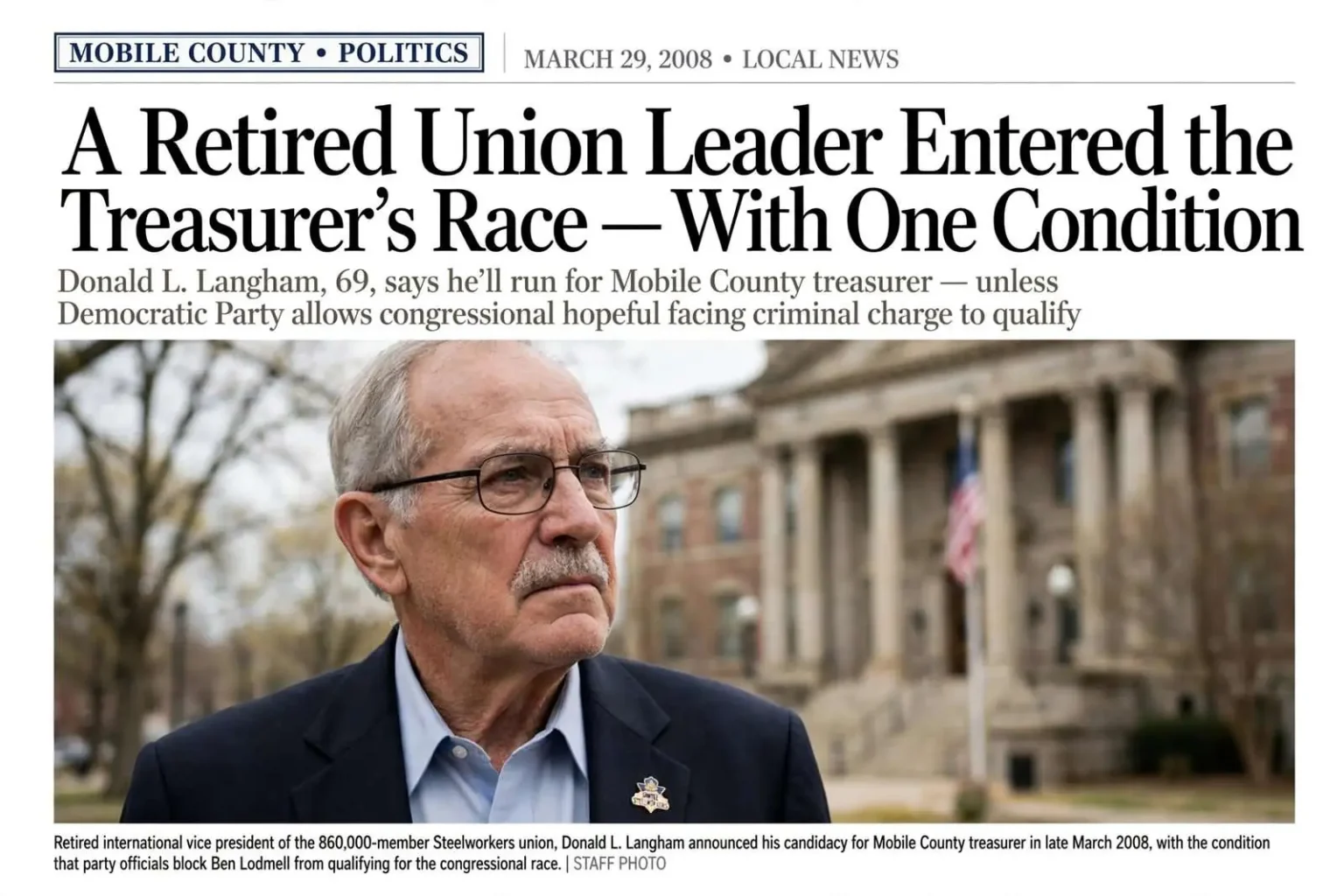
Donald L. Langham, 69, who had recently retired as international vice president of an 860,000-member union, said in late March 2008 that he would run for Mobile County treasurer as a Democrat — with a caveat that said as much about the state of his party as about his own ambitions. He would run, he said, unless party officials allowed Ben Lodmell to qualify as the Democratic candidate for Congress.
The condition was an unusual one for a candidate to attach to his own entry, and it made Langham’s announcement as much a message to party leadership as a kickoff. A retired labor official with a long résumé of public board service does not typically hedge his own candidacy; Langham did, because he did not want to share a ballot — and a press cycle — with a congressional nominee carrying a criminal charge.
The Lodmell Problem
Lodmell had moved to Mobile from Arizona about a year earlier and had campaigned aggressively against Republican U.S. Rep. Jo Bonner for months. Then he was charged with allegedly soliciting a prostitute on the Eastern Shore. His court date fell after the party’s April 4 qualifying deadline, leaving the party with a candidate whose legal troubles would hang over the entire local ticket — but with only a narrow window to do anything about it before qualification closed.
The Lodmell campaign had gone noticeably quiet in the weeks that followed. Sources close to the state Democratic Party said leaders hoped he would simply stand down in the interest of the other Democrats on the ballot, and suggested the party was not without options to block his candidacy if he attempted to qualify. Nothing about the situation was comfortable for party officials: forcing out a candidate is never tidy, but allowing a solicitation charge to attach itself to the county’s Democratic slate in an election year was, in the assessment of party insiders, worse.
Langham’s condition amounted to a warning: he was not prepared to spend his own campaign explaining somebody else’s arrest. If the party cleared the field, he was in. If it did not, he would stay retired. The ultimatum put the decision squarely back on the party officials who had, to that point, been waiting quietly for the problem to resolve itself.
The Candidate
Langham would have made a conventional case for himself in any year. He had retired the previous summer from the steelworkers’ union, sat on the University of South Alabama board of trustees and the board of the Mobile Housing Authority, and had overseen two pension trust funds.
“I think I’m qualified,” he said. “With two pension trust funds, the USA Foundation and the Housing Board, I’ve been involved in investing a lot of money. As I understand the job, that is what it is: investing money and assisting in investing money and writing checks for county expenses. I can certainly handle that.”
He described the work as fundamentally nonpartisan. “When you’re handling taxpayer money, it doesn’t matter whether you are Republican or Democrat, black or white, male or female.”
The argument was aimed at the job rather than the campaign. County treasurer, in the counties that still elect one, is a financial custodianship — receiving and disbursing county funds, managing accounts, and standing behind every check the county writes. Langham’s decades managing union pension money were, on their face, the closest thing to a direct qualification the office could ask for, and he presented them without embellishment.
The Office He Wanted to Keep
Langham’s entry resolved an unusual standoff. Mobile County Democratic Party chairman Brad Warren had announced weeks earlier that he would run for treasurer on a platform of abolishing the office, arguing its duties were duplicated elsewhere in county government and that it cost taxpayers $1 million every election cycle.
With Langham in, Warren was expected to drop those plans. Langham made clear he would not campaign on a pledge to dissolve the post.
“It’s an elected position and I’m going to serve in it,” he said. “If they want to get rid of it, that’s up to them. I’m running to do the job. Until they do get rid of the job, it’s an elected position, one that I would be proud to have to serve the public. I’ve got the time to do it. I’ve got the expertise to do it. I’ve got the knowledge to do it.”
Mobile was one of three Alabama counties — with Jefferson and Walker — that still elected a treasurer. The incumbent, Republican Al Sessions, was seeking re-election. The arrangement put the retiree from the union side of Mobile’s civic world directly across from a sitting Republican incumbent, in an office whose very existence was on the table in a way few county offices ever are.
The Bigger Picture
Warren, for his part, had expressed interest in the District 3 county commission seat held by Republican Mike Dean, who faced a primary challenge from a west Mobile businessman. Warren was expected to skip 2008 and wait until 2010, when the commission seat would come up without the complications of the treasurer’s race in the same cycle.
The whole sequence — a party chairman running to abolish an office, then stepping aside for a retired union official, while the party’s congressional nominee faced a solicitation charge — captured the position Mobile County Democrats found themselves in that spring. In a year when a presidential campaign was drawing record enthusiasm, the local party was still struggling to field candidates for offices it had held for a century.
The contrast was stark. Across Alabama and the country, 2008 was shaping up as a demonstration election, with turnout records expected and new voters pouring into the process at the top of the ticket. But down the ballot, in the county offices where budgets and deeds and tax payments actually got processed, the Democratic field in Mobile County was thin — and in the treasurer’s race, briefly, it did not exist at all until a 69-year-old retiree attached conditions to his entry.
A Party at a Crossroads
The Mobile County Democratic Party Langham addressed in late March 2008 was a generation removed from its dominance. Local Democrats had once held nearly every countywide office, but the realignment of the South had steadily flipped courthouse offices to Republicans through the 1990s and 2000s, and by 2008 the county party’s roster of candidates was short enough that each qualifying deadline carried weight. Party officials spent their springs recruiting more than campaigning, and the treasurer’s race illustrated the dynamic: the incumbent was a Republican, the challenger was the party chairman running on abolishing the office, and the strongest recruit was a man who had to be persuaded — and who set terms.
Langham’s own background made him an unusual fit for the moment. Labor leaders of his generation had often been pillars of the local Democratic coalition, and his service on the University of South Alabama’s board of trustees and the Mobile Housing Authority’s board had kept him inside the county’s civic establishment even as his party’s fortunes receded. His retirement from the steelworkers’ union — an international vice presidency over an 860,000-member organization — gave him a financial résumé that crossed party lines, and he made the most nonpartisan case available to a candidate: that handling taxpayer money is not an ideological job.
The treasurer’s office itself was an anachronism worth examining on its merits. In most Alabama counties, the duties Langham described had been absorbed over the decades by finance directors, probate judges and commissions, leaving the elected treasurer as a holdover in only a handful of courthouses. Warren’s abolition platform was built on that history; Langham’s answer was built on a different one — that if the voters of Mobile County chose to keep the office, someone qualified ought to hold it, and he was willing to be that someone.
Whether his condition regarding Lodmell was met, and how the qualifying deadline resolved the congressional question, determined whether his candidacy went forward at all. The deadline itself — April 4 — gave party officials less than a week from his announcement to clear the path he had demanded. In the meantime, the treasurer’s race stood as a small-scale test of the county party’s ability to manage its own ballot, and of how far a veteran of Mobile’s labor and civic establishment would go to serve one more term in public office.
What the episode left behind was a candid portrait of a local party in transition: a chairman willing to run against an office in his own party’s interest, a candidate willing to run only under conditions, and a congressional nominee whose campaign had gone quiet in the weeks before qualifying closed. In a year of record enthusiasm at the top of the ticket, the view from the courthouse basement — where the treasurer’s office actually does its work — was considerably more complicated.