Byrne, Brooks and a Pig Roast: The Parties Worked the Coast
The Mobile GOP booked the two-year college chancellor and a state senator for its quarterly meeting, a councilwoman toured her district, and South Baldwin Democrats planned a pig roast with a teenage peace activist.
As the 2008 qualifying deadline approached, the party organizations of coastal Alabama did what party organizations do: they held meetings, served food and gave their members someone to listen to. The qualifying deadline — the date by which candidates had to sign up to appear on the June primary ballot — was bearing down on both parties, and the week’s calendar of meetings and dinners offered a preview of the campaigns about to unfold across Mobile and Baldwin counties.
The Mobile GOP hosts a reformer
The Mobile County Republican Party scheduled its quarterly meeting for Thursday, March 27, at Bilotti’s Italian Café on Airport Boulevard, with two featured speakers: Bradley Byrne, chancellor of Alabama’s two-year college system, and state Sen. Ben Brooks. Quarterly meetings of the county party routinely drew its activist core — the club members, elected officials and campaign workers who would staff the fall’s contests — and a speaker of Byrne’s stature was a notable draw.
Byrne, a Mobile native and former state senator from Baldwin County, had been installed as chancellor the previous year with a mandate to clean up a system engulfed in scandal. The Alabama Department of Postsecondary Education, which governed the state’s community and technical colleges, had spent years at the center of federal investigations into boards, foundations and contracts across the two-year college network. Federal investigations had already produced charges, and the practice of legislators drawing salaries from institutions they funded — double dipping — had become the defining ethics fight in Montgomery. Byrne’s job was to end it, and he was making the case around the state, one county party and civic club at a time.
His appearance in Mobile was, in retrospect, an early stop on a longer road. Byrne ran for governor in 2010, losing the Republican runoff, then won the 1st Congressional District seat in 2013 and held it until 2021. In the spring of 2008, though, he was still principally known as the reform chancellor, and his message to Republican audiences was that the two-year college system was being put back in order — boards reined in, double dipping confronted, and public confidence slowly rebuilt.
Brooks, the Republican state senator from Mobile, was there to update the club on the legislative session — which for coastal Republicans meant insurance reform, the gill net fight and the governor’s ethics package. Insurance had become the dominant kitchen-table issue on the coast, where premiums had spiked after successive hurricanes; the gill net fight pitted commercial net fishermen against recreational interests in the state’s coastal waters; and Gov. Bob Riley’s ethics agenda was moving through the Legislature with the double-dipping controversy at its center. All elected Mobile Republican officials were invited to attend and be recognized.
A councilwoman on the road
Mobile City Councilwoman Gina Gregory continued a series of community meetings across District 7, in west Mobile. A session was set for Thursday, March 27, at Friendship Baptist Church on Cody Road, with others to follow at Shaw High School on March 31 and Orchard Elementary School on April 10. Gregory, one of the council’s newer members, had structured the meetings as a rolling town hall — a format that brought city government into church fellowship halls and school cafeterias rather than waiting for residents to come downtown.
The meetings were built to be useful rather than ceremonial. Representatives from several city departments attended, and officials from the Alabama Department of Transportation and the county commission were invited — a recognition that most complaints a council member hears involve roads, drainage and services that no single government controls. A pothole on a state route, a clogged ditch on a county road and a missed garbage pickup inside the city limits could all surface at the same meeting, and the multi-agency format let residents put their questions to whichever government actually owned the problem.
West Mobile was among the fastest-growing parts of the county, and growth was its own source of complaints: traffic on the arterial roads, drainage on newly developed land, and pressure on schools and parks. Meetings like these fed directly into the city’s budgeting process, giving district council members a running list of constituent priorities ahead of the fiscal year.
Democrats gather in Prichard and Foley
The Democratic Coalition of the South scheduled its first campaign kickoff for Saturday, March 29, at the Prichard Public Library on Love Joy Loop. The coalition was a Mobile-area Democratic organization, and Prichard — a city of roughly 28,000 just north of downtown Mobile that had weathered decades of economic difficulty — was a fitting venue for a party working to rebuild its grassroots presence along the Gulf Coast.
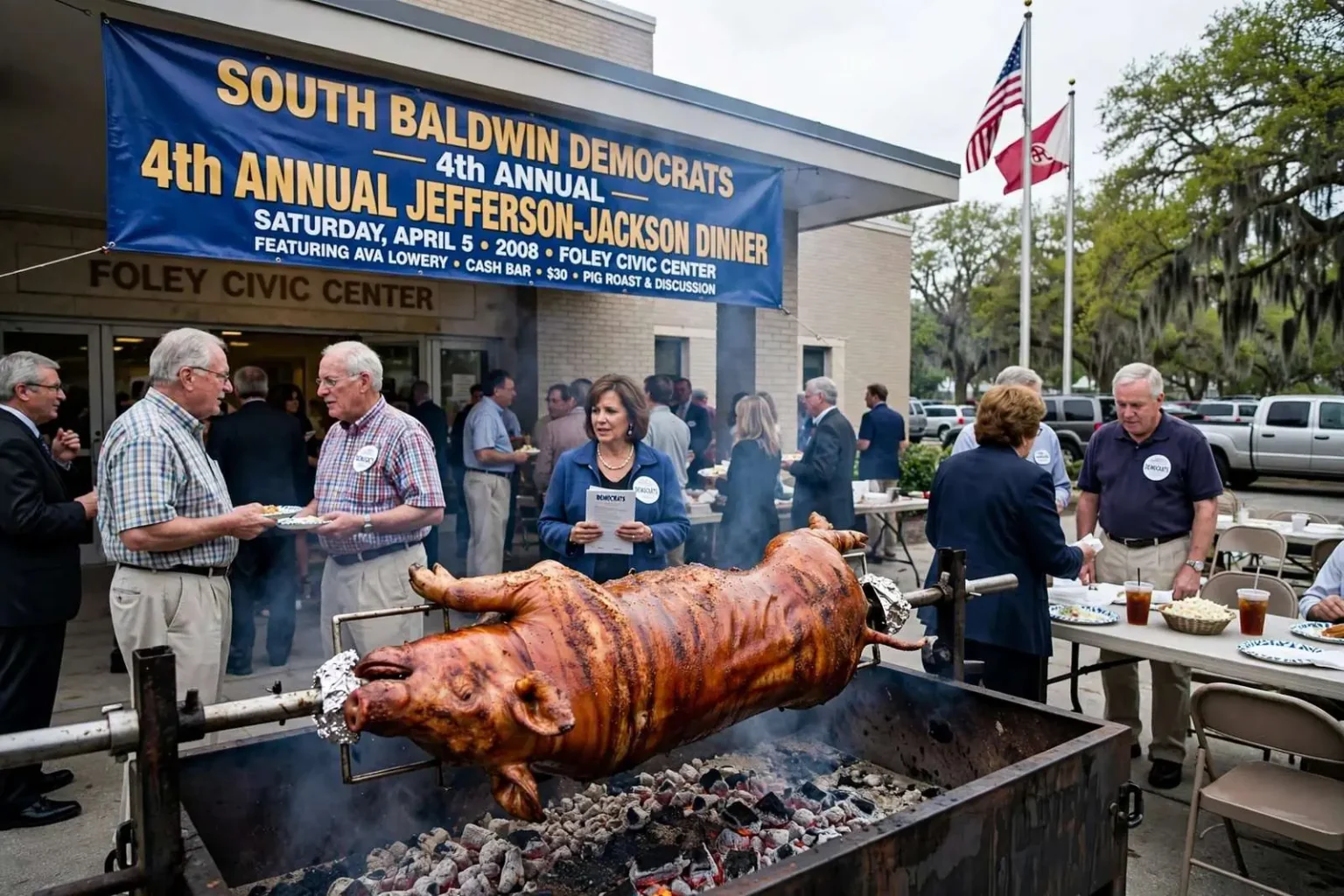
Farther east, South Baldwin Democrats planned their fourth annual Jefferson-Jackson Dinner for Saturday, April 5, at the Foley Civic Center. The Jefferson-Jackson dinner, named for the two founders of the Democratic Party, was a fixture of county party fundraising across Alabama, combining a banquet, local speeches and a keynote in the run-up to an election year’s qualifying deadline.
The featured speaker was Ava Lowery, a teenage antiwar activist from Alabama whose animated videos about the Iraq war had drawn national attention — and considerable hostility — after circulating online. She was, at the time, among the most recognizable young political voices the state had produced, and her videos had been featured by national outlets covering the antiwar movement’s online wing.
The evening included an informal pre-dinner discussion with state Rep. James Fields, newly elected in a north Alabama special election from a district that was roughly one percent Black — a result Democrats across the state had spent two months celebrating. Fields’ win in Cullman-based District 11 had been read as a sign that the party could compete even in overwhelmingly white, Republican-leaning territory, and party organizations along the coast were eager to hear the story firsthand.
There was a cash bar, an old-fashioned pig roast, and $30 tickets payable to South Baldwin Democrats in Robertsdale. For a county party, the proceeds mattered less than the turnout: dinners like this one were where candidates, activists and donors met face to face before the campaign season consumed everyone’s calendar.
The season underway
Taken together, the week’s calendar mapped the political geography of the coast. Republicans met over Italian food on Airport Boulevard to hear about reforming the community colleges and the state of the legislative session. Democrats gathered in a Prichard library and a Foley civic center. A councilwoman sat in a church fellowship hall in west Mobile taking questions about drainage. Each event served the same underlying function: keeping the party organizations warmed up and their networks intact ahead of the qualifying deadline.
The stakes were different for each party. Republicans in Mobile County were contesting primaries in legislative districts they already held, making the county party’s meetings a stage for intraparty positioning. Democrats were building toward general election contests in a state where their registration edge had eroded cycle after cycle, making events like the Jefferson-Jackson dinner as much about morale as fundraising.
Qualifying closed the following week, and the campaigns began in earnest. The dinners would get larger, the calendars fuller and the meetings less convivial — but the mechanics on display that week, from a county party’s quarterly meeting to a councilwoman’s church-basement town hall, were the machinery on which every Alabama campaign ultimately ran.
Byrne and the system he inherited
Byrne’s tenure as chancellor had begun under circumstances few would envy. The two-year college system — two dozen community and technical colleges with dozens of campuses serving students across every county — had spent the middle of the decade under a rolling cloud of federal subpoenas, and the revelations kept coming: legislators on college payrolls, board members directing foundation money, and athletic programs and sweetheart contracts that had flourished in the dark. The state school board had already moved to prohibit legislators from holding paid positions in the system, but the practice of double dipping had deep roots, and uprooting it required a chancellor willing to enforce the rules against sitting legislators.
That was the assignment Byrne carried into rooms like the one at Bilotti’s. To a county party meeting, his message doubled as a defense of the institutions themselves: the colleges, he argued, remained essential to workforce training in a state trying to recruit advanced manufacturing, and cleaning their governance was the price of keeping public confidence in them. It was a message tuned to exactly the audience he faced — Republicans who would spend the next legislative session debating the governor’s ethics package.
The ordinary business of parties
For all the high politics attached to Byrne’s visit, the quarterly meeting itself followed the long-established rhythm of Alabama county party life: a meal, a roll call of elected officials, brief committee business and a featured speaker who could draw a crowd. Organizations like the Mobile County Republican Party occupied an unusual position in state politics — Alabama had no party registration, so the party apparatus was built entirely from volunteers, and its county committees were the connective tissue between statewide campaigns and the voters who would decide them.
The same was true on the Democratic side, where organizations like the Democratic Coalition of the South and the South Baldwin Democrats worked to maintain a presence in a region that had been trending Republican for a generation. Their events that week — a library kickoff in Prichard, a civic center dinner in Foley — were smaller than their Republican counterparts, but they served the identical purpose: keeping volunteers engaged, raising modest sums, and giving local candidates a room in which to introduce themselves.