Confessions of the Crossover Voter: Alabama Politicos Owned Up
Partisanship in Montgomery had rarely been nastier. So how many Mobile-area Democrats and Republicans had never once voted for the other side? Asked directly, remarkably few could claim it.
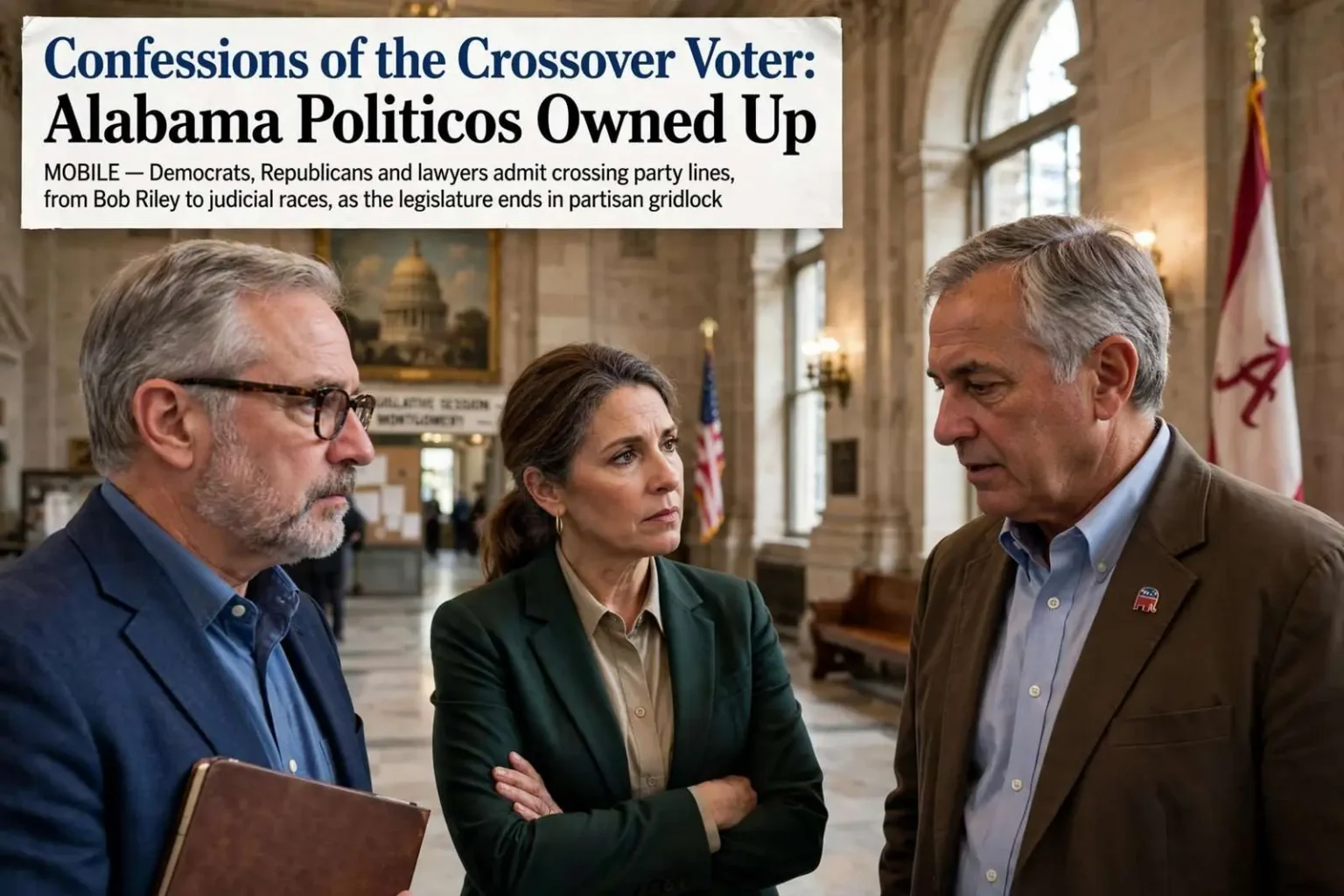
MOBILE — The legislative session that had just ended in Montgomery was, by general agreement, one of the ugliest in memory — a session in which the fists and the fur flew and very little else moved. Partisanship, everyone agreed, had never been worse. Party-line votes, floor standoffs and an atmosphere of scorched earth had made the Statehouse feel more like a campaign headquarters than a governing body, and the wreckage was measured less in bills passed than in relationships torched.
Which raised a question worth asking of the people who practice politics for a living: had they themselves ever crossed the line? Asked whether they had ever voted for a candidate of the opposing party, Mobile-area politicos, lawyers and party officials answered with a candor that suggested the partisan wall is thinner than the rhetoric implies — thinner, at least, in the privacy of the voting booth than in the press releases that follow.
The Democrats Who Voted for Bob Riley
A remarkable number of Democrats confessed to the same sin, and named the same beneficiary: Gov. Bob Riley. Riley, a conservative Republican congressman, had opened his first term by staking his governorship on a sweeping tax reform package aimed at shifting the burden off the poor — the $1.2 billion Amendment One campaign that asked Alabama, for one strange season, to tax itself for its own schools. Alabama voters crushed it at the polls, rejecting the largest tax increase in state history by nearly two to one. But it converted some unlikely admirers.
“I voted for Riley, believe it or not,” said Democratic attorney Henry Brewster. “I loved Lucy Baxley, but when Riley supported, and not just supported but emphatically supported, the tax initiative at the beginning of his first term, I made a commitment to myself to vote for him for re-election. It was critically important legislation, and a heroic gesture on his part. You have to reward people for taking a stand like that, even when you want the other person to win.” Baxley, the popular state treasurer and the Democratic nominee, was precisely the kind of candidate party loyalists wanted to see win — which was what made the confession matter. He added, drily: “Pretty weird to vote for the winner, let me tell you.”
Journalist and longtime Democrat Chris McFadyen put it more sharply still. He had voted Republican for the first time in his life for Riley’s second term, he said, “because I admired his leadership on tax reform — that is, for his acting like a Democrat.” The compliment contained its own critique: the only way a Democrat could bring himself to vote for the Republican governor was by deciding that the governor’s best moment had been the one where he governed like the other party.
Judicial Races: Everybody’s Loophole
The most common confession, by far, involved judges — and nearly everyone who made it insisted it did not count. “I have voted for some Republicans, even supported some, but all have been in local judicial races, which, even when I was on the State Democratic Executive Committee, I felt should be non-partisan,” said Democratic lawyer Al Pennington. In Alabama, where judicial candidates run under party labels in general elections, the label sits awkwardly on a job that most voters — and most lawyers — regard as technical, local and above politics.
Cecil Gardner said he had crossed over three times, each in a race for circuit judge, and each because he believed the Republican was better qualified. “I am pleased to report that the track record of these three confirms my judgment even in cases where they ruled against me,” he said — which, he argued, was itself proof that judicial races should be nonpartisan. A bench good enough to rule against your own client without losing your vote is a bench doing its job.
Democratic lawyer Steve Moore agreed. “We have a great bench in both Mobile County and Baldwin County,” he said. “I truly do not think politics enters into the day-to-day rulings at these courthouses. Beyond that, I have held true to my yellow dog roots.” The reference is to the oldest joke in Southern politics — the Democrat who would sooner vote for a yellow dog than a Republican — and Moore deployed it the way loyalists do, as a badge that makes the exceptions sound like lapses rather than convictions.
The Three-Time Offender From Jersey City
Criminal defense attorney Dom Soto grew up in the Democratic machine wards of Jersey City, where, he said, voting Republican “is seen as a severe character flaw.” New Jersey’s Hudson County machine ran on loyalty the way Alabama politics ran on kinship — and in either system, the ballot was treated as a family obligation. He confessed to three lapses, each of them, he argued, a compliment.
He voted for Sonny Gerron for county commissioner because Gerron had taken a principled stand in admitting the excesses of his youth — the rare politician who banked on candor rather than concealment. He voted for Congressman Jack Edwards because, at a time when Soto worked at Legal Services and Edwards’s party was “wreaking havoc on the poor,” Edwards could still be counted on to go to bat for ordinary people — the Mobile Republican whose three decades in Congress were built in part on constituent service that crossed party lines. And he voted for Ann Bedsole in her first state Senate race because she “was bucking her party’s anti-feminist bias and ran, not as a party hack, but as her own woman.” Bedsole, a Mobile legislator who would go on to run statewide, built exactly that reputation: independent, unfailingly courteous, and willing to contradict her own party when her district required it.
“Those votes had been in the privacy of the voting booth,” Soto said, “and were moments of quiet conscience.” He later remembered a fourth: he had crossed over in the primary to vote for Riley, he said, chiefly to keep Roy Moore off the general election ballot. The tactical primary vote was the purest form of crossover there is — not admiration but damage control, deployed in the only election where the other party’s ballot mattered.
The Unrepentant
A few claimed clean records. Former GOP state chairman Marty Connors said he had never voted for a Democrat over a Republican in a partisan race, and explained why in almost missionary terms: he had committed himself in 1976 to building a two-party system in Alabama and considered a crossover vote a betrayal of that project. For a generation of Alabama Republicans, the party’s rise from permanent minority to governing majority was a project someone had to be disciplined about — and Connors counted himself among the disciplined.
Republican official Terry Lathan was equally firm. “This is an easy one. No,” she said. She had left two races blank rather than vote for Republican nominees she disliked — the abstention as the last refuge of the loyalist — but she would never help a Democrat. Her husband, Jerry Lathan, had one confession. He voted for Fob James for governor in 1978. “Guy Hunt never let me forget it,” he said, “and kidded me in public at every chance.” The tease worked because Hunt, the Limestone County farmer who would win the governorship in 1982 and become the state’s first Republican governor since Reconstruction, carried the joke like a credential: the loyalist who had caught someone straying a full four years before he himself took the office.
And District Judge Mike McMaken, a Republican who had once run as a Democrat, offered the most efficient answer of all: “Well, yes, I certainly have. I voted for myself every time. And it did not hurt even a little bit.” McMaken’s one-liner made the survey’s most honest point: party labels are the frame, but candidates are the vote, and no one is ever more of an exception than the man whose own name is on the ballot.
What the Confessions Add Up To
Taken together, the answers sketch the unwritten rules of crossover voting in Alabama. First: judges don’t count. Lawyers of both parties have long treated the bench as a professional calling rather than a partisan prize, and the general-election party label is regarded as a relic of the ballot layout rather than a statement of judicial philosophy. Second: character outranks party. Every crossover vote named above — Bedsole, Edwards, Gerron, Riley — was cast for a person the voter respected, not against a party the voter opposed.
Third: the primary is the real loophole. Voting in the other party’s primary, as Soto did to blunt Roy Moore, requires no general-election betrayal at all and has long been the pragmatic instrument of Alabama’s open-primary tradition — one reason statewide primaries in the state have often been shaped by the other party’s strategic voters.
The timing of the confessions gave them their edge. They came at the end of a legislative session remembered for exactly the opposite of the civility these voters were describing — a Montgomery in which the partisan wall was defended in public while it was ignored in the booth. The gap between the two is the survey’s real finding: Alabama’s politics, hardened by decades of one-party rule and counter-revolution, still runs through individuals, and the people who know the candidates best are the ones most willing to admit it.
The yellow dog, it turns out, votes conditionally. He votes his party in races that matter to the party, abstains or sits out the races where the party fails him, and quietly crosses the line — a handful of times in a lifetime, in judgeships and first-term governorships and primary gambits — for candidates who earn it. Ask him directly and he will even confess. The booth, as Dom Soto said, is where conscience goes when it can no longer be spoken aloud.