University of South Alabama Theodore
Kim Hastie Steps Away From the County Payroll to Run for License Commissioner
The longtime secretary to Commissioner Mike Dean took a leave of absence to seek the Mobile County license commissioner's office as a Republican, promising to overhaul the office's customer service.
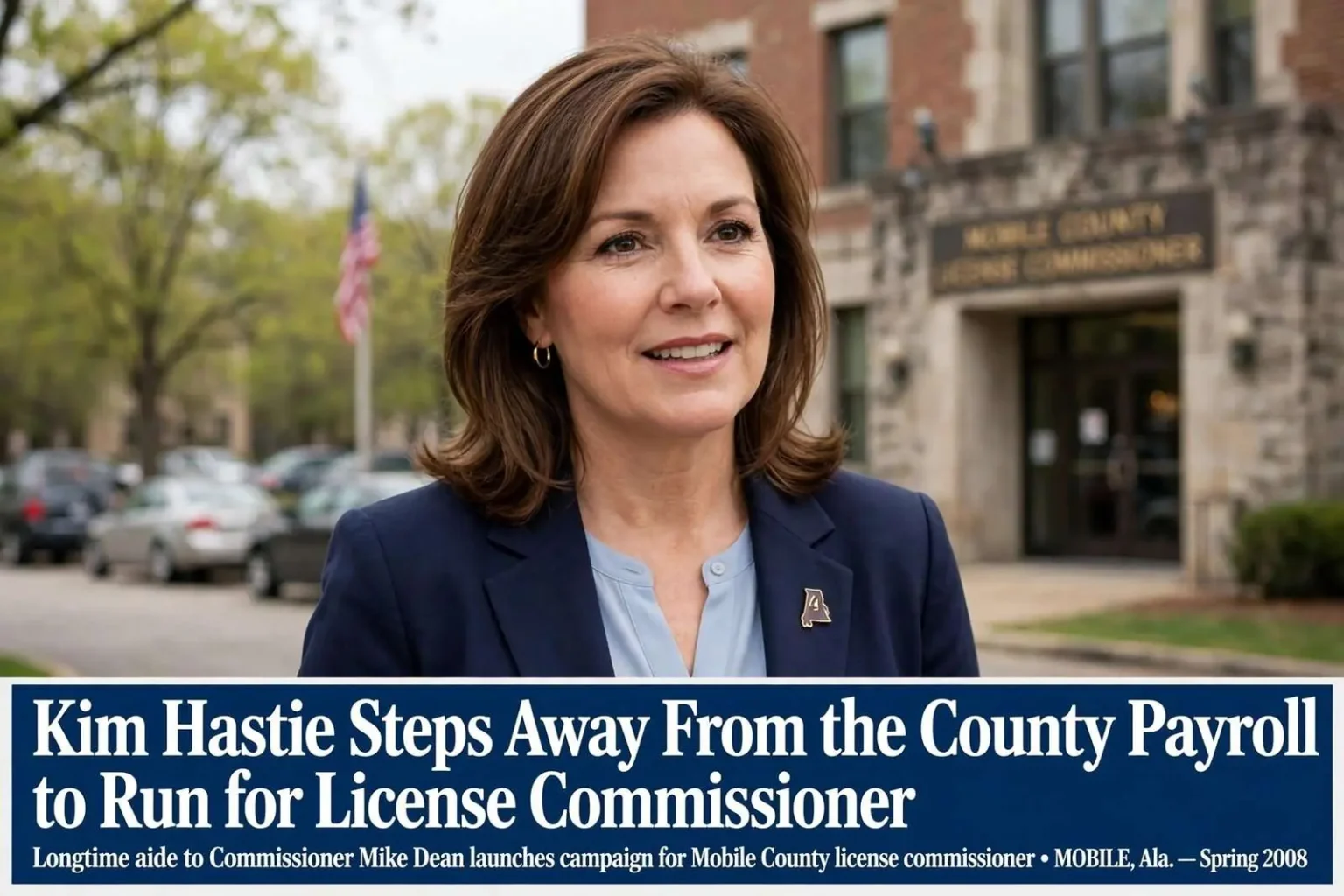
Kim Hastie had worked at the elbow of a Mobile County commissioner for years. In the spring of 2008 she stepped away from that desk to try to win an office of her own.
Hastie, the longtime secretary and administrative assistant to Mobile County Commissioner Mike Dean, took a leave of absence to run for Mobile County license commissioner as a Republican — a move that had been expected for weeks and that formally launched one of the more closely watched countywide races of the year.
The license commissioner’s office is one of the most visible in county government precisely because it is one of the few that ordinary residents must visit. It handles motor vehicle registration and titling, driver’s licenses, boat registrations, hunting and fishing licenses and the assorted decals and records that Alabama law routes through county offices. Nearly every household in Mobile County touches it, and nearly every household has formed an opinion about it — usually formed while standing in line.
A native with a customer-service pitch
A 48-year-old Mobile native, Hastie graduated from Theodore High School and studied business and marketing at the University of South Alabama. Before joining the county, she spent 15 years as vice president of marketing for the Scott Paper credit union, experience she pointed to as evidence that she understood both customer service and the bottom line.
Her campaign message was straightforward, and it was aimed at an experience nearly every adult in Mobile County had endured at least once: standing in line at the license office.
“Of course, everyone you talk to has a story about how horrible the customer service was,” Hastie said. “And that’s what I want to change, to see people treated in a friendly manner with better communication. We can do a better job.”
That pitch — competence and courtesy at the counter rather than a fight over policy — suited the office she was seeking. The license commissioner does not legislate. The job is operations: branches, staffing, queues, hours and the endless mechanics of making a mandatory errand as painless as possible. Campaigns for the office have traditionally been won on exactly the ground Hastie was staking out, one branch visit and one civic club luncheon at a time.
She was careful, however, not to campaign against the incumbent personally. Democrat Carol Norris was retiring after 20 years of public service, and Hastie said she believed Norris had performed admirably given the circumstances and resources she had been handed. The distinction mattered: with the incumbent stepping down, the race was an open seat, and criticism aimed at a retiring predecessor tends to alienate the very voters who remember that predecessor’s decades of service.
Norris had held the office through a period of enormous change in Mobile County, when the metro area’s growth pushed demand at the branch offices steadily upward and technology changed what the counters were expected to do. By 2008, the office was issuing and processing a widening range of state records while working with systems and buildings that predated much of that growth — the “circumstances” Hastie referenced when describing her predecessor’s tenure.
Making the case from the inside
Hastie argued that her years working alongside the county commission would help her win the resources the license office needed — that she understood not just what was wrong at the counter but how to get it fixed at the budget table.
“I know that process,” she said.
That argument had a practical edge. The license commissioner’s budget, staffing and capital requests must win approval from the very three-member county commission Hastie had served. A commissioner’s longtime aide, she said, would arrive in the office knowing which committee handles a request, how a budget amendment moves, and who has to be persuaded — knowledge that a newcomer would spend a term acquiring.
County government observers noted the arrangement was not unusual in Mobile County politics, where careers often begin as staff positions in the courthouse and graduate into independent offices. What made Hastie’s candidacy notable was the timing and the office itself: a race for a customer-facing job, run by a candidate whose entire pitch was her inside knowledge of how county government works.
Why the office matters to residents
For most Mobilians, the license office is county government. The courthouse, the commission office and the probate court are places most residents visit rarely or never, but the license commissioner’s branches are where teenagers get their first driver’s licenses, where new parents register the family car, where hunters and fishermen buy their licenses each season and where boat owners renew their registrations ahead of a summer on Mobile Bay.
That ubiquity gives the office an outsized political footprint. Long lines on a Saturday morning generate phone calls to county commissioners and letters to the editor in a way few other county functions do, and the commissioner who keeps the queues moving tends to be rewarded at the polls. The flip side is equally true — nothing reaches voters faster than a two-hour wait.
The office also operates across a sprawling county. Mobile County stretches from the Mississippi line to Mobile Bay and down to the Gulf, from the densely developed western suburbs around Tillman’s Corner and Semmes to the rural northern reaches near Mount Vernon. Branch locations and their hours determine how far a resident has to drive for a simple renewal, which is why the placement and staffing of satellite offices have been perennial issues in every license commissioner’s race for decades.
The 2008 countywide landscape
Hastie’s entry came in a spring when countywide races were taking shape well ahead of the June party primaries. In Alabama, the license commissioner’s race would be decided in the Republican primary if no Democratic qualifying candidate emerged to contest the seat in a county where Republicans had built a durable advantage in local offices over the preceding two decades. That made the primary the decisive contest, and it made organization, name recognition and retail campaigning the currencies of the campaign.
Her departure from Commissioner Mike Dean’s office also carried a bureaucratic wrinkle. Taking a leave of absence rather than resigning left a door open — if the campaign fell short, a return to county employment remained possible, a path many staff members who run for office have taken. Dean, a Republican whose district covered much of west Mobile County, had been a fixture on the commission, and his aide’s candidacy carried the implicit benefit of familiarity among the west Mobile and Semmes voters who knew his office well.
The campaign’s early shape was consistent with the office’s history. Candidates for license commissioner tend to campaign not on ideology but on administration: hours, branches, courtesy, technology. The office collects revenue that funds county and state functions, but its day-to-day character is that of a service business with a captive customer base, and voters judge it accordingly.
What Hastie promised
Beyond the customer-service message, Hastie emphasized communication — letting residents know what documents they need before they arrive, what hours branches are open, and what the office is doing about waits. Anyone who has made the trip to a license office only to discover a missing title or an expired insurance card understands the complaint; each such trip doubles the customer’s time cost and deepens the frustration the office is remembered for.
Her business background was part of that argument. Fifteen years marketing for a credit union, she argued, meant experience in a member-service institution where the customer could walk away — the opposite of a government monopoly counter, and the reason, she said, the private-sector service standard was worth importing.
Whether the argument would persuade primary voters was the open question of the summer. The office’s retiring incumbent had served two decades, and the transition promised to be the first open-seat contest for the job in as long. For a candidate who had spent her career one desk away from county power, the bet was that Mobile County’s voters would choose the person who already knew where the levers were — and who had stood in their shoes at the counter of every branch office in the county.
The economics of the office were also part of the public conversation. License commissioners operate on fee revenue and county appropriations, and every improvement a candidate promises — more staff, longer hours, better systems — carries a price tag that must survive the county’s budget process. That reality looped back to Hastie’s core argument: whoever holds the office has to know the commissioners, the finance department and the procurement rules, or every good idea dies in a budget meeting.
As the campaign moved toward the primary, Hastie’s schedule filled with the staples of a countywide race: civic clubs, church gatherings, business associations and the branch-to-branch listening tour that every serious license commissioner candidate walks. Her message rarely varied, by design. Friendly service, better communication, a do-better job at the counter — and a candidate who said she knew the process because she had lived it.