Man Indicted After Eight-Hour Standoff and Gunfire at Spanish Fort Apartments
A Baldwin County grand jury has indicted a 60-year-old man on multiple felony charges tied to a shooting and fire during a lengthy Spanish Fort standoff.
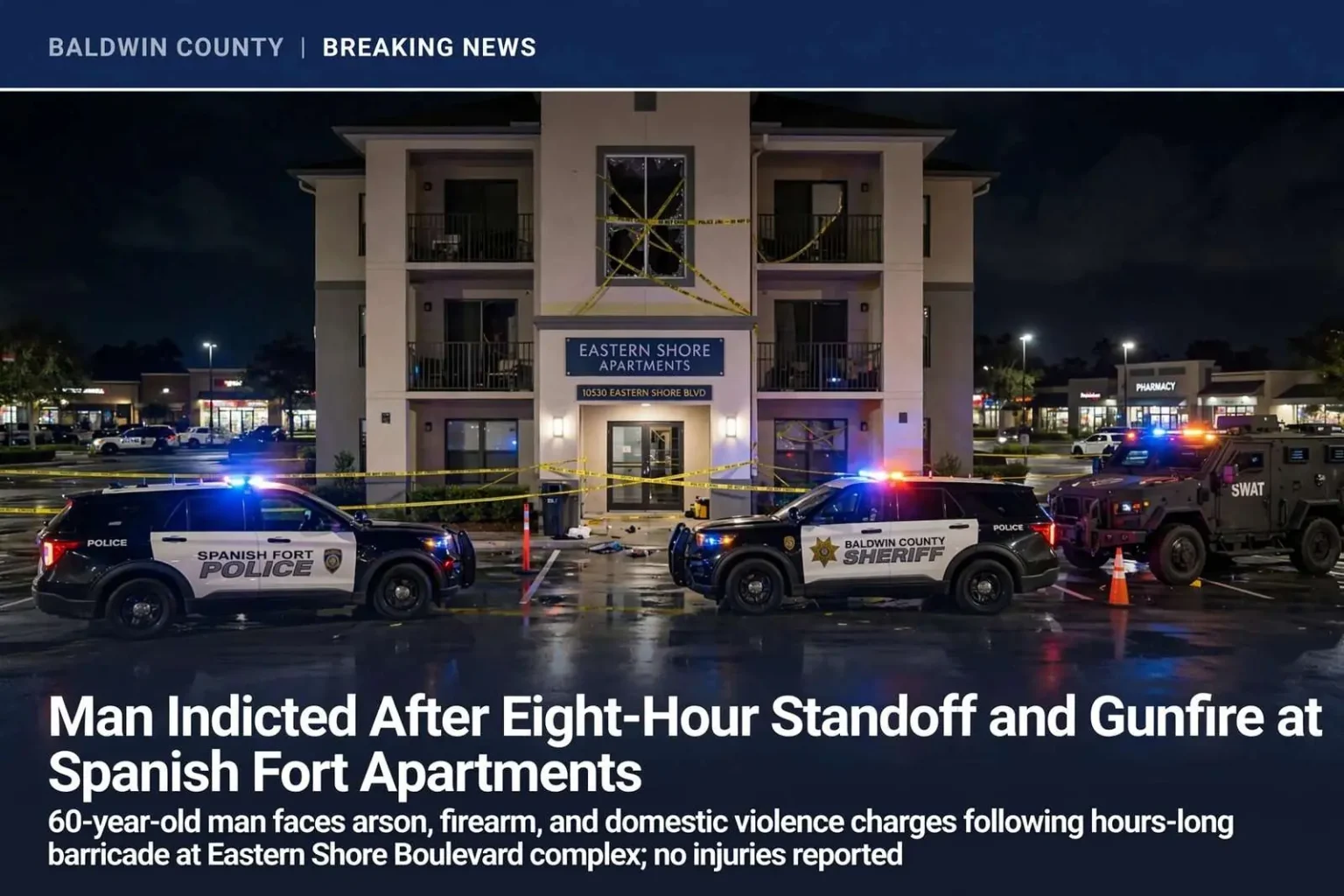
A Baldwin County grand jury has indicted a 60-year-old man formerly of Spanish Fort on a string of felony charges stemming from a gunfire-and-fire incident at an Eastern Shore Boulevard apartment complex that led to a roughly eight-hour standoff with law enforcement.
The man faces charges including first-degree arson, three counts of discharging a firearm into an occupied building, second-degree domestic violence, reckless endangerment and resisting arrest, according to the indictment. He is scheduled to be arraigned later this spring.
An indictment is not a conviction. It means a grand jury — meeting in secret and hearing only from prosecutors and investigators — found probable cause to believe the charged crimes occurred. The panel’s decision moves the case into Baldwin County Circuit Court, where the defendant will formally answer the charges at arraignment and the case will proceed through pretrial stages toward trial or resolution by plea. The man remains presumed innocent unless and until a court finds otherwise.
How the night unfolded
According to Spanish Fort authorities, the incident began after an argument inside the man’s apartment escalated. His wife left the unit and called 911 as the dispute intensified. Investigators say the man then fired a shot into the ceiling of the apartment before officers arrived on scene.
When police responded to the complex, they came under gunfire themselves, though no officers were struck, according to authorities. Several rounds fired during the incident struck neighboring apartment units, raising serious safety concerns for other residents of the complex during the hours-long standoff.
The gunfire transformed what began as a domestic disturbance call into one of the most dangerous situations officers can face: an armed subject inside an occupied multifamily building, with families living a wall away from the gunfire. Spanish Fort’s police department is a comparatively small force, and incidents of this scale routinely draw support from neighboring agencies across the Eastern Shore — a pattern common throughout Baldwin County, where departments regularly back one another up on major calls.
Authorities say the man is also accused of attempting to set fire to the apartment complex while barricaded inside during the standoff. The building’s sprinkler system activated and extinguished the flames before they could spread further, according to police accounts of the incident.
Fire safety advocates have long pointed to sprinkler systems as the difference between an inconvenient activation and a deadly structure fire, and the incident offered a real-world illustration. Multifamily buildings are required to maintain those systems, and in this case the sprinklers suppressed the flames long enough for the standoff to continue without the added catastrophe of a spreading fire threatening the entire complex and everyone still inside it.
The standoff stretched on for hours as negotiators and tactical officers worked to safely resolve the situation without further injury. Officers ultimately used tear gas and a flash grenade to end the standoff and take the man into custody. No injuries were reported among residents, officers or the man himself despite the exchange of gunfire and the attempted fire, according to authorities.
Crisis negotiation is the preferred first approach in barricade situations, with tactical teams staged as a fallback, and the goal in every such incident is a peaceful surrender. The hours negotiators spend talking are often described as hours bought for everyone’s safety. When talks stall or conditions deteriorate, tactical units use chemical agents and diversionary devices to disorient a subject and force an arrest while minimizing the chance of a gun battle — the sequence authorities described in this case.
A long night for a family neighborhood
The complex, located along Eastern Shore Boulevard in Spanish Fort, houses numerous families, and the lengthy standoff prompted a significant law enforcement response. Eastern Shore Boulevard runs through the heart of Spanish Fort’s commercial district, near the Interstate 10 exchange and the shopping centers that anchor the city’s rapid growth, and an emergency presence of that scale is an unusual sight in a corridor more accustomed to retail traffic than police activity.
Incidents like this one place a burden on a neighborhood that lasts beyond the night itself. Families pulled from their routines, the sound of gunfire and emergency equipment, and the sight of officers in tactical gear all leave an impression, and departments across the country have increasingly paired major incidents with victim services and community outreach in the days that follow.
Domestic disputes are among the most unpredictable calls officers answer, and they account for a substantial share of on-duty officer injuries nationwide. The escalation in this case — from an argument, to gunfire, to an attempted fire — illustrates how quickly such calls can spiral, which is why departments treat them differently from almost any other type of response, staging additional units and involving supervisors early.
Advocates for domestic violence victims note that the safest outcomes come when help arrives before a dispute reaches the point of crisis, and they encourage anyone in a dangerous relationship to contact law enforcement or a domestic violence hotline for safety planning and support. Alabama maintains a statewide network of shelters and crisis services, including resources available to families in Baldwin County, and officers who respond to domestic calls are trained to connect victims with those services.
For prosecutors, the indictment stacks charges that each carry significant prison exposure, and the potential sentences compound when convictions stack. First-degree arson under Alabama law involves setting fire to an occupied structure — among the most serious felony categories on the books — and the three counts of discharging a firearm into an occupied building each relate to separate shots fired during the incident.
The second-degree domestic violence charge reflects the assault that set the night in motion, while the reckless endangerment and resisting arrest counts cover the broader danger created for police and neighbors as the standoff wore on. How those charges are ultimately resolved — through trial, plea agreement or dismissal — will depend on evidence gathered during the investigation and arguments that have yet to be heard in court.
The arraignment scheduled for later this spring will be the public’s first look at the case’s progression through the court system. At that hearing, the charges will be read, counsel will be confirmed, and a judge will address bond and scheduling matters. From there, the case enters the long rhythm of the criminal docket: discovery, motions, and eventually trial or a negotiated outcome.
For the residents of the complex, the charges mark an accounting but not an ending. Many returned to apartments scarred by stray rounds, and the memory of an eight-hour siege in a family neighborhood is not easily set aside. Property owners and managers of apartment communities across Baldwin County have used incidents like this to review security practices and emergency plans, and emergency officials remind residents that reporting dangerous behavior early — as the man’s wife did with her 911 call — is often the step that prevents a tragedy.
Baldwin County has grown faster than almost any county in Alabama over the past two decades, and the Eastern Shore cities of Spanish Fort, Daphne and Fairhope have absorbed much of that growth in the form of apartment complexes, townhomes and retail centers clustered around the interstate exchanges. More residents living closer together means that a single violent incident touches more people than it once would have, and it raises the stakes for the first responders who handle confrontations in densely occupied buildings.
Sheriff’s deputies and municipal police across the county train together on active threats, barricaded subjects and crisis negotiation, and mutual-aid agreements mean that a call in Spanish Fort can quickly bring officers from Daphne, county deputies, state troopers or federal partners depending on the need. That coordination is credited in communities across the region with resolving dangerous standoffs without loss of life, and it was on full display over the eight hours described in court documents.
The court process from here will unfold over months rather than weeks. Defense attorneys will receive the state’s evidence, file whatever motions the record supports, and the case will appear and reappear on the Circuit Court docket before it reaches a final resolution. Victims and witnesses in cases of this scale are typically kept informed by prosecutors’ offices as milestones approach, including the arraignment set for later this spring.
The case also serves as a quiet testament to the systems that held under pressure: a sprinkler system that stopped a fire, negotiators who kept a volatile situation from ending in gunfire between police and a barricaded man, and tactical officers who ended the standoff without a single reported injury on any side. Those outcomes are the norm officers train for, even when they are not the ones that make headlines.