Pine Rest Case Grows: About 30 Baldwin County Families Report Paid-for Funeral Services That Never Happened
About 30 families now report paying for funeral services or headstones at a Foley funeral home and receiving nothing, as the Pine Rest case heads to a grand jury.
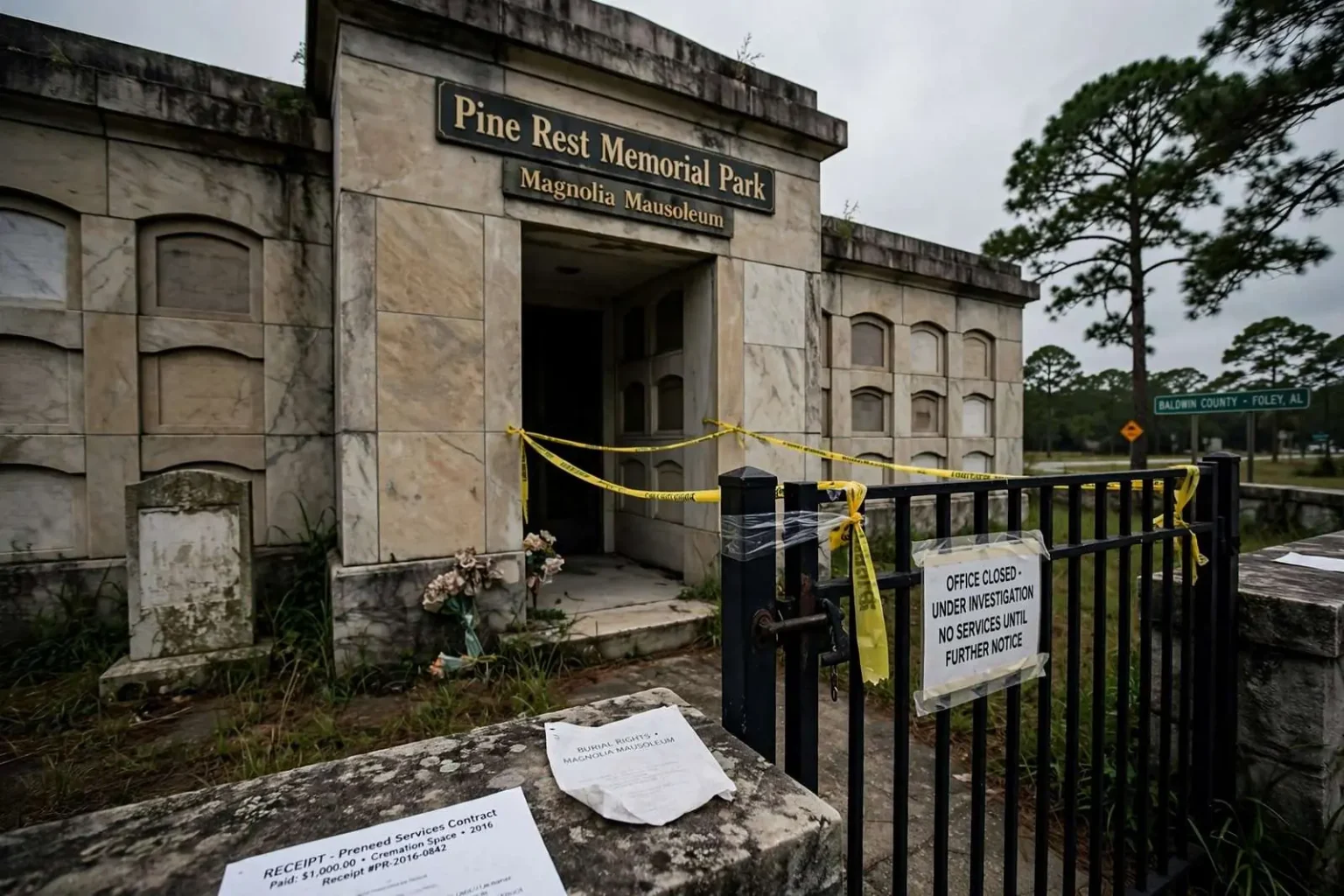
FOLEY, Ala. — More than two months after the arrest of former Pine Rest Funeral Home director Tim Street, the Baldwin County Sheriff’s Office says about 30 people now claim they paid for services at the Foley funeral home and received nothing in return.
Sheriff’s officials say the case will go before a grand jury all at once, but assembling the documentation is expected to take a few more months.
A family waiting more than two years
Mike Batt says his family has been waiting more than two years for his mother’s name to be engraved on a marker at their family mausoleum. His mother died in 2024 and was laid to rest at Pine Rest Memorial Park in Foley.
“I’ve sent numerous emails through their system and left numerous voicemails, and no responses still yet to me,” Batt said.
“To go over there and find out just six months ago nothing’s been done for her…that was very sad for all of us,” Batt said.
Batt says he hoped things would improve after Street was arrested on charges of financial exploitation of the elderly.
“Since then, weekly, and have had very little communication or feedback or updates from the funeral home,” Batt said.
Dozens of families, similar stories
Detectives say dozens of families have reported paying for headstones or other services that were never provided. Investigators say the Pine Rest Funeral Home owners have fully cooperated with the investigation and are working to notify affected families.
Batt says he has kept meticulous records — receipts, emails and a document covering burial rights in the Magnolia Mausoleum. He says his nephew spoke with an area manager last month, who told the family the engraving was delayed after a truck broke down.
The family says it has now been promised the engraving will be finished by Sept. 5 — more than two years after his mother’s death.
Batt also shared a receipt from 2016, when his father paid for a cremation space next to his mother.
“He paid another thousand dollars for that. A thousand dollars plus a few years. And my dad and I sent emails back and forth. And we both were concerned with their communication. And we were not getting good confirmation and good documentation that everything was all set,” Batt said.
Others finally seeing results
After initial coverage of the case in June, Batt says he contacted another alleged victim who had been interviewed. She told him her late grandfather’s headstone finally arrived after Street’s arrest — more than a year after it was paid for.
Batt says he hopes his family will see results too. He has filed reports with both the Baldwin County Sheriff’s Office and the Alabama Board of Funeral Service.
“I just want the funeral home to follow through on their obligations financially on the contracts. That’s it. I’m not looking for anything else,” Batt said.
What happens next
Court records show Street was previously released on a $10,000 bond. The grand jury presentation is expected to consolidate the growing number of complaints into a single case, a process that allows investigators to organize payment records, contracts and witness statements before charges are considered.
For families still waiting, the advice from investigators and consumer advocates is consistent: gather every receipt, contract and piece of correspondence, and report problems to both law enforcement and the state funeral board. Batt says that is exactly what his family plans to keep doing until the promises made at the funeral home are kept.
How Alabama Prosecutes Financial Exploitation of the Elderly
The charge facing former Pine Rest director Tim Street — financial exploitation of the elderly — has existed as a distinct crime in Alabama only since 2013, when the Legislature passed a law aimed specifically at people who use a position of trust to take money, property or assets from older residents. Before that law, prosecutors often had to rely on general theft or fraud statutes that did not account for the particular vulnerability of elderly victims or the caregiving, financial or business relationships that make this kind of crime possible in the first place. Under the current statute, the severity of the charge is tied largely to the dollar amount involved: cases involving losses of $2,500 or more can be charged as a Class B felony, punishable by up to 20 years in prison, while larger losses can push a case into Class A felony territory, the same category as offenses like first-degree robbery. Prosecutors also have to show that the victim was 60 or older, or otherwise met the law’s definition of a vulnerable adult, and that the person accused stood in a position that gave them access to the victim’s money or property.
Cases like this one are also unusual in how they move through the system. Rather than charging each victim’s loss as a separate case, investigators often build a single, consolidated file that documents a pattern of conduct across many complainants. That is largely why the Baldwin County Sheriff’s Office has said it intends to present the growing list of Pine Rest complaints to a grand jury together rather than piecemeal. A grand jury in Alabama does not determine guilt; its job is to review the evidence investigators have assembled and decide whether there is probable cause to issue an indictment. For a case this size, that means detectives must first organize potentially hundreds of individual contracts, receipts, bank records and witness statements into a coherent presentation, which is a major reason cases of this scope can take months to reach that stage even after an arrest has already been made.
Preneed Funeral Contracts and State Oversight
Funeral homes in Alabama that sell “preneed” contracts — arrangements paid for in advance of when services are actually needed — operate under rules set by the Alabama Board of Funeral Service, the state agency responsible for licensing funeral directors, embalmers and funeral establishments. The board investigates consumer complaints, can suspend or revoke a funeral home’s license, and refers suspected criminal conduct to local law enforcement or the Attorney General’s office. Preneed money is typically supposed to be placed into a trust or an insurance-funded arrangement so that it remains available when the contracted services are eventually needed, rather than being treated as ordinary operating revenue for the business. When a funeral home fails to deliver on those contracts, families are often left with two separate avenues for recourse: a licensing complaint to the state board, which can affect whether the business is allowed to keep operating, and a criminal complaint to law enforcement, which can lead to charges if investigators find evidence that money was misappropriated rather than simply mismanaged.
Consumer advocates who track funeral industry complaints nationally say cases involving unfulfilled preneed contracts and cemetery services tend to surface slowly, in part because families often do not realize anything is wrong until they need a service — a burial, an engraving, a marker installation — and discover it was never arranged. That lag is part of why regulators and investigators frequently see complaint counts climb for months after an initial arrest or public report, as more families check on services they paid for years earlier and discover the same pattern others have already reported.
What Families Are Generally Advised to Do
Both the funeral service board and consumer protection offices around the state give similar advice to families who believe they may have paid for services that were never delivered. The first step is almost always documentation: gathering original contracts, payment receipts, cancelled checks or bank statements, and any written or electronic correspondence with the business. Investigators rely heavily on this kind of paper trail to establish both the existence of an agreement and the fact that payment was made, which is often the most straightforward part of proving a financial exploitation case. Families are also generally encouraged to file complaints with more than one agency — both local law enforcement, which can pursue criminal charges, and the relevant state licensing board, which can take administrative action independent of any criminal case.
Timing also matters in a practical sense. Once a criminal investigation into a business is underway, the agency’s cooperation — or lack of it — with individual customer complaints can shift, and families are often told to continue documenting any further contact so that timeline becomes part of the broader case file. Because prosecutors handling exploitation cases involving multiple victims typically try to establish a pattern of conduct rather than treat each family’s experience in isolation, every additional documented complaint can become part of the evidence used to support the eventual charges, even for families who are still waiting for their own situation to be resolved.
The Role of the Alabama Attorney General’s Office
Large consumer fraud cases involving dozens of victims across a single county sometimes draw involvement from the Alabama Attorney General’s office in addition to local prosecutors, particularly when a case touches on consumer protection statutes or when the volume of victims and financial records exceeds what a county district attorney’s staff can efficiently process alone. The Attorney General’s Consumer Protection Division has authority to pursue civil remedies, including restitution orders and injunctions barring a business from continuing to operate in a way that harms consumers, separate from any criminal case a county grand jury might pursue. For families like the Batts, that means the eventual resolution of the Pine Rest matter could involve more than one avenue — a criminal case aimed at holding individuals accountable, and potentially a civil or regulatory action aimed at recovering money or ensuring the business either fulfills its outstanding obligations or is barred from taking on new preneed customers until it does.