Mobile Children’s Boutique Marks 70 Years of Serving Families on Airport Boulevard
Tiny Town Children's Boutique on Airport Boulevard is marking 70 years of serving Mobile families, a milestone rare among small independent retailers.
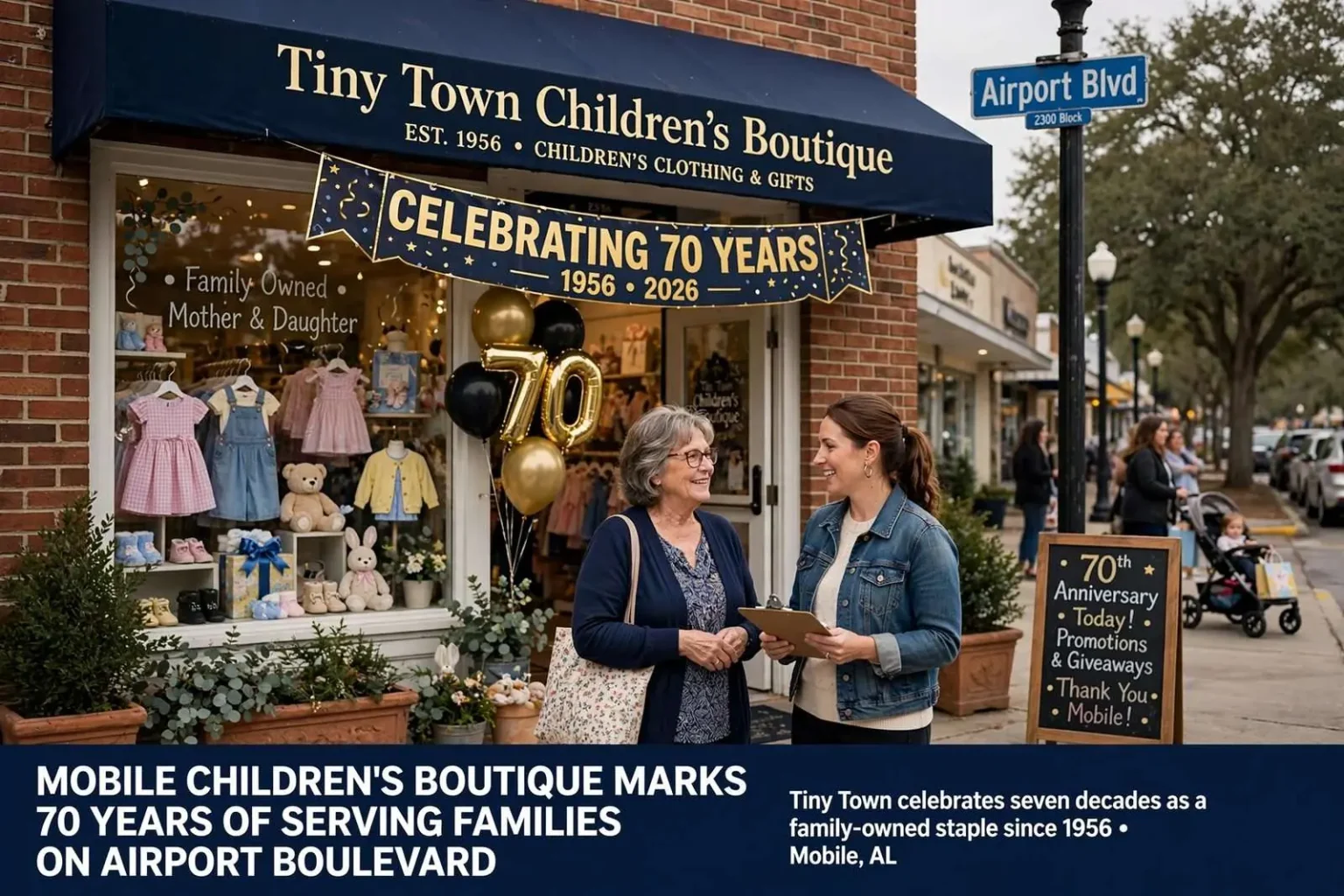
A Mobile children’s clothing store is celebrating a milestone few small retailers ever reach: 70 years in business. Tiny Town Children’s Boutique on Airport Boulevard has helped generations of children and families find clothing, gifts, and keepsakes since 1956, and the mother-daughter team that now owns the shop marked the occasion with a celebration for longtime customers.
Seven Decades on Airport Boulevard
Sunny Boothe, who owns Tiny Town alongside her mother, said reaching 70 years in business is an honor, expressing gratitude for the community’s sustained support of the store throughout its history. The anniversary celebration featured promotions and giveaways, along with an opportunity for longtime customers to reflect on the store’s history and legacy with the family that has run it.
Seventy years of continuous operation places Tiny Town among a small group of Mobile businesses that have survived multiple generations of economic change, shifting retail trends, and evolving neighborhood demographics along Airport Boulevard, one of the city’s busier commercial corridors. Few independent, family-owned children’s retailers anywhere in the country manage to remain open for seven decades, given the pressures small specialty retailers have faced from big-box competitors, online shopping, and rising commercial rents.
A Family Business Built Across Generations
Tiny Town’s ownership structure — passed down within the same family and currently operated as a mother-daughter partnership — reflects a common pattern among the country’s longest-surviving small retailers, many of which stay in business precisely because ownership transfers within a family rather than being sold to outside investors or larger retail chains. That kind of continuity allows a business to maintain long-standing relationships with customers, some of whom may have shopped at the store as children themselves and now bring their own children or grandchildren through the same doors.
For many Mobile families, that generational continuity is part of what makes a store like Tiny Town meaningful beyond its function as a place to buy children’s clothing. Shopping there can carry a sense of tradition and familiarity that larger, more anonymous retail chains rarely replicate, particularly for families who have relied on the store across multiple decades and multiple generations of children.
The Challenge Facing Independent Children’s Retailers
Independent children’s boutiques like Tiny Town operate in a retail category that has seen significant consolidation and disruption over the past several decades. National chains offering lower prices on children’s clothing, combined with the rapid growth of online retail, have squeezed profit margins for small, independent shops that cannot match the purchasing power or marketing budgets of larger competitors. Many family-owned children’s clothing stores that once anchored neighborhood shopping districts across the country have closed in the decades since Tiny Town first opened its doors in 1956.
Stores that have managed to survive and thrive despite that competitive pressure typically do so by leaning into exactly the kind of personalized service, curated selection, and community relationships that larger retailers struggle to replicate. Independent retailers often point to that personal touch — remembering a regular customer’s preferences, offering gift recommendations tailored to a specific family, or simply providing a level of attentive service uncommon in big-box stores — as their most durable competitive advantage against larger, better-capitalized competitors.
A Piece of Mobile’s Retail History
Tiny Town’s 1956 opening places its founding in a period of significant growth for Mobile and for Airport Boulevard specifically, as the corridor developed into one of the city’s primary commercial thoroughfares in the decades following World War II. Businesses that opened along the boulevard during that era and have survived to the present day offer a kind of living record of the city’s retail history, having witnessed and adapted to decades of changing shopping habits, economic cycles, and neighborhood development.
The preservation and continued support of long-standing local businesses like Tiny Town has become an increasingly common talking point among city officials and economic development advocates in Mobile, who often frame independent, multi-generational businesses as an important part of maintaining the city’s distinctive character even as national chains and franchise concepts continue to expand into the local market.
What the Anniversary Means for the Community
For customers who attended the anniversary celebration, the event offered a chance to do more than take advantage of promotions and giveaways — it provided an opportunity to publicly recognize a business that has quietly served as a fixture in many families’ lives for decades. Anniversary celebrations of this kind often draw not just current regular customers, but former customers who may not have shopped at the store recently, reconnecting with a business that played a meaningful role in an earlier chapter of their family’s life.
Boothe and her mother have not publicly announced any specific plans for how they intend to mark future milestones or whether the business will eventually pass to a third generation of family ownership. For now, the 70th anniversary stands as a recognition of seven decades of continuous operation in an industry where survival itself, let alone sustained community support across multiple generations, represents no small achievement.
Supporting Small Business Along Airport Boulevard
Airport Boulevard has evolved considerably since Tiny Town first opened, now hosting a mix of national chains, medical offices, and long-standing independent businesses along one of Mobile’s busiest commercial corridors. Local business advocates have periodically highlighted the corridor’s independent retailers, including Tiny Town, as examples of the kind of small business resilience that helps distinguish Mobile’s commercial landscape from a more generic suburban retail strip dominated entirely by national franchise chains.
As Mobile continues to grow, the fate of long-standing family businesses like Tiny Town will likely remain closely tied to broader trends in commercial rents, foot traffic patterns, and consumer shopping habits along corridors like Airport Boulevard — trends that have already reshaped much of the surrounding retail landscape over the store’s 70-year history, and that are likely to continue evolving in the years ahead.
How Small Retailers Compete in a Changed Market
The retail landscape that Tiny Town has navigated over the past seven decades looks almost nothing like the one it opened into back in 1956. At that time, small, independently owned shops were the dominant model for children’s clothing retail in most American cities, with department stores and mail-order catalogs representing the main alternatives. The rise of suburban shopping malls in the 1960s and 1970s introduced new competition from mall-based national chains, followed by the growth of big-box discount retailers in the 1980s and 1990s that undercut independent retailers on price. More recently, the explosion of online shopping over the past two decades has added an entirely new competitive front, allowing consumers to comparison-shop instantly and have children’s clothing delivered directly to their homes within days.
Retail analysts who study small business survival note that stores like Tiny Town, which have weathered all of these successive waves of competitive disruption, typically share certain characteristics: a loyal, multi-generational customer base; a reputation for curated selection or personalized service that’s difficult for larger competitors to replicate; and often a favorable, long-held lease or owned property that insulates the business from the kind of rent increases that have forced many independent retailers out of prime commercial corridors as those areas gentrify or redevelop.
The Value of Multi-Generational Customer Relationships
For a business built around children’s clothing specifically, the multi-generational customer relationship carries a particular kind of value that’s harder to quantify than simple repeat business. A parent who shopped at Tiny Town as a child and now brings their own children into the store isn’t just a returning customer — they’re someone whose entire relationship with the business is wrapped up in personal and family memory, from childhood visits to holiday shopping trips to, potentially, baby shower gift purchases for their own children years later.
That kind of emotional continuity is something retail consultants often describe as nearly impossible for larger chains to manufacture artificially, since it depends entirely on decades of consistent, trustworthy service delivered by the same family, often in the same physical location, across a span of time long enough for customers themselves to become parents and grandparents. Businesses that manage to sustain that kind of relationship, as Tiny Town appears to have done, often find that their most effective marketing is simply the accumulated goodwill of thousands of family relationships built one purchase at a time over multiple decades.
Mobile’s Broader Small Business Landscape
Tiny Town’s anniversary arrives at a moment when small business advocates across Mobile have been increasingly vocal about the importance of supporting long-standing, independently owned retailers as the city continues to grow and attract new residents and new commercial development. Organizations including the Mobile Chamber have periodically highlighted local business milestones like this one as part of broader efforts to raise awareness of the city’s independent business community and to encourage residents to prioritize local shopping over larger national chains when possible.
That kind of local business advocacy has taken on additional significance in recent years as Mobile has seen new residential and commercial development reshape parts of the city, raising questions among some longtime residents and business owners about whether rising commercial rents and changing neighborhood demographics might eventually threaten legacy businesses that have operated in the same locations for decades. For now, Tiny Town’s continued operation on Airport Boulevard, seven decades after it first opened, stands as a counterpoint to those concerns — evidence that a well-run, community-rooted small business can still find a way to endure even as the broader retail environment around it continues to change.