Bathroom Graffiti Sparks Rumor Storm, Extra Police Presence at Spanish Fort Middle
Baldwin County schools added police at Spanish Fort Middle after restroom graffiti fueled unfounded rumors of a gun threat before spring break.
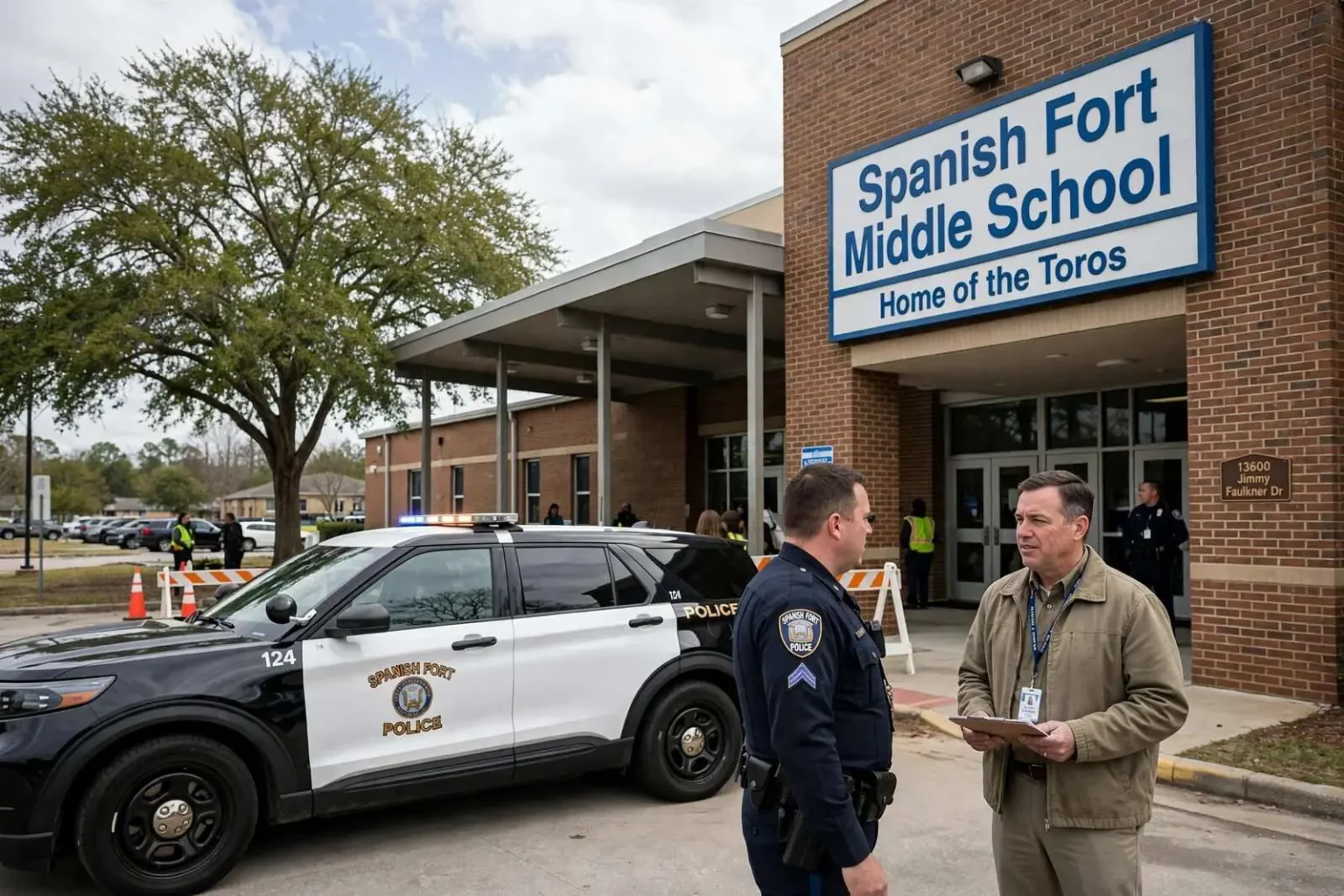
Baldwin County school officials called in extra Spanish Fort police officers to patrol Spanish Fort Middle School this week, describing their presence as a reassuring gesture after inappropriate language turned up scrawled on a restroom wall and set off a wave of rumors among parents and students. The episode, which unfolded in the final days before spring break, offered a familiar lesson in how quickly an unverified claim can travel through a school community in the age of group texts and social media.
School and police investigators found the writing in a bathroom on a Wednesday, just a day before the district’s schools were set to break for more than a week of spring vacation. The discovery set off a rapid response from both the school administration and the Spanish Fort Police Department, which worked to trace the source of the message while school leaders fielded a growing stream of calls and messages from concerned parents.
Terry Wilhite, spokesperson for the Baldwin County school system, said investigators determined there was no credible threat behind the graffiti and no reason for alarm, despite rumors that spread quickly through the school community. Even so, some parents pulled their children out of classes the following day as a precaution while the rumors were still circulating unconfirmed.
Wilhite said the timing suggested the writing may have been a deliberate attempt to disrupt the school day right before break, rather than any genuine threat. “The thought process might have been, ‘If I write something on the wall, we might get an extra day of spring break,'” he said. “We’ve seen that countless times over the years.”
Spanish Fort Middle School serves students in the central part of the Eastern Shore city, an area that has grown rapidly along the Interstate 10 corridor between Mobile Bay and the delta. The campus sits near Spanish Fort High School on Jimmy Faulkner Drive, just north of the Eastern Shore Centre shopping area, a positioning that made the heavier-than-usual parent traffic on Thursday all the more noticeable to commuters passing through the area.
School officials emphasized that the extra officers were not sent because investigators believed students were in danger. Their role, Wilhite said, was to steady nerves — a visible sign that the district and the city took the concerns seriously even as both worked to knock down the rumors spreading online.
Rumors outrun the facts
As of Thursday afternoon, no student had been identified as responsible, though Wilhite said anyone found to have written the language would face serious disciplinary consequences. He added that this was not the first time the district has dealt with this kind of incident.
“This is not the first time we’ve had this occur in our system and unfortunately it won’t be the last,” Wilhite said.
His prediction reflects a pattern school administrators across the Gulf Coast and the country have grown accustomed to: restroom graffiti mentioning violence tends to surface most often right before holidays and extended breaks, when the payoff for whoever writes it — a canceled day of classes, an early start to vacation — is highest. Districts have responded in recent years with bathroom monitoring policies, anonymous reporting tools and, in cases like this one, a visible police presence meant to head off panic before it starts.
The rumor cycle in Spanish Fort moved quickly. Word of the graffiti spread from students to parents, and by Wednesday evening and Thursday morning, variations of the claim — each more alarming than the last — were circulating among families who had received no direct word from the school. By the time officials issued their assurances, some parents had already decided to keep their children home for the final day before the break.
Baldwin County Public Schools, one of the largest districts in Alabama, spans communities from the Mississippi line to the Florida border, and its Eastern Shore schools sit among the fastest-growing in the system. That size and spread shapes how the district communicates during a scare: a single rumor at one campus can reach thousands of households within hours, through parent Facebook groups, text threads and student accounts that no school official can monitor.
Administrators across the region have increasingly treated rumor management as a core part of school safety work, on par with drills and building security. The standard playbook in most districts now includes rapid verification with local police, a direct message to parents rather than relying on students to relay information, and a visible law enforcement presence the following day — precisely the sequence Spanish Fort followed this week.
School leaders say the calculus is delicate. Say too little, and the vacuum fills with speculation. Say too much about an unverified claim, and the district risks amplifying a rumor that might otherwise have faded overnight. In Spanish Fort’s case, officials chose to let investigators speak first and to correct specific false claims as they surfaced, rather than issuing a blanket warning that might have pushed more parents toward keeping their children home.
Police chief: the gun rumor was false
Spanish Fort Police Chief David Edgar addressed the situation directly in an email to parents, writing that rumors claiming a student had threatened to bring a gun to school were false and had spread without any factual basis.
Even though investigators found no substance to those rumors, Edgar said he sent officers back to campus to help ensure the safety of students and staff and to reassure the community. Those officers also helped manage the heavier-than-usual flow of parent traffic around the campus, which sits near Spanish Fort High School on Jimmy Faulkner Drive just north of the Eastern Shore Centre shopping area.
“It’s very much appreciated,” Wilhite said of the additional law enforcement support.
The department’s decision to put officers on campus despite finding no threat illustrates how police agencies on the Eastern Shore balance investigation with reassurance. A department that investigates quietly and says nothing can leave a community convinced officials are hiding something; a department that speaks plainly and shows a presence, even when there is nothing to fear, tends to close the rumor loop faster. Edgar’s email was aimed squarely at that second outcome — naming the false claim, debunking it, and explaining what the department was doing anyway.
Officers directing traffic may have seemed a small gesture, but it addressed a real frustration for parents who did bring their children to school. With families arriving in a concentrated window on the final morning before break, the added manpower kept the drop-off lines moving along the campus roads shared with the high school next door.
For the Spanish Fort officers themselves, the assignment was a familiar one. Departments across Baldwin County routinely station extra personnel at schools in the days following a reported threat, a practice that has become standard across the country since school shootings made even unfounded threats impossible for administrators to dismiss.
For the Spanish Fort officers themselves, the assignment was a familiar one. Departments across Baldwin County routinely station extra personnel at schools in the days following a reported threat, a practice that has become standard across the country in an era when even unfounded threats are treated as impossible for administrators to ignore. The presence of marked patrol cars at drop-off and dismissal can do as much to calm a nervous parent as any statement, which is precisely the effect officials said they were aiming for.
Anatomy of a rumor echo chamber
Wilhite characterized the two days of unease as largely the product of what he called a “rumor echo chamber,” where unverified claims about a threat spread faster than school officials could correct them.
The phrase captures a dynamic that school communicators say has grown sharply worse with smartphone use among middle school students. A message scratched on a bathroom wall once traveled at the speed of hallway gossip; now a student photographs it during class change, and by lunch period it has reached hundreds of phones, each share stripping away the context that would have made it less frightening. By the time the school can investigate and respond, the version of events circulating among parents may bear little resemblance to what investigators actually found.
He said the district’s experience with similar incidents in the past has shown that quick, transparent communication from both school administrators and police is often the best way to calm nerves once a rumor starts circulating on a middle or high school campus.
Baldwin County school officials have urged parents in past incidents to check district and school communication channels before forwarding claims they receive secondhand, and to report concerning messages to school administrators or police rather than sharing them. Districts that respond within the first hours — confirming what was found, stating clearly whether investigators believe there is a danger, and identifying who is looking into it — consistently see fewer absences and less panic than those that stay silent until the next morning.
The discipline side of the equation remains open. If investigators identify the student responsible, the consequences will be handled under the district’s student code of conduct, which treats threats and false alarms as serious offenses. School officials did not say whether the writer would face criminal charges as well; that determination typically rests with police and the district attorney’s office once an investigation identifies a suspect.
For now, the episode ends quietly: schools across the district headed into spring break on schedule, the extra officers completed their assignment, and the predicted disruption never materialized. What school leaders in Spanish Fort and across Baldwin County took from the week was less about the graffiti itself than about the speed of the response it required — and the reminder that in a connected school community, managing what parents believe is now as much a part of school safety as securing the building.