Electrical Smoke Prompts Brief Evacuation at Spanish Fort High School
Students briefly evacuated Spanish Fort High School Thursday morning after an alarm and a smell of burning electronics near the library.
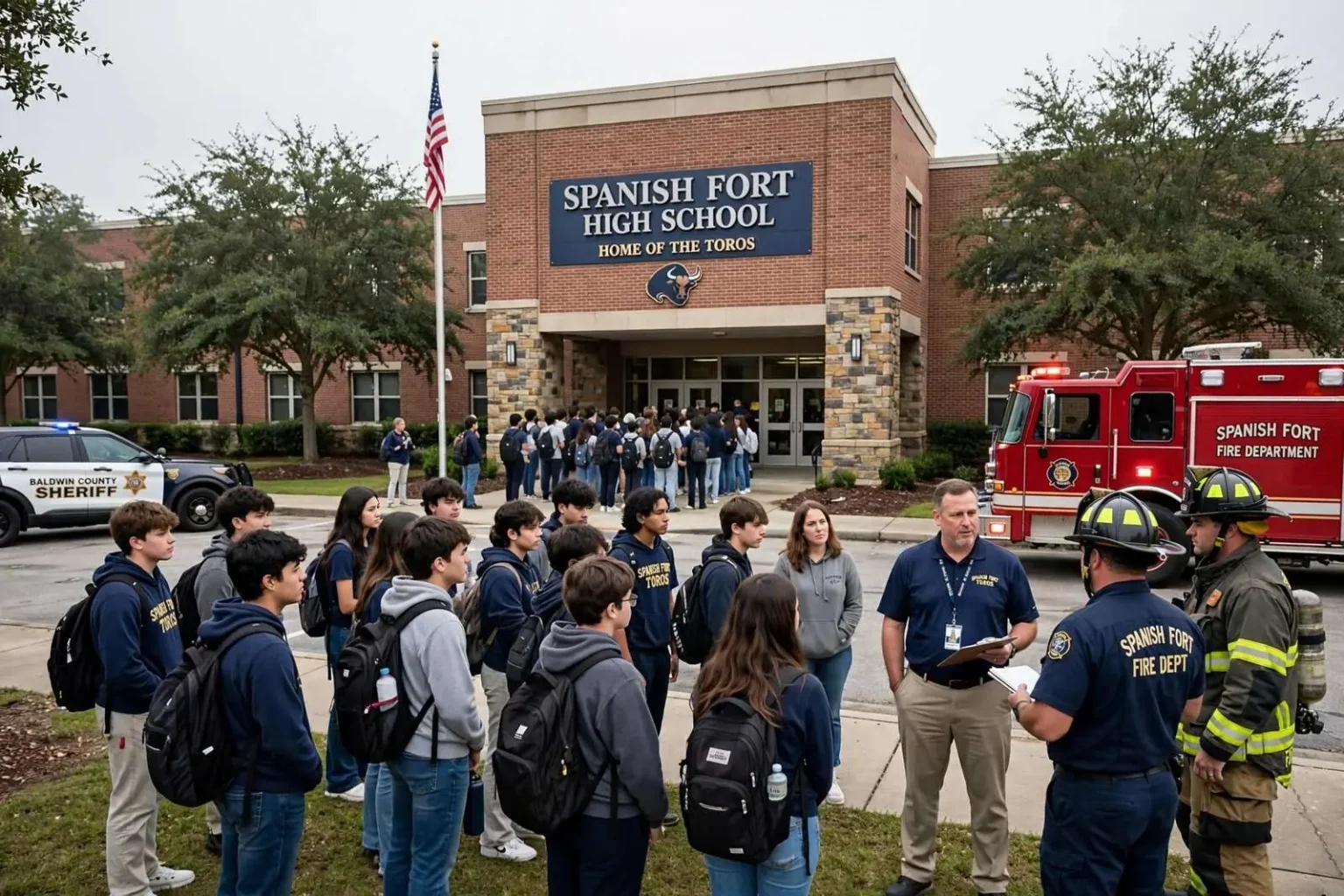
SPANISH FORT, Alabama — Students at Spanish Fort High School spent part of Thursday morning outside their classrooms after a fire alarm sounded just before 8 a.m., prompting firefighters to respond to the campus, according to Baldwin County school officials. The precautionary evacuation cleared the building while crews investigated reports of smoke inside.
Terry Wilhite, the Baldwin County school system’s director of communications, said the alarm appeared to be triggered by an electrical issue that produced smoke near the school library. “We believe there’s some sort of electrical issue that caused some smoke near the library,” Wilhite said at the time, adding that students were “safe and sound” while they waited outside during the response.
School staff and emergency crews traced the alarm to a smell of burning electronics rather than an active fire, and there was no indication of flames or a larger hazard on campus. Students were cleared to head back inside around 8:45 a.m., less than an hour after the alarm first sounded, once officials determined the building was safe to reoccupy.
The Spanish Fort Fire Department confirmed it responded to the alarm but did not release additional details about the nature of the electrical issue beyond confirming the response. No injuries were reported, and classes resumed on a normal schedule after students returned to the building.
A Routine Response, By Design
Electrical smoke incidents like this one are relatively common in older school buildings and mechanical systems, and fire alarms are designed to trigger even for smaller issues such as an overheating outlet, wiring fault, or HVAC component, as a precaution. In school settings, that sensitivity is intentional: detectors and pull stations are calibrated to err toward early warnings, because the cost of a false alarm is measured in lost class time, while the cost of a missed warning can be measured in lives.
Baldwin County school officials have said in the past that erring on the side of caution and fully evacuating a building, even for what turns out to be a minor issue, remains standard procedure any time smoke is detected or reported inside a school. The district operates dozens of campuses across Alabama’s largest county by area, and evacuation drills run at every school through the year, so students and staff moved through the process with little drama Thursday morning.
Electrical fires in schools most often begin in predictable places: aging wiring inside walls, overloaded circuits in classrooms that have added computers and devices over the years, motors in air handlers and kitchen equipment, and connections that loosen or corrode over time. The burning-insulation smell that students and staff noticed is typically the first sign, and it is one fire officials urge everyone to report immediately rather than wait to see whether smoke becomes visible.
Spanish Fort High and a Fast-Growing System
Spanish Fort High School, part of the Baldwin County school system, has seen rapid enrollment growth in recent years as the surrounding area has developed, a trend that has put added strain on aging infrastructure across the district. The school serves one of the fastest-growing corners of the Eastern Shore, where new subdivisions along Highways 31 and 98 and the growth of the Spanish Fort and Daphne communities have filled classrooms steadily since the school opened.
Baldwin County is among the fastest-growing counties in Alabama, and its school system is one of the largest in the state, spanning communities from Fairhope and Daphne on the Eastern Shore to Gulf Shores and Orange Beach on the coast and the farming towns of the north county. That growth has forced the district to balance new construction with the upkeep of older buildings, a challenge familiar to fast-growing systems across the Gulf South.
Fast growth carries infrastructure consequences. Buildings constructed decades ago were wired for far fewer devices than today’s classrooms carry, and even newer buildings accumulate additions — portable classrooms, expanded technology labs, upgraded HVAC units — that stretch original electrical capacity. Districts typically address those needs through capital planning, but the work lags behind enrollment in fast-moving systems, which is why alarms triggered by electrical faults remain a recurring occurrence in growing school districts.
How Schools Handle Electrical Smoke Events
When smoke or a burning smell appears in a school, the response sequence is essentially automatic: activate the alarm, evacuate the affected building, call the fire department, and keep students accounted for until crews clear the structure. Teachers carry rosters or use digital attendance tools to confirm every student is outside, a step that matters as much as the evacuation itself, since responders need to know immediately whether anyone remains inside.
Fire crews arriving on a smoke report work through a standard checklist — locate the source, check for heat or active flame with thermal imaging, ventilate affected areas, and isolate the electrical circuit involved. Only after the source is found and de-energized, and the building is checked for fire extension inside walls or above ceilings, do officials authorize re-entry. Thursday’s timeline — from alarm to all-clear in under an hour — suggests crews found and isolated the problem quickly.
School officials will typically follow an incident like this with a closer look at the equipment involved, calling in electricians to trace the fault and repair or replace whatever produced the smoke. Maintenance records for the affected circuit or device become part of the district’s file, and similar equipment elsewhere on campus is often inspected as a precaution.
What Parents Should Know
For parents, incidents like Thursday’s alarm raise a familiar set of questions, and district communications officials like Wilhite spend considerable time on that front. Baldwin County schools use notification systems to alert parents when an evacuation or other safety response occurs, and officials have stressed that prompt, accurate information is part of the response, not an afterthought. The district’s message Thursday emphasized the same three points officials make after every such event: students were safe, the hazard was minor and classes proceeded normally.
Safety planners note that the public rarely hears about the evacuations that go exactly to plan, even though those are the overwhelming majority. Every alarm is treated as real until proven otherwise, and the discipline of full evacuation — even when the source turns out to be an overheated motor or a scorched wire — is what keeps a small electrical fault from becoming a tragedy.
Electrical safety experts offer schools and homeowners the same early-warning advice: take any burning smell seriously, especially one that resembles hot plastic or insulation; never ignore a breaker that trips repeatedly or an outlet that feels warm; and make sure smoke detectors are tested on schedule. In commercial buildings, the same principles apply at larger scale, with licensed electricians performing periodic inspections of panels, connections and major equipment.
Back to Normal
By mid-morning Thursday, the episode at Spanish Fort High was essentially over: students back in class, firefighters clear of the building, and the electrical issue isolated for repair. The school day proceeded on a normal schedule, and after-school activities were unaffected as far as officials indicated.
The response showed the system working as intended. An alarm sounded on time, students moved out in an orderly fashion, firefighters found the source quickly, and administrators communicated with families while the crews worked. No one was hurt, and the only real cost was an hour of instructional time — a trade school leaders across Baldwin County have said they will make every single time smoke is reported in a building.
For a campus that has grown as quickly as Spanish Fort High, Thursday’s incident was a reminder that infrastructure maintenance is part of the growth story, not separate from it. District officials have said future capital plans will continue to address electrical, mechanical and roofing systems across the system’s older and fastest-filling schools, so that the next alarm — whenever it comes — finds a building ready for it.
Spanish Fort High opened in the mid-2000s as the Baldwin County system spread east along the Eastern Shore, and it has grown into one of the district’s flagship campuses, drawing students from Spanish Fort, parts of Daphne and the surrounding communities. Its athletic and academic programs have grown alongside its enrollment, and the school’s rise has tracked the city’s transformation from a quiet suburb into a commercial hub anchored by the Eastern Shore Centre and a corridor of new retail and medical development along Highway 31.
That growth has repeatedly forced the county system to plan ahead. District leaders have gone to voters for property tax support and have pursued state construction funds to add classrooms and campuses, while maintenance budgets work to keep pace with the aging of buildings the district added quickly during boom years. Electrical systems, roofing and HVAC are perennial items in those plans, and Thursday’s alarm was a small, manageable example of why.
The school’s rapid growth also explains the community’s attention to the incident. Parents in fast-growing districts watch infrastructure news closely, both because it affects the quality of their children’s schools and because construction and maintenance choices today shape capacity for the enrollment waves still coming. A one-hour evacuation caused by an electrical fault is minor, but it is also a signal that the district’s upkeep agenda remains as important as its building agenda.
Officials said the campus would continue normal operations Friday, and the district indicated no further action was needed beyond the electrical repair. For Spanish Fort High, Thursday ended as a quiet demonstration of preparedness — the kind of day that makes no headlines except for the alarm itself.