One-Third of Mobile County Grads Needed Remedial Classes in College
New state data show a third of Mobile County high school graduates entering college in 2014 needed remedial math or English classes.
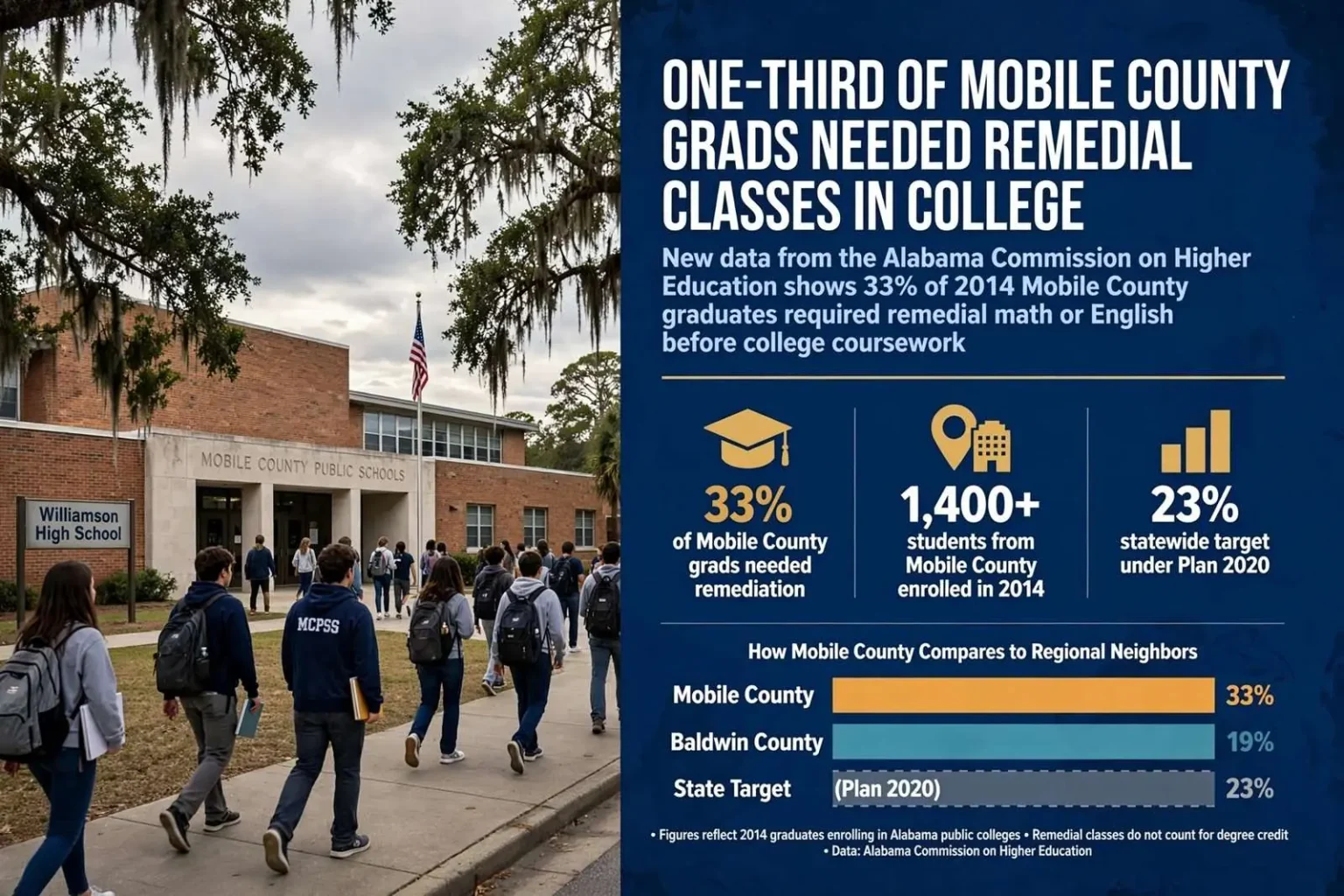
New data from the Alabama Commission on Higher Education shows that roughly a third of Mobile County high school graduates who enrolled in public colleges in 2014 needed remedial math or English classes before they could take courses that actually count toward a degree. The figures, released as part of the state’s annual review of college readiness, offer a statistical snapshot of the gap between high school graduation and true college preparation — a gap that costs students time, tuition money and momentum toward a credential.
More than 20,000 Alabama public high school graduates enrolled in two- or four-year public colleges in 2014, and more than 1,400 of them came from Mobile County Public Schools, the state’s largest school system. Of those students, about 33 percent required remedial coursework, a rate that held steady from the year before rather than improving. Remedial classes, sometimes called developmental education, do not carry credit toward a degree but are required before students can move into college-level work, which means every remedial course adds to the time and expense of earning a diploma.
Mobile County Superintendent Martha Peek said the unchanged rate is a concern, since the district’s goal is to see the number shrink year over year. The Alabama Department of Education’s Plan 2020 reform initiative has set a long-term statewide remediation target of 23 percent, a benchmark officials expect will take years to reach. Plan 2020, the state’s sweeping education reform blueprint, was built around raising standards, improving graduation rates and making sure a diploma signals genuine readiness for college or a career, and remediation numbers are one of the clearest measures of whether that promise is being kept.
“We’ve just got to fine-tune what we’re doing in education to find the basis for support,” Peek said. “Our college programs can only be as strong as our K-12 programs.”
The superintendent’s point cuts to the heart of the remediation problem. Community colleges and universities across Alabama design their entry-level courses assuming students arrive with certain skills; when a third of a district’s college-bound graduates need to relearn material first, the burden falls on families who pay tuition for non-credit classes and on institutions that must staff courses covering high school material.
Wide Variation From School to School
The data varied widely by individual high school, a pattern that complicates districtwide solutions. B.C. Rain High School improved significantly, dropping more than 16 percentage points to a 53.2 percent remediation rate among its college-bound graduates. The improvement at the Mobile school shows that year-over-year gains are possible, even at campuses where large shares of graduates historically arrived at college unprepared, and it gives administrators an internal example of what progress looks like.
On the other end, Williamson High School saw a 27-percentage-point increase, with 72 percent of its 43 college-enrolled graduates needing remedial coursework, the highest rate among the district’s 12 high schools. With a small college-enrolling class, each student’s outcome weighs heavily on the percentage, but the magnitude of the jump still signals a problem district leaders cannot ignore. Overall, five Mobile County high schools improved their remediation numbers while six saw them worsen, leaving the district essentially split between progress and backsliding.
How Mobile County Compares Across the Region
By comparison, Baldwin County reported a considerably lower remediation rate of about 19 percent, though Baldwin County school officials were not immediately available to discuss the numbers. The contrast between Alabama’s two neighboring coastal systems is stark: Baldwin’s rate already sits below the statewide Plan 2020 target, while Mobile County remains about ten points above it. The difference gives Mobile County administrators a regional benchmark to study, since factors such as course offerings, counseling ratios and the mix of students heading straight to college after graduation all influence remediation rates.
The comparison also matters because the two districts draw from similar communities along the Gulf Coast, with families in both counties sending graduates to the University of South Alabama, the University of Mobile, Spring Hill College and the campuses of the Alabama Community College System, including Coastal Alabama Community College and Bishop State Community College in Mobile. Students who arrive at those campuses needing remedial courses face a longer road: developmental classes consume financial aid eligibility time, can discourage students before they earn a single degree credit, and are among the strongest predictors of whether a first-year student returns for a second year.
Using the Data
Peek said district administrators use the annual remediation data to look for patterns within specific subjects and grade levels, and that improving outcomes will require identifying where the preparation breaks down. A school whose graduates struggle mainly in math, for example, points to a different instructional problem than one whose graduates need English remediation. By breaking the numbers down by campus and subject, the district can target teacher training, tutoring programs and curriculum adjustments where they are most needed rather than applying a uniform fix.
The remediation report is produced annually because the commission tracks each cohort of public high school graduates into the state’s public colleges, matching records to determine who needed developmental coursework in their first year. That longitudinal tracking makes the data unusually actionable for school districts — it follows actual students from specific campuses into actual college classrooms, rather than relying on exit exams or senior-year grades as proxies for readiness.
The Road to Plan 2020
Closing the gap between Mobile County’s 33 percent and the state’s 23 percent target will take sustained effort across multiple graduating classes. Education officials across Alabama have tied remediation rates to the adoption of college- and career-ready standards, earlier and more frequent assessments that flag struggling students before their senior year, and expanded dual-enrollment opportunities that let high schoolers experience college-level expectations while support is still close at hand.
For the more than 1,400 Mobile County graduates who enrolled in public colleges in 2014, the report’s findings arrive too late to change their first semester. But the data gives the district a clear assignment going forward: move the overall rate down year after year, close the gap between the district’s strongest and weakest campuses, and ensure that the diploma every Mobile County student earns reflects genuine preparation for the college classrooms waiting on the other side of graduation.
Why Remediation Rates Matter for the Coast
The stakes of the remediation problem extend well beyond report cards. Mobile County’s economy increasingly runs on jobs that require education after high school, from the healthcare systems anchored in Mobile to the shipbuilding, aerospace and port-related industries that line the Gulf Coast. Employers in those fields consistently report difficulty filling positions that demand strong math and communication skills, and students who stall out in developmental coursework often leave college without the credential that would qualify them for those jobs, carrying debt but no degree.
Community college leaders have experimented in recent years with ways to move students through developmental education faster, including compression models that let students remediate while simultaneously taking college-level courses, and placement reviews that look at high school transcripts rather than a single test score. How quickly those approaches spread across the colleges that serve Mobile County graduates could determine whether the district’s remediation numbers fall faster in coming years.
For now, the 2014 data stands as both a warning and a measuring stick. The steady 33 percent rate tells Mobile County that the status quo is not producing improvement, while the school-level gains and declines show that individual campuses can move the needle in either direction within a single year. Peek’s formula — that college programs can only be as strong as the K-12 programs feeding them — frames the challenge plainly for a district that educates more students than any other system in Alabama, and whose graduates will fill the classrooms, campuses and workplaces of the Gulf Coast for decades to come.
A Blueprint for Improvement
Education researchers who study developmental education generally point to a handful of interventions with proven results: identifying at-risk students as early as middle school, strengthening algebra instruction long before senior year, and building senior-year math and English courses that keep college-bound students practicing the skills they will need on campus. Mobile County administrators reviewing the new data will be weighing which of those levers to pull first, campus by campus, as they work toward the district’s goal of a declining rate every year.
Parents and students, meanwhile, can use the same report to inform their choices. Families comparing high schools now have access to campus-level remediation figures that show, in plain numbers, how well each school prepares its college-bound graduates. That transparency is part of what reformers intended when the state committed to tracking graduates into college: when preparation gaps are visible, schools, families and colleges can all push on the same problem at the same time, rather than discovering the shortfall only after tuition has been paid for a remedial class that earns no credit.