Mobile County Schools Set New Goal: 90 Percent Graduation Rate by 2017
After reaching an 82 percent graduation rate years ahead of schedule, Mobile County school officials set an even more ambitious 2017 target.
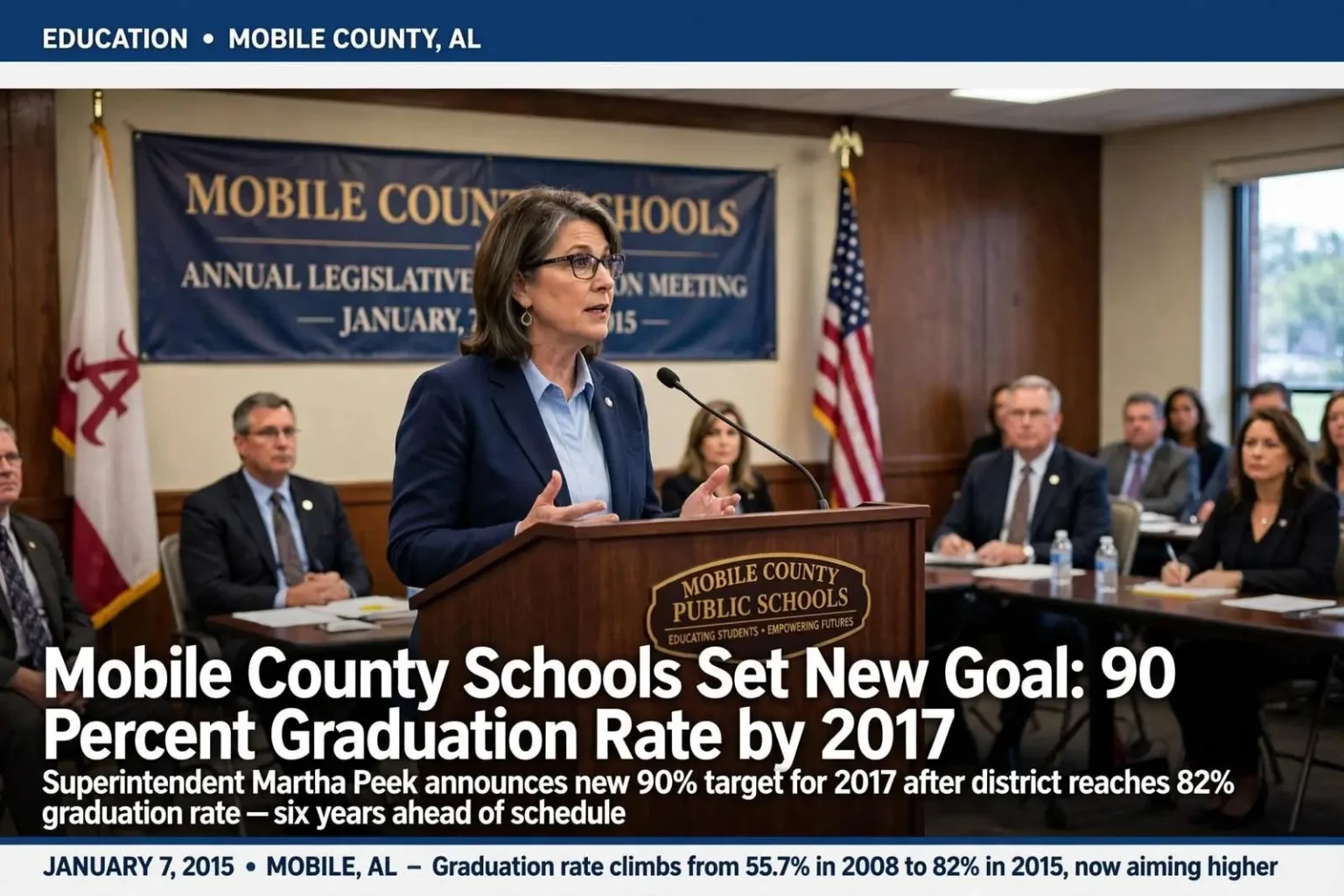
Mobile County school officials announced a new, more ambitious graduation rate goal after the district blew past its previous target years ahead of schedule. Superintendent Martha Peek revealed the updated benchmark, a 90 percent graduation rate by 2017, during the school system’s annual legislative delegation meeting in early January 2015. The setting was no accident: the delegation meeting brings county legislators and school leaders together each year, and Peek used the moment to tell the officials who help shape education policy that Alabama’s largest district intended to keep raising its own bar.
The announcement came on the heels of striking progress. Mobile County’s four-year, on-time graduation rate reached 82 percent, meaning 82 percent of students who entered high school as freshmen in 2010 graduated on schedule the previous spring. That figure doesn’t even include an additional 6 percent of students who either finished in December 2014 or remained enrolled and working toward a diploma. Together, the numbers mean that nearly nine of every ten students in the class were either graduating on time or still on a path to a diploma, a level of persistence that would have seemed out of reach only a few years earlier.
The graduation rate itself is calculated on a federal formula that tracks a single cohort of students from ninth grade through their expected graduation, counting only those who earn a standard diploma on time. That methodology, adopted uniformly across states, removed much of the ambiguity that once let districts define success differently, and it makes Mobile County’s climb all the more credible, since the 82 percent figure measures exactly the students who started together in 2010.
The district’s original goal, set years earlier, had been to reach an 80 percent graduation rate by 2020. Hitting 82 percent put Mobile County six years ahead of that original timeline, prompting the decision to raise the bar significantly. Goals that districts set a decade out often drift into the background of daily operations, but Mobile County’s leadership chose to treat the early achievement as a mandate for more work rather than a moment for celebration.
The new 90 percent target is also considerably more aggressive than the Alabama State Department of Education’s statewide goal under its Plan 2020 initiative, which aims for a 90 percent graduation rate across Alabama by 2020, three years later than Mobile County’s self-imposed deadline. The statewide graduation rate stood at 86 percent at the time. By setting a faster deadline than the state’s own plan, the district positioned itself to pull the statewide average upward rather than simply ride it, a meaningful role given the district’s size.
A Remarkable Turnaround
The turnaround in Mobile County has been years in the making. In 2008, the district’s graduation rate stood at just 55.7 percent, among the lowest in the state. A rate in the mid-fifties meant that nearly half the students who started ninth grade in Mobile County’s public high schools were not earning a diploma with their classmates, a figure that carried consequences for everything from the local workforce to the area’s competitiveness for economic development projects that scrutinize school systems closely.
Community organizations, including the Mobile Area Education Foundation, partnered with the school system starting in 2006 on a concerted improvement effort backed by a $200,000 grant from the U.S. Department of Labor, issued through the mayor’s office. The Mobile Area Education Foundation had built its reputation on bridging the gap between the school system and the community, and the graduation campaign it helped launch reframed dropout prevention as something the whole city owned rather than a problem the schools faced alone.
The rate climbed steadily in the years that followed: 64 percent in 2011, 70 percent in 2012, and 75 percent in 2013, before reaching 82 percent by early 2015. The trajectory shows a district gaining roughly six to eight percentage points a year, a pace that education researchers consider exceptional for a district of any size. Each year’s gains compounded the previous year’s, as graduation-focused culture took hold in individual high schools and intervention systems matured.
Education advocates in Mobile County have pointed to targeted interventions, dropout-prevention programs and closer tracking of at-risk students as key drivers behind the rate’s steady climb since 2008. The tracking piece matters more than outsiders might expect: districts that follow student-by-student credit accumulation can identify a freshman falling behind months before the deficit becomes irreversible, then connect that student with tutoring, counseling or credit recovery before disengagement sets in. Mobile County’s high schools built those habits over years of deliberate practice.
Behind the districtwide number are the individual high schools, where the turnaround looked different depending on the campus. Suburban schools in the county system pushed their rates into the upper ranges years ago, while the largest gains in percentage terms came at campuses in Mobile’s older neighborhoods, where poverty and mobility had long dragged rates down. The district’s strategy of concentrating dropout-prevention resources where they were needed most helped close those gaps rather than simply allowing strong schools to carry the average.
Why the District’s Numbers Matter Statewide
As the largest school district in Alabama with roughly 59,000 students, Mobile County accounts for about 10 percent of all high school graduates statewide, giving its graduation rate outsized influence on Alabama’s overall education outcomes. When Mobile County’s rate moves up or down, the statewide number moves with it, which means the district’s gains since 2008 have been quietly improving Alabama’s education profile in reports that reach employers and site-selection consultants far beyond the state’s borders.
Business leaders in Mobile had reasons of their own to care about the numbers. The region’s economy had diversified dramatically over the preceding decade, with aerospace, shipbuilding and manufacturing employers bringing jobs that require technical training, credentials and, at a minimum, a high school diploma. A school system graduating barely half its students was a real obstacle in recruiting conversations, and the improvement to 82 percent gave economic developers a far better story to tell companies considering the area.
The size of the district also makes the achievement logistically harder than it might appear elsewhere. Mobile County’s system stretches from inner-city Mobile neighborhoods across suburban communities to rural schools near the Mississippi line and the bayshore, encompassing stark differences in family income, school age buildings and student needs. Raising graduation rates across that entire range requires strategies that work in environments as different as a downtown high school and a small rural campus, not a single program stamped onto every building.
Superintendent Peek’s announcement framed the new 90 percent goal as both a challenge and a statement of confidence following years of measurable gains built on sustained community and school system collaboration. Presenting the goal to the legislative delegation carried its own significance. Graduation rates depend partly on policy choices made in Montgomery, from graduation requirements to funding formulas, and district leaders wanted the county’s legislators invested in the target they had just set for themselves.
The legislative delegation meeting itself is an annual ritual in Alabama county politics, a chance for local governments, school boards and agencies to lay out priorities before the session convenes in Montgomery. For the school system, it is the one occasion each year when the district’s leadership and the county’s House and Senate members sit in the same room focused on education, which is why superintendents traditionally save their biggest announcements for it. Peek’s decision to unveil the 90 percent goal there placed Mobile County’s legislators on notice that the district expected to keep needing their support.
The Hard Miles Ahead
The last stretch of any graduation rate campaign is widely understood to be the hardest. The students still leaving school without a diploma as a rate approaches 90 percent are often those facing the deepest challenges, including students who have moved repeatedly, students balancing school with jobs that support their families, and students who have fallen far enough behind on credits that conventional schedules cannot get them to graduation. Reaching them typically requires flexible scheduling, night classes, credit recovery options and intensive individual attention, all of which carry real costs.
Whether the district can maintain that pace and reach 90 percent within two years remained an open question for local school leaders heading into the rest of the school year. Two years is a short window to add eight percentage points, though the district’s own history argues against pessimism. A system that climbed from 55.7 percent to 82 percent in seven years has already defied the conventional expectations for how fast a large district can change.
What is not in dispute is the distance covered. In seven years, Mobile County transformed itself from one of Alabama’s lowest-performing large districts on graduation into a system outpacing the state’s own goals, and it did so with community partners at the table from the start. The 90 percent by 2017 target now stands as the next measure of that partnership, and the students entering Mobile County’s high schools will be the ones who determine whether the district reaches it.