Country Star Headlines Tim James Fundraiser as Charter Schools Enter the Governor’s Race
Republican gubernatorial candidate Tim James drew country star John Rich to a Montgomery fundraiser, while his campaign staked out a charter school position built on a Mobile elementary school's success.
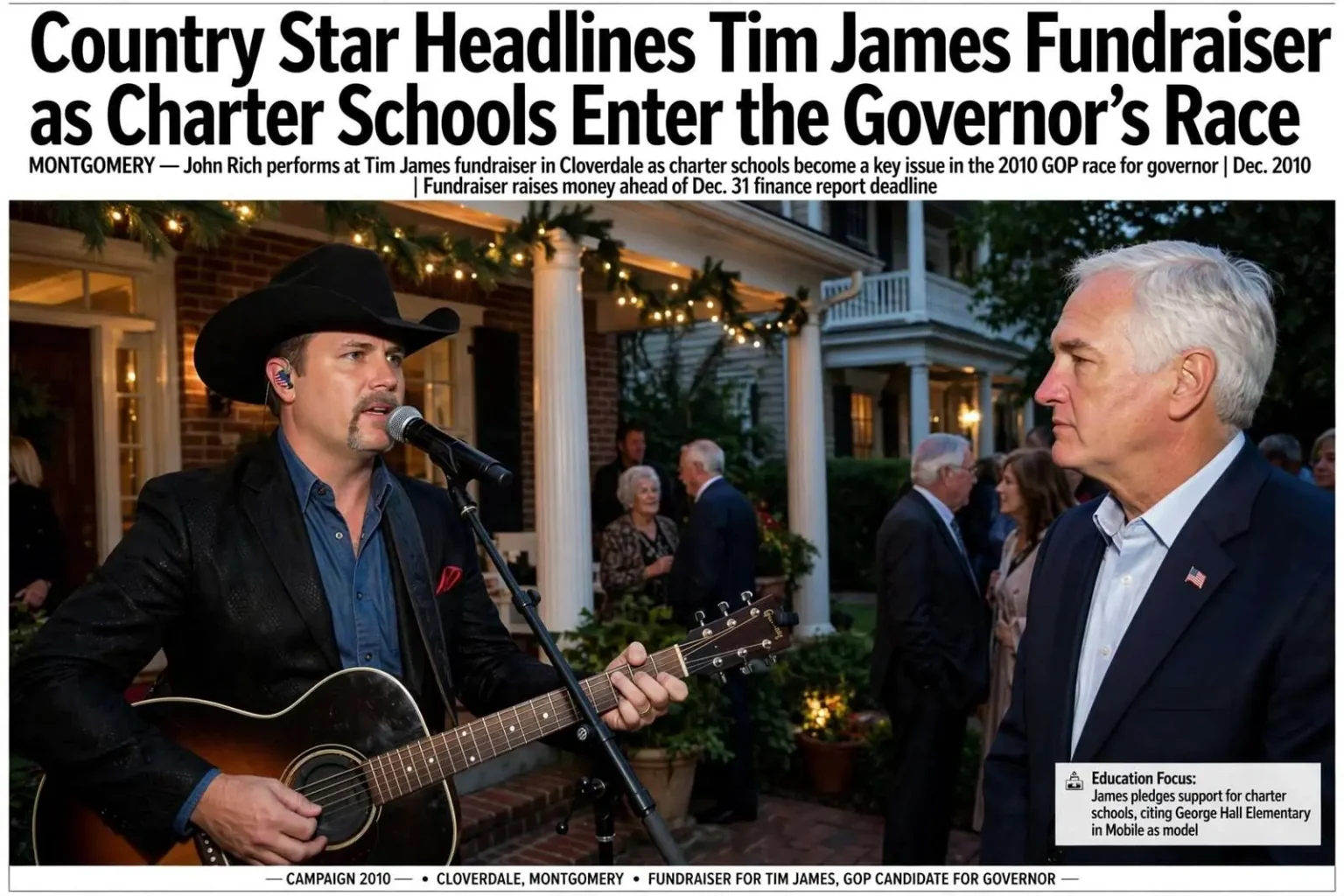
MONTGOMERY — Republican candidate for governor Tim James collected a night of country music and a room full of paying supporters this week, turning a private home in Montgomery’s Cloverdale neighborhood into one of the more conspicuous fundraising stops of the young 2010 campaign.
The headliner was John Rich, half of the Nashville duo Big & Rich and a solo artist, songwriter and producer in his own right. Rich performed Tuesday evening at the home of Tami and Stinson Slawson, working through Johnny Cash’s “I Walk the Line,” his own hits “Save a Horse (Ride a Cowboy)” and “Lost in this Moment,” and closing with “Rudolph the Red-Nosed Reindeer” for the children who gathered around him, according to a published account of the event.
Admission ran $125 a person. More than 100 members of the host committee paid $500 apiece. Among the guests were the candidate’s parents, former Gov. Fob James and his wife, Bobbie, and former Alabama Supreme Court Chief Justice Perry Hooper.
Cloverdale, one of Montgomery’s oldest garden neighborhoods, has long been the setting for the capital city’s political entertaining, and a December fundraiser there carries a double significance: the money it collects and the Dec. 31 deadline that determines which year-end finance reports will show momentum. A crowd of host-committee donors paying five times the general admission — with a former governor and a former chief justice in the room — was designed to be reported.
An out-of-state endorsement
Rich, who is based in Nashville, described the appearance as his first out-of-state effort on behalf of a campaign with no direct bearing on him. He said he had simply connected with James and believed the candidate was the kind of leader the country needed in every state.
Celebrity muscle is a familiar feature of Alabama gubernatorial campaigns, where name recognition is expensive and television time is the single largest line item in most budgets. A recognizable face on a host committee sells tickets, generates coverage in local media markets and, just as important, signals to donors that a campaign has momentum.
With party primaries set for June 1 and a Dec. 31 deadline approaching for contributions to appear in annual campaign finance reports, every candidate in a crowded Republican field was hunting for exactly that kind of signal.
In a primary with no incumbent, the money race and the attention race are the same race. Television markets in Birmingham, Mobile, Huntsville and Montgomery reach the whole state, and airtime is bought by the quarter-hour; a candidate who can generate free coverage — through a country star, a famous family name or a headline-grabbing event — stretches every dollar he raises. The Rich appearance delivered all three at once: a music story, a James story and a fundraising story that would surface again when the year-end reports were filed in January.
James follows a familiar path
Tim James was running on a name Alabama voters have known for decades. His father won the governorship twice, first in 1978 in a long-shot campaign built on grassroots organizing rather than establishment backing.
Fob James’s political career traced one of the more unusual arcs in modern Alabama history: a football star at Auburn, a successful businessman, a Democratic governor in the late 1970s, a Republican conversion, and a second stint in the governor’s office in the 1990s — four years as a Democrat, then reelected as a Republican. His son’s campaign inherited both the name recognition and the conservative identity that came with it, along with the family’s history of campaigns that confounded the establishment.
The younger James, a businessman, was competing in a Republican primary that also included former two-year college chancellor Bradley Byrne of Baldwin County, former Chief Justice Roy Moore, state Treasurer Kay Ivey, former state economic development director Bill Johnson and state Rep. Robert Bentley of Tuscaloosa.
The field mapped the party’s factions onto a single ballot. Byrne represented the reformist, business-and-education wing, carrying his two-year college cleanup record into the race. Moore brought the strongest following among religious conservatives and a statewide name built during the Ten Commandments monument fight. Ivey, the only statewide officeholder in the field besides Moore, offered treasury experience and establishment steadiness. Johnson ran as an outsider with Washington credentials, and Bentley, a physician and legislator, would stake his candidacy on a promise he would later make famous: not to raise taxes. James positioned himself as the conservative businessman in the family tradition — anti-establishment, plainspoken, and unconstrained by support from the party’s institutional leadership.
The primary’s crowded dynamics meant the race would likely be decided by pluralities and coalition-building rather than a majority, with a runoff looming for the two top finishers. That arithmetic shaped every early move: a candidate needed a loyal base, a signature issue and enough money to stay on television long enough for the base to find him.
Charter schools, and a Mobile example
The James campaign also moved this week to sharpen its position on charter schools, an issue that was beginning to divide the field in unexpected ways. Some observers had suggested the leading Republicans were cool to charters while Democratic congressman Artur Davis, the front-runner for his party’s nomination, had embraced them — an inversion of the usual partisan script.
James’s campaign pushed back, saying he was on record favoring charter schools and supporting a change in Alabama law to allow them to be created. At the time, Alabama’s statutes made no provision for charter schools, and legislation to authorize them was expected to surface again in the session convening in January.
The inversion the observers noted was genuine. Charter school advocacy in most states ran through urban Democrats and civil-rights figures frustrated with failing district schools, while rural and suburban Republicans — and teachers’ organizations with leverage in both parties — tended to resist. Alabama fit that pattern loosely: the Alabama Education Association’s influence ran deep in the Legislature, and no charter bill had survived it. Davis, a Birmingham congressman courting a Republican-leaning general electorate, had broken with his party’s base on the issue, and a Republican primary field that could not match him risked ceding an education-reform argument to a Democrat.
To make the case, the campaign reached for a South Alabama example.
“George Hall Elementary School in one of Mobile’s most disadvantaged neighborhoods is an excellent example of how the charter school model can succeed,” James said. He put the share of George Hall students scoring at or above grade level as high as 95 percent, and argued the state needed to “do all we can to empower principals and teachers to replicate the George Hall School success.”
The reference carried weight in Mobile. George Hall, a Mobile County public school serving a low-income neighborhood, had become a widely cited turnaround story, held up by educators and politicians alike as evidence that a school’s fortunes are not fixed by its ZIP code. That candidates in both parties were now claiming its lesson said something about how far the school’s reputation had traveled.
What George Hall actually demonstrated — and what the charter debate around it blurred — was a campus transformed by an empowered principal, a focused instructional model and measurable accountability, all within the existing public system. Advocates cited it to argue that Alabama’s problem was rigid rules rather than incapable schools; skeptics answered that if one principal could produce those results without a charter, every school could, and the answer was leadership and support rather than a new category of institution. The example worked precisely because both sides could claim it.
What it meant on the coast
For voters along the Gulf Coast, the fundraiser mattered less for the music than for what it revealed about the shape of the race. The Republican primary was already crowded, the money was moving early, and the candidates were testing which issues would carry them into the summer.
Education funding and school governance — questions with direct consequences for the Mobile County Public School System, the largest district in Alabama — were plainly among them.
The timing of the charter argument, weeks before a legislative session and months before the primary, showed how a gubernatorial campaign in Alabama operates as a shadow legislature. Positions staked in December become the bills introduced in January, the ads run in May and the policy fights of the following term. A candidate’s December embrace of charter authorization — or his silence on it — told legislators and lobbyists which direction the next governor’s office would lean before a single vote was cast.
For Mobile County specifically, the stakes ran through the district’s classrooms. The county system educates more students than any other in the state, spanning affluent suburbs, working-class neighborhoods inside Mobile and rural communities across the county’s southern end. Whatever restructured accountability, charter authorization or funding formula emerged from the 2010 campaign would fall first and hardest on a district that size — which is why a candidate standing in Montgomery invoking a Mobile school’s name was making an argument aimed directly at Alabama’s largest education constituency.
The fundraiser itself would be remembered, if at all, for the snapshot it left behind: a country star with a guitar in a Cloverdale living room, a former governor in the audience, and a second-generation candidate whose campaign had just demonstrated the two assets that would define his run — a famous name and a knack for turning a December crowd into a January headline. Whether those assets could carry him past a field of better-funded rivals and a primary electorate still finding its candidate would be answered the following June.