B.C. Rain’s Turnaround: How a Struggling Mobile High School Rebuilt Its Culture
B.C. Rain High School's graduation rate jumped from 49 to 85 percent in three years, driven by an aerospace academy and a schoolwide culture shift.
Four years after Mobile County school officials targeted B.C. Rain High School for an ambitious turnaround, the Dauphin Island Parkway school has posted graduation gains that outpaced even the district’s own five-year timeline.
In 2011, the school system began using an $8 million federal grant to overhaul B.C. Rain and its feeder school, Pillans Middle, with a goal of transforming B.C. Rain into a model campus within five years. The graduation numbers tell the story of how quickly that goal arrived: from 49 percent in 2011, the rate climbed to 71 percent in 2012, then 77 percent for the Class of 2013, before reaching 85 percent for the Class of 2014.
That puts B.C. Rain in a tie for the third-highest graduation rate among Mobile County high schools, trailing only Baker High and Citronelle High, and just ahead of Murphy High School.
A campus with deep roots on the parkway
B.C. Rain High School sits along Dauphin Island Parkway in southern Mobile, serving one of the more geographically distinct attendance zones in the county. The route to the school runs past some of the older neighborhoods in the city, communities that look toward Mobile Bay and that have sent generations of students through the same hallways their parents and grandparents once walked. For years, though, the school struggled with the challenges that confront many urban campuses: family mobility, poverty, and a graduation rate that lingered near the bottom of the district.
When Mobile County Public School System leaders decided in 2011 to make B.C. Rain a showcase for change, they did so with the backing of an $8 million federal grant, an investment of a scale few individual schools in the district had ever received. The money came with an explicit deadline: five years to transform the campus into a model for the rest of the system. Pillans Middle School, which feeds most of its students directly to B.C. Rain, was included in the overhaul so that improvements could follow students from one building to the next rather than reset when they reached high school.
The district bet that concentrated resources, a redesigned instructional approach and new programs tied to the local economy could change outcomes that incremental effort had not. Four years in, the graduation rate had nearly doubled.
Where the money went
Much of the turnaround traces back to how the federal grant money was spent. Rather than a single fix, the funding supported early-intervention programs aimed at students identified as being at risk of dropping out, while also helping launch one of the district’s first career-focused signature academies: an Aviation and Aerospace program based at the school.
The intervention strategy reflected a lesson educators have emphasized for years: students rarely drop out in their senior year. They disengage years earlier, falling behind in credits and attendance in the ninth and tenth grades, often quietly. By identifying at-risk students early and wrapping them in additional support, the school aimed to keep small problems from becoming permanent ones.
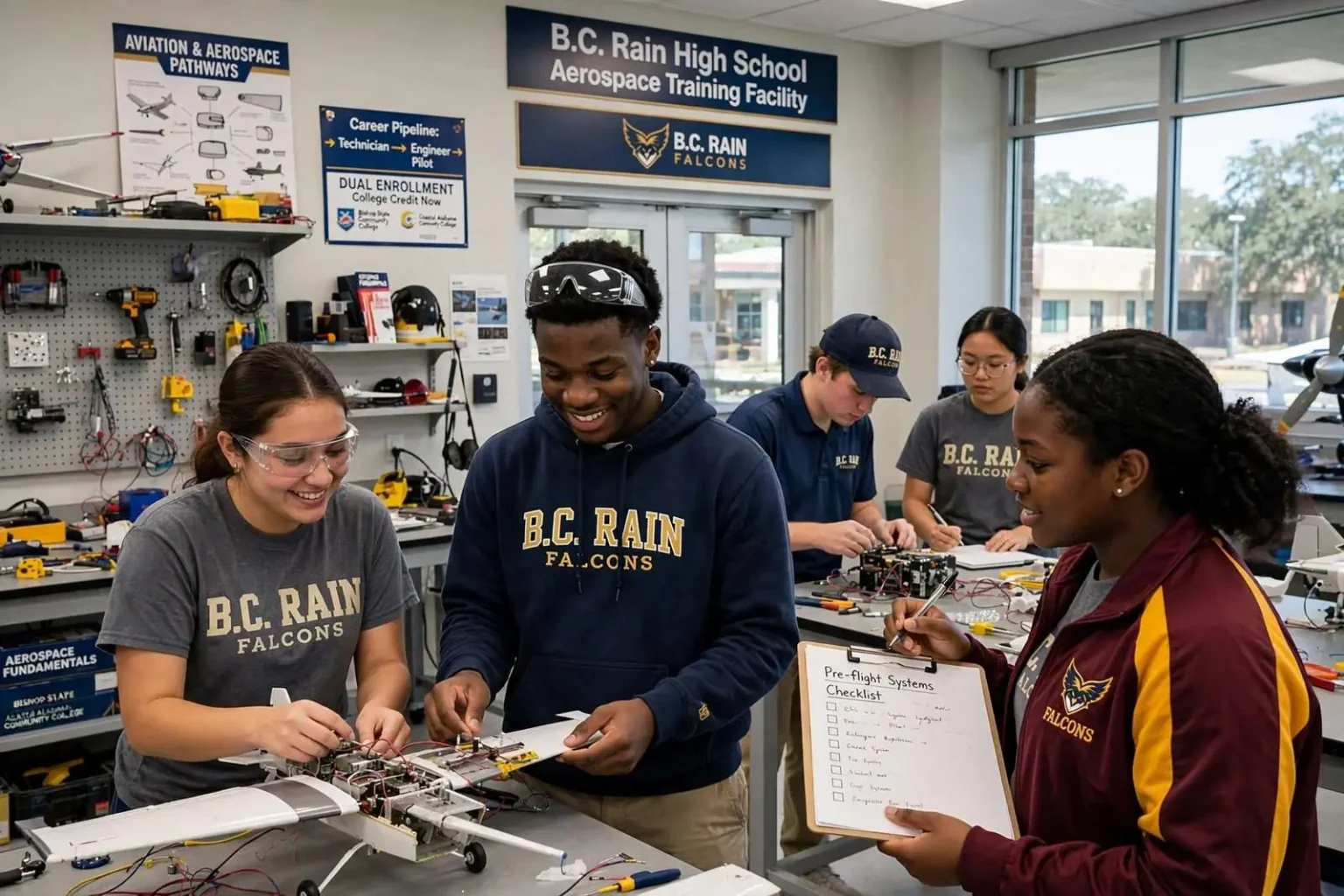
The signature academy, meanwhile, gave students a reason to connect their coursework to a career. Aviation and aerospace carry particular resonance in Mobile, where the region’s aerospace sector has grown steadily and where Mobile Aeroplex at Brookley and the broader Gulf Coast aviation corridor have made the industry one of the most promising employment paths in the region. A student at B.C. Rain could now see a direct line from a high school classroom to an aircraft hangar.
The academy now operates out of a state-of-the-art Aerospace Training Facility that opened on campus in 2014, a roughly $1.9 million project funded largely through Qualified School Construction Bonds. The financing mechanism, a federal program that helped school districts borrow for construction at sharply reduced borrowing costs, allowed the district to build a facility it could not otherwise have afforded in the middle of a turnaround effort.
The building itself signaled something to students and to the surrounding neighborhood: that the district was investing in the campus for the long term, not merely managing its decline. Students now train in classrooms and lab space designed around the equipment and standards they would encounter in actual aviation workplaces.
College credit before a diploma
The school system partnered with two community colleges to build a dual enrollment option at the facility, allowing students to earn college credit and technical credentials before they graduate high school. For many families in the B.C. Rain zone, the arrangement removes one of the most stubborn barriers to higher education: cost and uncertainty. A student who finishes high school with both a diploma and a semester or more of college credit, or with an industry credential in hand, starts adulthood with momentum.
The academy now enrolls 110 students, more than half of whom are on a college-bound track, with the rest pursuing career-focused coursework. That mix reflects the range of jobs the aerospace industry actually creates, from engineering degree paths to hands-on technician work, and it allows students headed in very different directions to train side by side in the same building.
Dual enrollment has become one of the fastest-growing strategies across Alabama in recent years, with community colleges partnering with high schools to deliver technical training that individual school systems could not easily staff on their own. B.C. Rain’s academy put the school at the front of that movement within Mobile County, and it gave the turnaround something concrete to show families who had heard promises of reform before.
A culture shift behind the numbers
But school leaders say the academy is only part of what turned the school around. Administrators point to a broader culture shift among staff and students, built around stronger relationships between teachers and students, consistent expectations for behavior and attendance, and a sense of shared ownership in the school’s recovery. Teachers who might once have viewed the campus as a stopping point on the way to other assignments began to see themselves as stewards of a rebuilding project.
That kind of cultural work is difficult to measure, but it shows up in the numbers that matter. Graduation rates respond to thousands of small moments: a counselor catching a credit deficiency before it becomes fatal, a teacher calling home when attendance slips, a coach convincing a discouraged sophomore to stay enrolled. The grant gave the school the tools for those interventions; the staff delivered them.
The contrast between where the school started and where it landed is stark. In 2011, only 49 of every 100 students at B.C. Rain graduated on time. For the Class of 2014, 85 did. A jump of that size on a single campus in three graduating classes is rare anywhere, and in a district as large as Mobile County’s it made B.C. Rain a case study that administrators in other systems began to watch closely.
What it means for the parkway corridor
For the neighborhoods along Dauphin Island Parkway, the numbers carry significance that goes beyond rankings. A high school that graduates most of its students changes the trajectory of a community: more young people stay attached to school, more families see the local campus as an asset rather than a liability, and more students walk across a stage with credentials that mean something to employers along the Gulf Coast.
The aviation academy ties that story directly to the regional economy. South Alabama’s aerospace employers, from maintenance and repair operations to the large-scale manufacturing taking shape at Brookley, have consistently described a need for a pipeline of trained technicians. A public high school producing graduates with actual aviation training, on the city’s south side, is precisely the kind of pipeline those employers have asked for, and it positions B.C. Rain graduates to compete for jobs without leaving their home communities.
The ripple effects reach Pillans Middle as well. Because the grant treated the feeder pattern as a single unit, students arriving at B.C. Rain now come from a middle school that has been part of the same reform effort, giving teachers a more consistent foundation to build on from the ninth grade forward.
Lessons for other turnaround attempts
There are lessons in the structure of the turnaround itself. District officials did not simply add tutors or adjust the schedule. They combined money, a deadline, a new program tied to local industry and a physical facility, and they treated the feeder middle school as part of the same problem rather than a separate one. That approach, intervening early while giving students a visible destination, is what pushed B.C. Rain past schools that no one had counted among the county’s strugglers.
The placement in the district rankings underscores the point. B.C. Rain now stands tied for third in graduation rate among Mobile County high schools, ahead of Murphy, one of the system’s most storied campuses, and behind only Baker and Citronelle. For a school that posted 49 percent just four years earlier, the climb reshapes expectations for what a transformation school can achieve.
Challenges remain, as they do at every urban high school. Sustaining an 85 percent rate year after year requires the interventions to keep working as each new freshman class arrives with its own needs. The aerospace facility must keep its equipment and curriculum current with an industry that changes quickly, and the partnership with the community colleges must keep adapting to what employers actually hire for.
Still, the five-year goal set in 2011 called for a model campus. Four years in, with an 85 percent graduation rate, a $1.9 million aerospace training facility, and a signature academy sending students toward both college and careers, B.C. Rain had arrived early. What began as a federal grant with a deadline has produced something harder to fund: a school community that expects to succeed.