Mobile County Schools Credit Three Programs for Rising Graduation Rates
Mobile County school officials point to credit recovery, evening classes and a mentoring program as key drivers behind improved graduation rates.
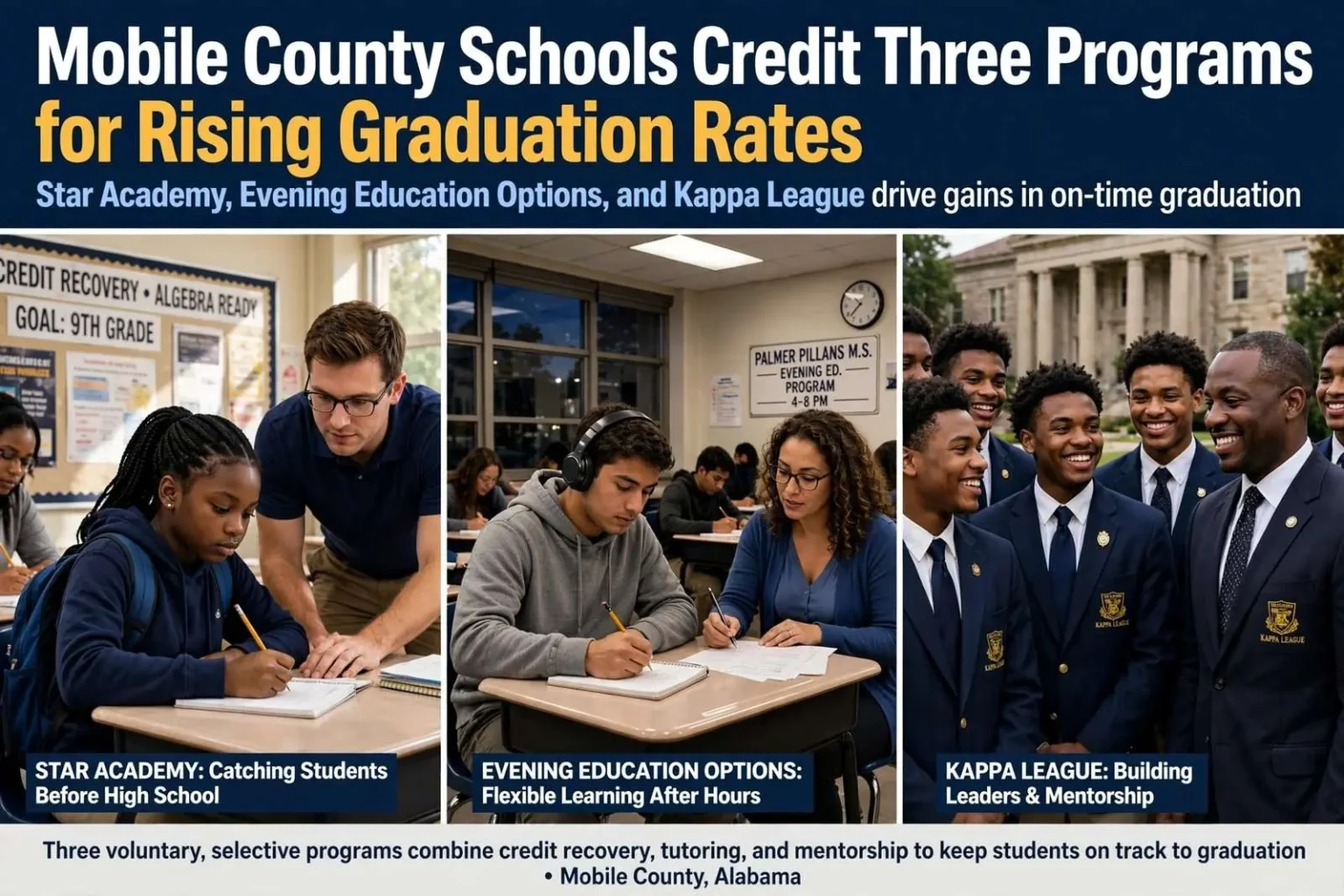
Mobile County school officials say a handful of targeted programs are making a measurable difference in helping students graduate on time, part of a broader push that has included after-hours credit recovery sessions, expanded tutoring and counseling, and a wider array of rigorous coursework such as Advanced Placement classes.
The district’s approach pairs two different strategies that education researchers have long identified as essential: catching students before they fall too far behind, and reeling back those who already have. With tens of thousands of students spread across schools from downtown Mobile to the county’s rural stretches, the system’s dropout challenge is not a single problem but many, and the programs officials point to are built for specific points where students slip.
Star Academy Catches Students Before High School
One of the initiatives, the Mobile County school system’s Star Academy, is designed for eighth-graders who have fallen at least a year behind and, based on age, should already be in high school. Admission requires an application, and students who enroll must complete a demanding curriculum.
Those who succeed can finish all of their eighth-grade credits and most of their ninth-grade credits within a single school year, effectively closing the gap that put them at risk of falling further behind. The academy’s model rests on a simple arithmetic problem: a student who enters ninth grade at 15 or 16 with no credits already carries a schedule nearly impossible to recover within the normal four-year window, and every month of distance makes quitting more likely.
The application requirement is deliberate rather than bureaucratic. Students who choose the academy, with their families, arrive having made a commitment, and the demanding pace of the program is presented as an opportunity rather than a punishment. Educators involved with the model say that element of choice separates Star Academy from simple grade retention, which research has shown tends to disengage older students further.
The stakes could hardly be higher for the students involved. Eighth-grade failure is among the strongest statistical predictors of dropping out, and a student who reaches high school over-age and credit-deficient typically faces a choice between a fifth or sixth year of school and leaving altogether. The academy’s one-year credit recovery window is designed to eliminate that choice by compressing the catch-up into a single, intensive year.
For the district, the program also carries a fiscal logic. Dropouts cost school systems per-pupil funding, and communities pay far larger costs over time in reduced earnings and higher social service needs. Intervening in the eighth-grade year, before a student has formally entered high school with a transcript already in deficit, targets the moment when prevention is still possible.
Evening Education Options Reaches Older Students
A second program, the Mobile Area Education Foundation’s Evening Education Options Program, gives high school students who have fallen behind a chance to attend classes from 4 to 8 p.m. on weeknights at Palmer Pillans Middle School. Students work at their own pace with tutors and counselors, and many end up graduating alongside their original classmates.
Most participants are 17 or older and roughly two years’ worth of credits behind, a profile that describes students who have often cycled through jobs, family responsibilities or repeated failures in the standard school day. The evening schedule exists precisely for them: students who work daytime jobs, care for younger siblings, or simply found the traditional school day unworkable long before anyone noticed they were slipping away.
The Mobile County school system contributes more than $638,000 annually to fund the program, which launched in 2009 and has drawn national recognition, including praise from America’s Promise Alliance, which cited it as a factor in Mobile being selected as a site for a national Grad Nation Community Summit. The Grad Nation campaign has made raising on-time graduation rates a national priority, and Mobile’s selection as a summit site placed the district among the communities whose practices other systems were invited to study.
Program leaders say the evening format helps re-energize students who had disengaged from traditional high school, combining academic instruction with life-skills development, including career planning. The smaller scale changes the dynamic of the classroom: instead of a student lost among hundreds in a large high school, the evening program offers an environment where attendance is noticed, progress is tracked weekly and relationships form between students and the adults teaching them.
Officials say the personalized attention students receive in the evening program often makes the difference between dropping out and finishing a diploma. Counselors work with students not only on coursework but on the practical obstacles, transportation, work schedules, childcare and family strain, that derailed them in the first place, treating those barriers as part of the educational problem rather than excuses for it.
The role of the Mobile Area Education Foundation as operator illustrates the partnership structure the district has built around graduation. The foundation, Mobile’s local education fund, connects the school system to community donors and national organizations, allowing programs like the evening school to run with flexibility a district bureaucracy alone could not easily provide, while the system supplies funding and students.
Graduations through the evening program carry a weight the ceremony’s schedule understates. When students who were once two years behind their classmates walk across the stage on time, or only slightly late, they close a gap that statistics said would not close, and the district counts each of those diplomas among the measurable returns on its $638,000 annual investment.
The Kappa League Builds Leaders
The third initiative highlighted by school officials is the Mobile Kappa League, a leadership training program for male high school students sponsored by the Mobile chapter of Kappa Alpha Psi Fraternity. The league, which has about 80 members, requires students to apply, interview and maintain good grades to participate.
Advisors say a student’s attitude and commitment matter as much as academic standing, and that demand for spots regularly exceeds the number available. The selection process mirrors the fraternity’s own traditions of achievement, treating the young men not as at-risk cases but as future leaders being prepared for responsibility, a framing advisors credit with changing how the students see themselves.
Members volunteer regularly in the community and take part in college tours together, with many going on to earn scholarships. The college tours, which take students onto campuses they might never have visited otherwise, have become one of the program’s signature experiences, and advisors describe watching students revise their ambitions upward after walking through a university for the first time.
The league’s structure reflects its fraternity sponsor’s history. Kappa Alpha Psi, founded at Indiana University in 1911 by Black students shut out of the era’s white fraternities, built its mission around achievement in every field of human endeavor, and chapters across the country operate Guide Right youth programs of which the Kappa League is the centerpiece. The Mobile chapter’s version connects high school students to a network of professional men, many of them local graduates of the same schools the students attend now.
That mentorship pipeline matters for a demographic that district data, like national data, shows at elevated risk of disengagement. Male students who lack mentors, especially those from households without college experience, face steeper odds of both graduating and enrolling in postsecondary education, and the league attacks both risks at once through its requirements and its exposure.
A Philosophy of Meeting Students Where They Are
Taken together, officials say the three programs reflect a broader philosophy within the Mobile County school system: meeting students where they are, whether that means an accelerated curriculum, flexible scheduling, or mentorship, in order to keep them on track toward graduation.
The three initiatives occupy different points in a student’s trajectory. Star Academy intervenes at the transition into high school, the evening program rescues students who have already fallen years behind, and the Kappa League works to keep successful students on that success. No single program addresses the district’s graduation challenge, but the combination covers the range of ways students drift off track.
They also share a common design principle that distinguishes them from the standard school day. Each one is voluntary, selective and relationship-intensive, relying on applications, interviews, small cohorts and personal attention rather than broad mandates. Officials describe that pattern as a lesson learned from years of watching which interventions actually hold students: the ones that give students a reason to belong, not just a requirement to attend.
The district’s broader push, from credit recovery sessions after regular hours to expanded Advanced Placement offerings, frames graduation as a system-wide measure rather than a high school problem. Every grade level contributes to whether a student walks across the stage, and the programs officials highlight are the visible edges of an approach that treats every year, and every student, as worth the effort.