Mobile Mayor Stimpson Touts City’s Financial Turnaround After First Year
Mayor Sandy Stimpson says Mobile's finances swung from a $4.3 million deficit to a $15.4 million balance in his first year, though $250M in needs remain.
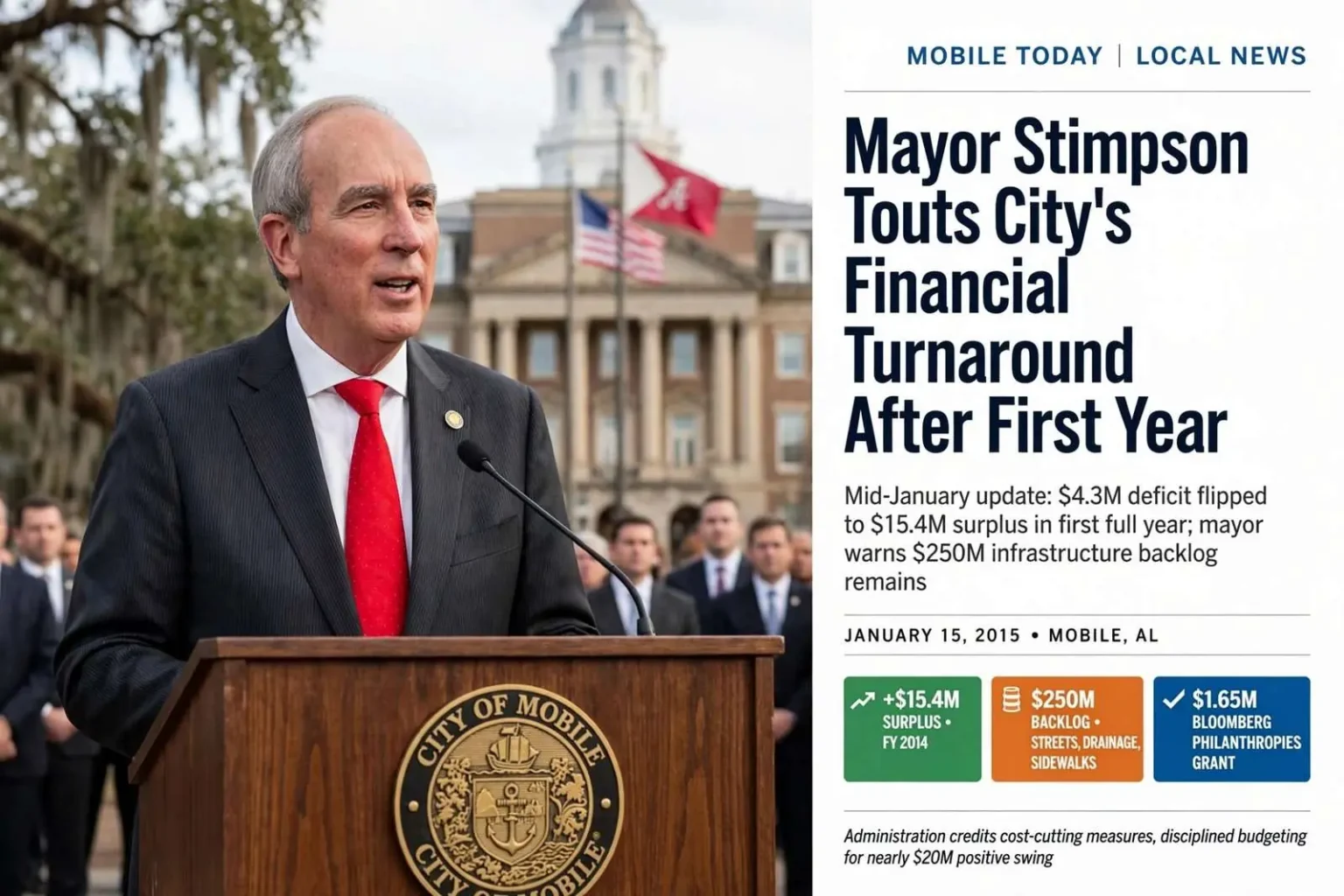
Mobile Mayor Sandy Stimpson used a mid-January update to lay out the city’s financial progress after his first full year in office, telling residents that the administration had turned a multimillion-dollar deficit into a healthy surplus while warning that major infrastructure needs remain unaddressed. The report marked the first complete fiscal cycle since Stimpson, a Mobile businessman who took office in November 2013, reshaped the city’s budget approach, and it gave the public its clearest look yet at how the new administration’s spending philosophy was showing up in the city’s bottom line.
According to figures shared by the mayor’s office, Mobile inherited a general fund deficit of roughly $4.3 million when Stimpson took office. By the end of September 2014, the close of the city’s fiscal year, that shortfall had been converted into a positive balance of about $15.4 million — a swing of nearly $20 million in a single budget cycle. The administration credited the turnaround to a broader, department-by-department effort to cut what it described as wasteful spending across city government rather than to any new revenue stream.
The general fund is the financial engine of day-to-day city government in Mobile. It pays for police and fire protection, sanitation, parks, street maintenance and the administrative functions residents interact with most often. When a general fund runs a deficit, the city is spending more than it takes in, drawing down reserves or patching gaps. Eliminating that gap is usually the first step toward funding anything beyond basic operations.
From deficit to surplus
Alabama municipalities operate on an October-to-September fiscal year, so the September 2014 balance represented the first full twelve months under the new administration. Stimpson’s team entered office promising a more businesslike approach to city finances, and the mid-January update was framed as evidence that the approach was working. Rather than raising fees or taxes to close the inherited deficit, city leaders said, the administration went through operating budgets line by line, looking for contracts, positions and practices that could be trimmed without cutting services.
Despite the improved bottom line, Stimpson cautioned residents against expecting new spending or handouts in the near term. A one-year surplus, he suggested, is a starting point rather than a windfall, and the city’s first obligation is to keep its recurring costs in line with its recurring revenue so the gains hold.
A $250 million backlog
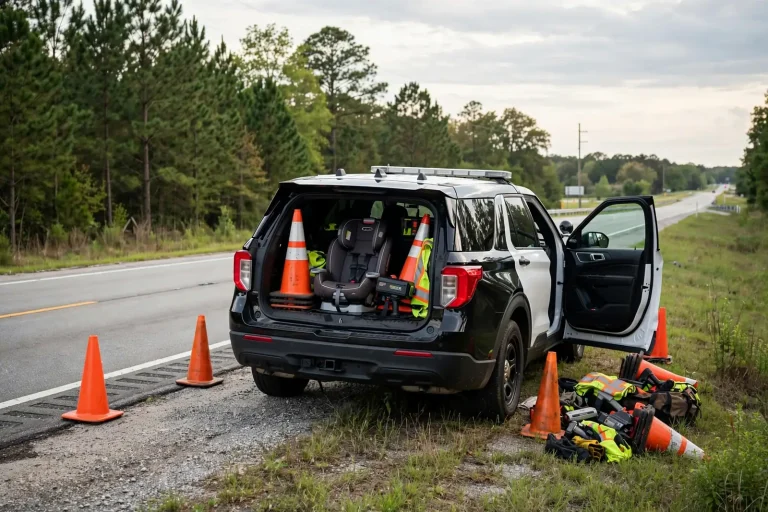
The mayor pointed instead to an estimated $250 million in capital needs that he said had gone unaddressed for years. The list includes deteriorating sidewalks, drainage problems and streets in need of repaving and restriping — the unglamorous backbone of a city that most residents notice only when it fails. Deferred maintenance of that scale does not accumulate overnight, and it cannot be cured in a single budget year, which is why Stimpson framed the surplus as capacity to begin catching up rather than a fund to be spent down quickly.
Drainage is a particularly sensitive subject along the Gulf Coast, where heavy rainfall is a fact of life and aging stormwater systems can turn routine downpours into street flooding. Sidewalk and street conditions, meanwhile, affect everything from pedestrian safety to neighborhood property values. City officials have acknowledged that the backlog spans every district, meaning prioritization decisions will inevitably involve hard conversations among council members about whose projects move first.
The mayor said the city intends to keep trimming unnecessary expenses so that savings can be redirected toward those long-deferred infrastructure projects. He also committed to directing resources toward paying city employees what he called equitable, prevailing wages and providing them with adequate equipment to do their jobs — an acknowledgment that years of tightening budgets had consequences inside the workforce as well as on the street.
Public works crews, police officers and firefighters depend on functioning vehicles and current equipment, and pay levels shape the city’s ability to recruit and retain experienced workers. By naming wages and equipment alongside infrastructure, Stimpson signaled that the administration sees the surplus as an opportunity to reinvest in the city’s own operations, not only in bricks and asphalt.
Outside validation from Bloomberg Philanthropies
Stimpson also highlighted a $1.65 million grant awarded to Mobile by Bloomberg Philanthropies, framing it as external validation of the administration’s approach. The foundation, established by former New York City mayor Michael Bloomberg, funds innovation in city government, public health and environmental initiatives across the country, and its grants are highly competitive. For a mid-sized Southern city, attracting that level of national philanthropic investment is unusual, and the mayor presented it as evidence that Mobile’s efforts were being noticed beyond city hall.
The grant, aimed at improving residents’ quality of life, showed, in Stimpson’s telling, that the city’s broader effort to transform Mobile was gaining traction. Grants of this kind typically require the city to dedicate staff time and match the funding with its own planning capacity, so the award carries obligations as well as opportunity. Administration officials have indicated the work funded through the grant is meant to complement — not replace — the city’s core investments in streets, drainage and public safety.
National recognition also has a practical value for a city trying to change its trajectory. Competitive awards can help recruitment of employers and talent, and they tend to open doors to further philanthropic and federal funding opportunities. Stimpson’s administration has consistently argued that Mobile’s revival depends as much on perception as on any single project, and the Bloomberg award fit neatly into that narrative.
Balancing discipline against the backlog
The financial update comes as Mobile officials continue to grapple with how to balance immediate budget discipline against the backlog of capital projects built up over previous years. The tension is a familiar one in municipal government: money spent on reserves and debt reduction is money not spent on paving, but money spent on paving this year is money that will not be available when the next economic downturn arrives. Stimpson’s team has staked its reputation on the former approach, arguing that a stable financial base is what makes sustained investment possible at all.
City leaders have signaled that additional funding decisions, including how to prioritize infrastructure spending, will be a central theme of budget discussions throughout 2015. The city’s budget process, in which the mayor’s office proposes a spending plan and the city council reviews, amends and adopts it ahead of the October 1 fiscal year start, gives the seven-member council real leverage over which capital projects get funded and when. Expect debate over that prioritization to play out in public work sessions rather than behind closed doors.
Financial analysts generally watch a few indicators when judging whether a municipal turnaround like Mobile’s is durable: whether the surplus reflects one-time cuts or structural savings, whether reserves are being rebuilt to a level that protects the city’s credit rating, and whether deferred capital spending is being addressed before it compounds. The administration’s own framing — surplus first, then investment — tracks with that conventional wisdom, though council members and residents will ultimately judge the results by the condition of their streets.
For residents, the near-term message was patience. Stimpson’s update acknowledged the frustration of neighborhoods that have watched sidewalks crumble and potholes multiply, but it offered a sequencing rather than a promise of immediate relief: stabilize the finances, identify the savings, and then direct them, year by year, at the backlog. Whether that plan moves quickly enough to satisfy taxpayers will be one of the defining questions of the mayor’s second year.
What it means for Mobile neighborhoods
For everyday residents, the numbers translate into a familiar list of frustrations that now have a funding path, if not a timeline. Repaved and restriped streets improve safety and commute times. Repaired sidewalks matter to schoolchildren, elderly residents and people with disabilities. Working drainage ditches and stormwater lines determine whether a heavy rain is an inconvenience or a flooded living room. Those are the services city government is judged on, and the mayor’s update effectively promised that surplus dollars will chase them first.
City employees are watching a different ledger. Equitable, prevailing wages address turnover and morale in departments that have absorbed years of budget tightening, and adequate equipment affects response times and safety for police, fire and public works crews. Both commitments, if funded consistently, would mark a shift from the austerity posture that dominated the first months of the administration.
Looking ahead to the 2015 budget season
The mid-January update sets the stage for a 2015 in which fiscal questions dominate city hall. Council members will weigh which capital projects rise to the top of the list, how quickly to rebuild reserves, and whether the spending cuts that produced the surplus can be sustained without degrading services. Administration officials have said the same discipline that produced the $15.4 million balance is what allows the city to begin attacking the $250 million backlog without borrowing heavily.
There is also a political dimension. A first-term mayor who campaigned on running the city like a business has delivered the financial results he promised, and the surplus gives him a concrete talking point heading into budget negotiations. But the same figures raise expectations, and residents who accepted sacrifice during the deficit years will want to see the surplus show up on their street, not just in a spreadsheet. How quickly that happens will shape perceptions of the turnaround long before the next election cycle arrives.
For now, the message from the mayor’s office was measured: the deficit is gone, the grant money is coming, and the hard work of rebuilding Mobile’s infrastructure — dollar by dollar, project by project — is underway. City leaders have asked residents to hold them accountable to that standard, and in 2015, they will get the chance.