Prichard Chosen for EPA Sustainable Communities Program
Prichard was selected among dozens of applicants nationwide to receive EPA technical assistance aimed at boosting sustainable local development.
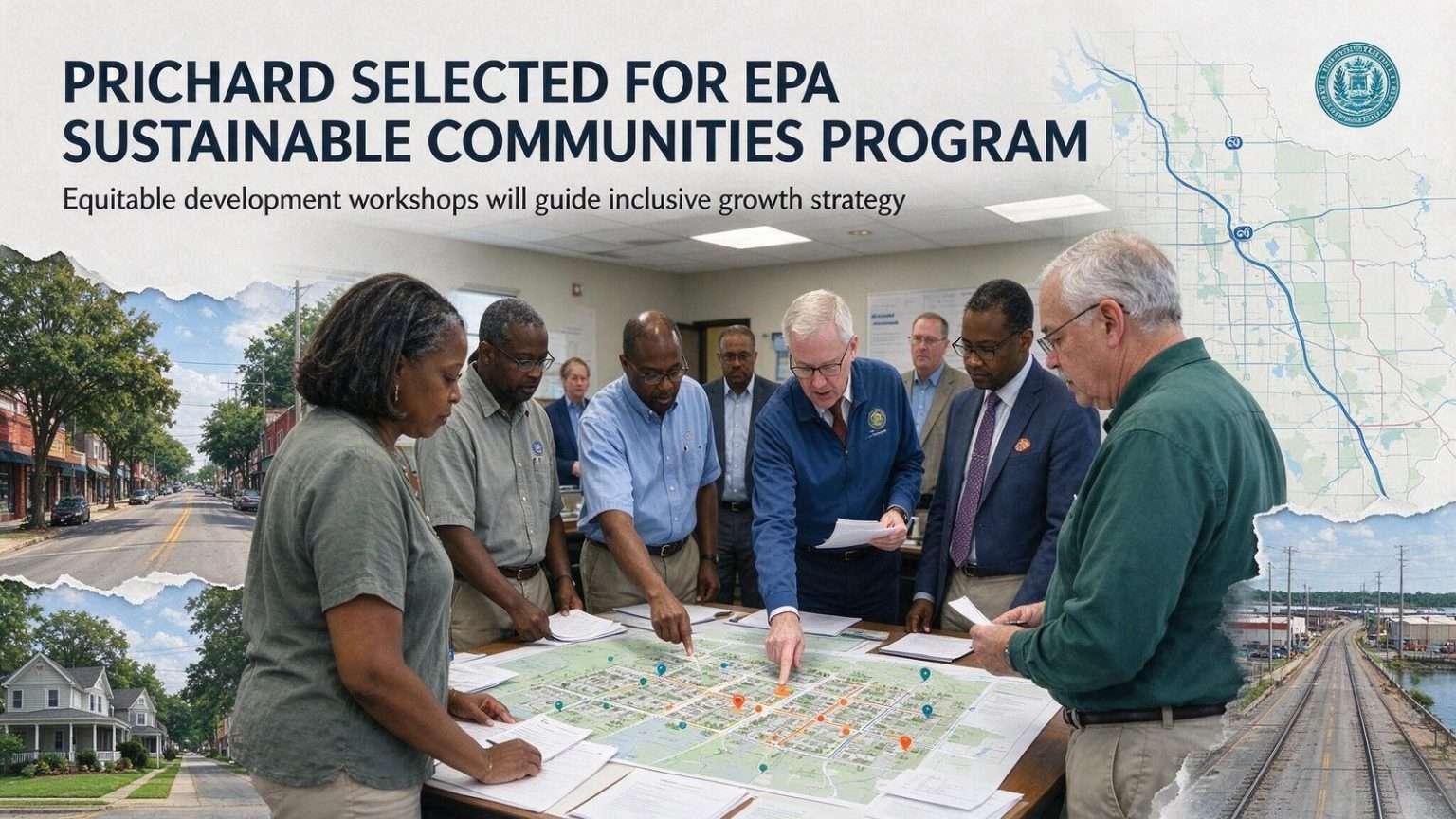
The city of Prichard has been chosen to receive technical assistance from the U.S. Environmental Protection Agency as part of a national program designed to help local governments pursue smarter, more sustainable growth. The selection places one of Mobile County’s oldest cities in the company of a short national list of communities tapped for a program that has become one of the federal government’s principal vehicles for hands-on planning help.
City officials announced this week that Prichard was one of a small number of communities selected from a large pool of applicants nationwide to take part in the EPA’s Building Blocks for Sustainable Communities program. The initiative connects municipal governments with EPA staff and outside experts who help identify practical strategies for economic development, land use planning and environmental resilience. Unlike grant programs that arrive as a check, Building Blocks delivers its value in expertise — days of concentrated, tailored analysis from planners whose services would otherwise carry a price tag well beyond a small city’s consulting budget.
According to a city spokesperson, Prichard specifically requested assistance focused on equitable development, a category within the program aimed at ensuring that growth strategies benefit longtime residents and don’t leave existing neighborhoods behind as new investment arrives. The request signals where Prichard’s leadership sees both the city’s opportunity and its risk: after years of disinvestment, any new development wave brings the dual possibility of renewal and displacement, and the equitable development framework is designed to help cities plan for the former without importing the latter.
Prichard’s application rose out of that balancing act. City officials have spent recent years repairing the city’s finances and rebuilding basic administrative capacity, and the EPA request reflects a deliberate next step: converting stability into strategy. The equitable development category the city chose is among the program’s most popular tools, used by communities nationwide that expect new investment and want a plan for spreading its benefits beyond the parcels where it first lands.
As part of the award, the city will take part in one- or two-day workshops led by EPA staff and national planning experts, though a specific date for those sessions had not yet been finalized. The workshop format is the program’s signature: rather than delivering a report months later, the visiting experts work directly with city staff, local stakeholders and residents in an intensive session that produces prioritized, actionable recommendations the city can begin using immediately.
A Vote of Confidence After Hard Years
City leaders described the selection as a meaningful vote of confidence in Prichard’s ongoing efforts to stabilize its finances and attract new investment after a period of significant fiscal strain, including a municipal bankruptcy process in recent years. For a city that has spent much of the last decade managing through financial crisis — pension obligations, budget shortfalls and the difficult decisions that followed — external validation from a federal agency carries weight with potential investors and partners who may know Prichard mainly through its fiscal headlines.
The announcement also lands as regional planning organizations across the Gulf Coast sharpen their own focus on the northern Mobile County corridor. Growth pressures from the Port of Mobile’s expansion, industrial development along the waterways and residential spillover from Mobile’s suburbs have all pushed attention toward the communities between the city line and the Washington County border. Cities that enter that wave of attention with adopted plans and organized priorities stand to shape the growth; cities that wait tend to absorb it.
Local officials said the free technical assistance could help the city develop a more coherent growth strategy without having to pay for expensive outside consultants. Professional planning work of the kind the Building Blocks sessions provide — corridor analysis, land use assessments, economic development strategy — routinely costs cash-strapped municipalities tens of thousands of dollars, an expense Prichard has had little capacity to absorb while stabilizing its budget. The program’s structure lets the city capture that expertise at no cost.
The Building Blocks program has operated since 2011 and has previously provided similar assistance to well over a hundred communities across dozens of states, ranging from small towns to larger metropolitan areas. Over its run, the program has built a library of tools covering topics from walkable main streets to flood-resilient planning, and the communities selected each cycle are matched with the tool that fits the request they made. Prichard’s equitable development request fits squarely within that catalog.
Selected communities are not given direct funding through the program; instead, they receive expert guidance intended to help them make the most of whatever resources and grants they’re able to secure on their own. That design makes the assistance a multiplier: cities that leave a Building Blocks workshop with a prioritized strategy are typically better positioned to compete for the state, federal and philanthropic grants that require a demonstrated plan as a condition of application.
For Prichard, that competitive positioning may prove to be the selection’s most lasting value. The city sits along the Interstate 65 corridor north of Mobile, with available land, established neighborhoods and a location that regional planners have long identified as ripe for reinvestment. What Prichard has lacked is not opportunity but the planning capacity to package that opportunity for outside investors and funding agencies — precisely the gap the EPA workshops are designed to close.
What Equitable Development Means for Prichard
The equitable development focus requested by the city addresses a question that hovers over every reinvestment conversation in communities like Prichard: who benefits when new money arrives? Equitable development planning aims to answer that question in advance — connecting longtime residents to job opportunities created by new investment, preserving affordable housing as property values move, and making sure infrastructure improvements reach existing neighborhoods rather than stopping at the newest developments.
Those questions carry particular history in Prichard, a city incorporated in the early twentieth century that grew up around the rail lines and industries of northern Mobile County before decades of suburban migration shifted the region’s growth south and west. The city’s older commercial corridors and housing stock have absorbed years of deferred investment, and residents have watched nearby communities capture much of the mobile area’s retail and residential development. A growth strategy built on equitable development principles is, in part, an attempt to ensure that the next cycle of regional growth finally includes Prichard’s existing neighborhoods rather than routing around them.
The workshop process itself will determine the specifics. Under the Building Blocks model, EPA staff and consultants typically arrive with a framework tailored to the community’s request, then spend the sessions gathering local knowledge — maps, data, and the firsthand observations of city staff and residents — before helping the city shape a set of practical next steps. Cities that have completed the program have used their workshops to launch corridor studies, revise zoning approaches, organize around brownfield redevelopment and build the community engagement structures that keep planning grounded in resident priorities.
City officials had not finalized the date for Prichard’s sessions as of this week’s announcement, but the workshops are expected to involve city department heads and community stakeholders in addition to elected leadership. Preparing for the sessions — assembling data, clarifying the city’s own priorities and identifying which corridors and neighborhoods to examine — will be the first test of how much the city can extract from the opportunity.
For residents, the program’s arrival offers a structured opening to weigh in on what growth should look like in their neighborhoods. The Building Blocks process depends on local participation to produce recommendations that reflect actual community conditions, and cities that get the most from the program are those that turn out residents for the workshop sessions themselves. Prichard’s announcement is likely to be followed in the coming weeks by details on when the sessions will occur and how residents can take part.
The selection also adds Prichard to a national network of communities that have moved through the same process, giving city staff a body of peer cities to learn from as the recommendations turn into implementation. That network effect — modest as it may sound — has been one of the program’s quieter benefits, connecting small-city planners facing familiar constraints with counterparts elsewhere who have already tested the strategies Prichard is about to consider.
With the workshops ahead and a planning framework oriented toward protecting longtime residents, Prichard enters the next phase of its recovery with an asset it has rarely had in recent years: outside expertise, at no cost, focused on the city’s own stated priorities. City leaders are calling the selection a vote of confidence. Whether it becomes a turning point will depend on what the city does with the days of expert attention it has just won.