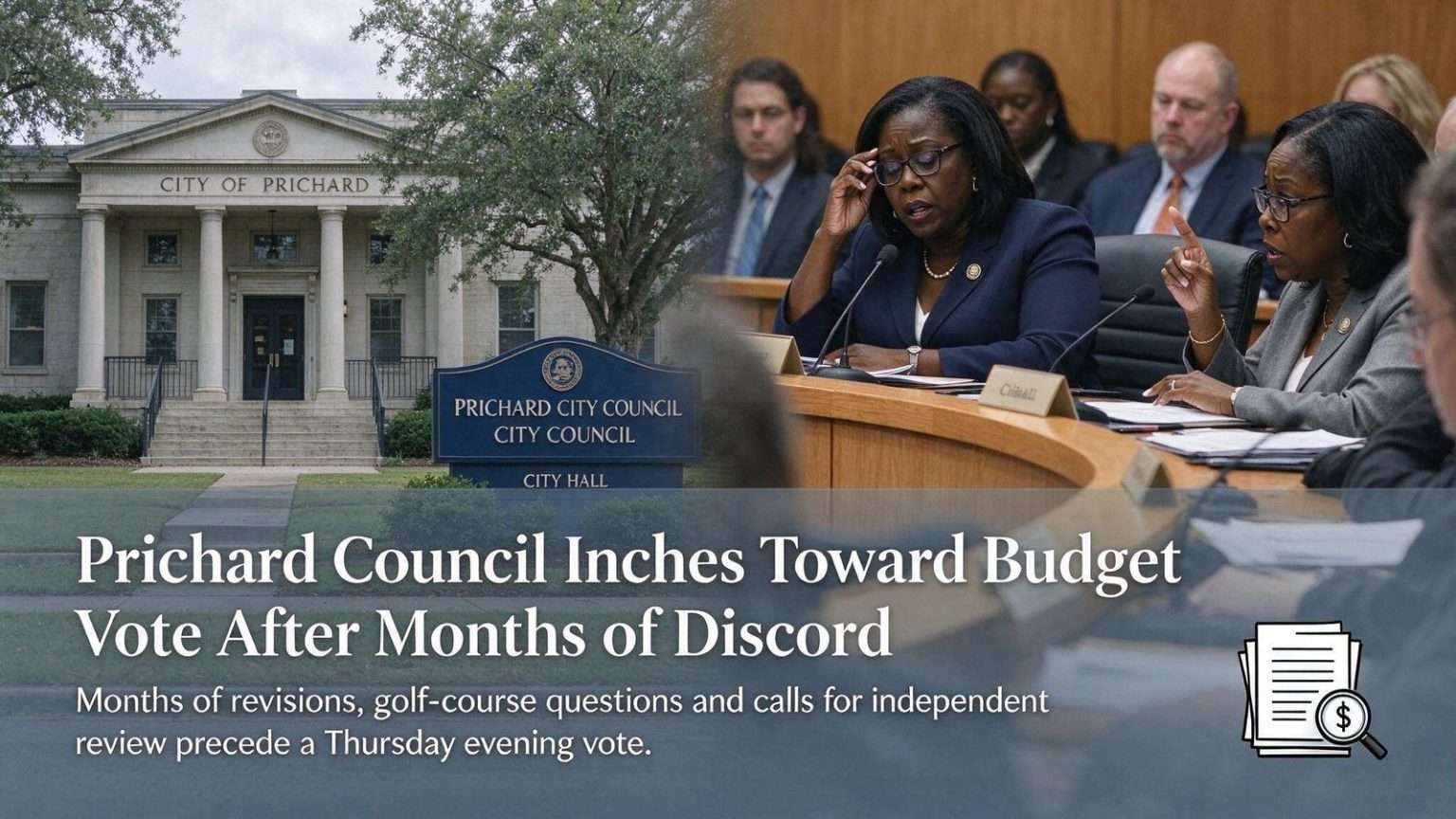
Prichard Council Inches Toward Budget Vote After Months of Discord
Nearly three months into the fiscal year, Prichard officials wrangled over golf-course spending and an accountant's review before a planned budget vote.
Nearly three months after Prichard’s fiscal year began, city leaders were still searching for common ground on a spending plan, with a vote finally expected at a City Council meeting scheduled for Thursday evening. The delay left Alabama’s fourth-largest city in Mobile County operating without a current budget deep into its financial year, a situation that frustrated residents and council members alike.
The council had been reworking the roughly $11.4 million budget for the 2015 fiscal year since late summer, even as the year officially started in October. In the meantime, city departments continued operating under the previous year’s $10.6 million plan, with spending effectively frozen at old levels while the new document remained in limbo. Operating on a continuing basis under a prior budget is a familiar stopgap, but it limits the city’s ability to start new initiatives, fill vacancies or adjust to changing costs.
Council President Ossia Edwards said Finance Committee Chairman George McCall first invited members to submit proposed changes back in August, but repeated new requests kept stalling progress. Rather than a single round of revisions followed by a vote, the process stretched across months of meetings as fresh amendments continued to surface.
“Every meeting has been some new change from some council member,” Edwards said, adding that members had also raised budget issues outside of the finance committee’s formal sessions rather than hashing out compromises at the table. Her comments underscored a core frustration: decisions that belonged in committee were being relitigated in other settings, making it nearly impossible to lock down a final document.
Prichard’s struggles with budgeting and financial management carry particular weight given the city’s history. The city of roughly 22,000 residents just north of Mobile has spent years working to rebuild confidence in its finances after a well-documented pension crisis that drew national attention, and every spending plan since has been scrutinized accordingly. That history helps explain why individual council members have been insistent on their own review of the numbers before signing off.
High Pointe golf course a recurring flashpoint
One recurring flashpoint was the city’s High Pointe golf course. Council members Severia Campbell-Morris and Lorenzo Martin questioned why the course was budgeted to cost roughly $148,700 while bringing in only about $48,600, a gap of some $100,000 that raised obvious questions about the municipal amenity’s place in a tight budget.
Finance Director Cyndy Norwood explained that the line items had been split to separate employee salaries from overhead, a presentation that made the course’s true cost appear in different places in the document rather than in a single bottom line. She also warned that cutting the course’s funding further would likely force layoffs, putting a human face on a dispute that could otherwise have been settled as a simple accounting question.
Municipal golf courses across the country routinely spark this kind of debate. Courses like High Pointe serve purposes that do not show up on a revenue statement, from affordable recreation for seniors and youth leagues to greenspace and property value support in surrounding neighborhoods. But for a city with limited funds and pressing needs elsewhere, a six-figure annual subsidy is a legitimate target for scrutiny, and the Prichard council’s questioning reflected that tension between community amenity and fiscal discipline.
The dispute over the course also illustrates how line-item presentation shapes public perception of a budget. When salaries and overhead are separated, the full cost of an operation is harder to see at a glance, and members reviewing the document for the first time can feel misled even when the accounting itself is standard practice. Norwood’s explanation addressed the mechanics, but it did not erase the underlying concern about whether the subsidy was sustainable.
Beyond the golf course, members also pressed for more money to spend on projects in their individual districts. District-level requests are a fixture of council budgeting in cities of Prichard’s size, where each member is expected to deliver visible improvements — repaved streets, cleaned lots, repaired lighting — to constituents who see the council as their most accessible level of government.
Dispute over an independent CPA review
A sharper dispute broke out between Edwards and Campbell-Morris over the newest councilwoman’s request that a certified public accountant review the budget before any vote. Campbell-Morris, who took office in October, argued that the use of federal and local tax dollars demanded an independent look by someone with professional training in examining financial statements.
“The buck stops right here,” she said. “I have a responsibility to be accountable.” For a newly seated member, the demand was both a statement of principle and a demonstration of independence, signaling that she intended to examine the city’s finances with her own eyes rather than rely entirely on staff summaries and committee recommendations.
Edwards countered that a CPA would examine the budget anyway as part of the city’s standard annual audit, and that councilors could adjust the plan as issues surfaced. From her perspective, adding an outside review before the vote would repeat the pattern that had already consumed three months, delaying a spending plan the city needed simply to operate.
Her larger worry, she indicated, was that yet another layer of review would push the process even deeper into a fiscal year the city had already been running on borrowed time. Every week without a budget meant departments planning against year-old numbers, and Edwards saw the audit process as the proper, already-scheduled venue for professional scrutiny.
The exchange between the two councilwomen captured a familiar municipal dilemma. Independent review offers genuine assurance, but it costs time and money, and a city already three months into its year without a spending plan has little of either to spare. The question was not whether Prichard’s budget should be examined carefully, but whether that examination should happen before the vote or through the audit mechanisms already in place.
What made the standoff more pointed was the timing of Campbell-Morris’s arrival. Taking office in October, precisely when the fiscal year began, she inherited a budget process that had been running since August without her input. Asking for a CPA review was, in part, a new member’s attempt to insert herself into a process that had developed without her, and to establish that the newest voice at the table intended to take the city’s finances seriously.
For residents, the months of discord carried practical consequences. Prichard provides basic services — police and fire protection, sanitation, street maintenance — on a scale of funding that leaves little room for improvisation. When the budget remains unsettled, departments cannot plan hires, equipment purchases or projects with confidence, and vendors and employees alike are left waiting for clarity.
The discord also played out against the backdrop of Prichard’s broader effort to stabilize its image. Cities competing for residents, businesses and development investment cannot afford the appearance of fiscal dysfunction, and a council at odds with itself over a routine annual budget feeds a narrative the city has worked hard to escape. The push to pass a spending plan was therefore about more than numbers; it was a test of whether the city’s leadership could govern smoothly.
The cost of the delay itself deserves mention. Compiling, debating and revising a municipal budget consumes staff hours from the finance office, the clerk and every department head asked to rework figures on request, and those hours produce no direct service for residents. Months of repeated amendment requests represent real money spent on process rather than on the city, a hidden price tag that rarely appears in the budget document itself but lands on taxpayers all the same.
What comes after the vote
Whenever the council finally approved the document, the practical work would only begin. Department heads would spend the remainder of the year executing a plan passed months late, compressing the timeline for any seasonal spending and forcing quick decisions about which delayed items could still be accomplished before the 2015 fiscal year closed.
The episode also set the stage for next year’s process. Council members who felt shut out of committee deliberations, and a finance chairman who watched amendments arrive meeting after meeting, both had reasons to push for a more structured calendar — earlier deadlines for change requests, firmer rules about where budget issues are raised, and a clearer path from proposal to vote.
Thursday’s meeting was expected to draw an audience of residents who have followed the budget fight closely, a reminder that in a city Prichard’s size, council decisions are watched at close range by the people they affect. Whatever amendments remained on the table, members faced a simple reality: at some point, the city needed a budget more than it needed one more revision.
Thursday’s expected vote, in other words, represented less an ending than a pause in an ongoing negotiation over how Prichard manages its money. Whether the lessons of a fractious autumn carry into a smoother process next year will depend on whether the council can convert months of friction into a working set of ground rules for future budgets.