State GOP Chairman Presses Democrats Over Bracy Letter Seeking Leniency for Relative
Alabama Republican Party Chairman Bill Armistead demanded that his Democratic counterpart address a Prichard-area lawmaker’s use of official House letterhead to seek leniency for a convicted drug-ring relative.
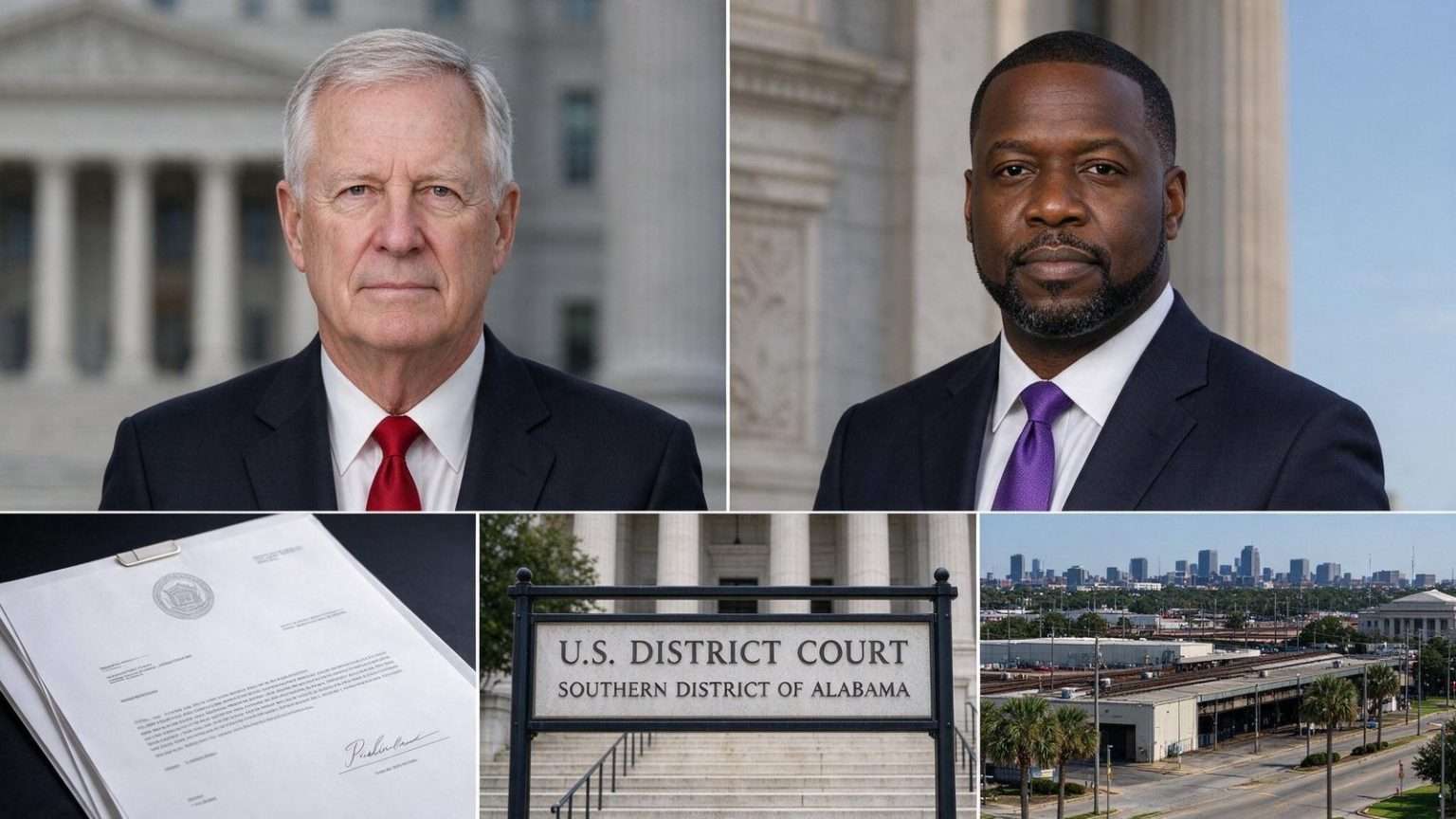
A dispute over a single letter escalated into a partisan clash when Alabama Republican Party Chairman Bill Armistead publicly called on his Democratic counterpart to “acknowledge the corruption” he said was on display in a south Alabama lawmaker’s effort to help a convicted relative.
The complaint centered on state Rep. Napoleon Bracy, a Mobile County Democrat whose district takes in the Prichard area, and a letter Bracy sent to a federal judge on official Alabama House of Representatives stationery. The letter asked U.S. District Judge Charles Butler Jr. to “be as lenient as possible” in sentencing Bracy’s brother-in-law, Lorenzo Evans, who had pleaded guilty to overseeing an illegal drug distribution ring operating in south Alabama. Evans was ultimately sentenced to six years in federal prison.
To Armistead, the use of an official legislative letterhead to intervene on behalf of a convicted drug figure crossed a line. In a sharply worded statement, the chairman argued that the image of a sitting legislator vouching for a man who admitted running a drug organization damaged the credibility of the entire Legislature, whatever the customary practice of character letters might be.
“It is inexcusable that State Rep. Napoleon Bracy used official letterhead in order to ask Judge Charles Butler, Jr. to show leniency for his convicted cocaine kingpin brother-in-law,” the chairman said, adding that the silence of Alabama Democratic Party Chairman Mark Kennedy on the matter was “equally abhorrent.”
A demand for a response
Armistead cast the episode as part of a broader double standard he accused Democrats of applying to questions of official misconduct. The letter, he argued, was not a private act of family sympathy but an official one, written on paper bearing the seal of the state House of Representatives and delivered by a man who holds public office in Mobile County.
“I’m becoming increasingly bewildered by Chairman Kennedy’s inability to recognize corruption in his own party,” he said. He argued that Kennedy was quick to call for the resignation of Republicans when they cooperated with investigators but looked the other way when one of his own lawmakers acted on behalf of a convicted offender.
“Rep. Bracy owes his constituents an apology for abusing their trust in this way,” Armistead said. “I am certain they did not vote for him in order for him to use his authority to protect convicted criminals. And if Chairman Kennedy would be half so strict with his own party office-holders as he is with Republican legislators, he’d ask Bracy to resign.”
The demand put Kennedy, a Birmingham attorney who had led the state Democratic Party through a period of rebuilding after years of Republican dominance, in the uncomfortable position of being asked to discipline a member of his own legislative delegation over a matter that had produced no criminal charge against the lawmaker himself.
How the letter fit into federal sentencing practice
In the federal court system, letters asking for leniency are a routine and entirely legal part of sentencing. Defense attorneys for defendants facing prison time routinely gather letters from family members, employers, clergy members and community figures, and judges are free to weigh them alongside presentence reports and prosecutor recommendations when deciding a sentence. Federal law leaves judges wide discretion to consider a defendant’s background, family ties and community standing.
Judge Charles Butler Jr. sits on the U.S. District Court for the Southern District of Alabama, which covers the Gulf Coast counties of the state and handles the bulk of federal drug prosecutions arising in Mobile, Baldwin and the surrounding area. Drug distribution cases originating in the region are a steady part of the court’s docket, and multi-year sentences for organizers of distribution networks are common under federal sentencing guidelines.
What made the Bracy letter unusual, according to critics, was not the act of writing it but the stationery it traveled on. Letters on official government letterhead carry an implicit suggestion of institutional weight, and lawmakers in Alabama and elsewhere have generally been cautioned that public resources and official indicia of office should not be used for private purposes. Alabama’s ethics law, strengthened by reform legislation passed after a series of corruption scandals in the state, broadly prohibits public officials from using their position for personal benefit or the benefit of family members.
Bracy and the community he represents
Bracy represented portions of Mobile County centered on Prichard, a city of long-standing significance in the region’s political life. Located just north of Mobile along the corridors that connect the Port City to Washington and Chappeapeela Creeks, Prichard grew up around the railroad and industrial plants in the early twentieth century and absorbed waves of workers who helped build the Gulf Coast economy. Like many older industrial cities in the South, it has struggled for decades with population loss, aging infrastructure and serious fiscal strain, including bankruptcy filings that made it a frequent case study in municipal finance.
The city and its surrounding neighborhoods form the heart of one of the few Democratic-leaning legislative districts in southwest Alabama, a region where Republicans hold nearly every countywide and legislative office. Bracy’s district therefore carries particular weight in the minority party’s delegation, and its representative sits on a bench of Mobile-area legislators who split their attention between local constituent service and the partisan battles that dominate the Statehouse in Montgomery.
Constituent service, in fact, is precisely the terrain where the line between official duty and personal loyalty can blur. Legislators routinely write letters for constituents seeking pardons, parole consideration, admission to schools or help with federal agencies, and few of those letters attract notice. The Bracy letter became controversial because the beneficiary was a close family member, the request went to a federal judge in a serious narcotics case, and the paper it was written on belonged to the state.
A long shadow of Alabama corruption cases
The intensity of the dispute cannot be separated from Alabama’s political history. For generations, the state has cycled through corruption prosecutions that removed legislators, governors, commissioners and judges from office, from the era of the “amoeba” investigations of the 1990s through the federal cases that emptied out portions of the Legislature in the 2000s and 2010s. Both parties have used the residue of those cases as ammunition, and accusations of selective outrage over ethical lapses are a familiar feature of Alabama political rhetoric.
Armistead, a former businessman who led the state GOP through a period in which the party captured every statewide office and solidified supermajorities in both legislative chambers, had made aggressive use of such episodes part of his chairmanship. Statehouse Republicans, holding overwhelming control of the Legislature, had repeatedly pressed ethics questions against Democratic lawmakers in years past, while Democrats countered that their own members faced heightened scrutiny compared with Republicans implicated in comparable conduct.
Kennedy, for his part, had inherited a Democratic Party working to recover from near-irrelevance in statewide politics. His response to the Armistead statement became the test the Republican chairman was explicitly trying to force, framing silence as tacit approval and any defense of Bracy as evidence of the double standard he alleged.
What the episode left behind
No formal ethics complaint or legislative disciplinary action against Bracy was announced in connection with the letter, and the episode played out almost entirely as a war of statements between the two party chairmen rather than as a legal proceeding. Federal judges are not obliged to explain how much weight, if any, they give to sentencing letters, and Evans’s six-year sentence stood as the case’s practical outcome.
For residents of Prichard and the surrounding district, the clash underscored a familiar tension in south Alabama politics: a legislator whose constituency depends heavily on constituent service and personal loyalty also operates inside an ethics framework that has grown steadily stricter since the reform wave of the early 2010s. Whether a letter to a judge on official stationery amounts to an abuse of office or an ordinary act of family advocacy is precisely the kind of judgment call the state’s revised ethics law was written to police, and the disagreement between the parties over that call showed how far apart the two sides remained.
Armistead’s statement made clear that he intended to keep the issue alive as long as Kennedy declined to respond, positioning the letter as a talking point for future campaigns in the Mobile County delegation and a recurring contrast in the broader partisan argument over which party takes corruption seriously. Whether the demand produced an apology, a resignation or a rebuke from the Democratic chairman, the chairman of each party had staked out a position the other would now have to answer for at the ballot box.
The episode also served as a reminder of how quickly local matters in the Mobile County delegation can be absorbed into statewide political warfare. A letter written for a family member in a federal courthouse on Government Street became, within days, a test of party discipline argued between two chairmen in Montgomery, with Prichard’s voters left to judge for themselves whether their representative’s act of family loyalty had cost the district anything at all.