Prichard Adopts $11.4 Million Budget in Final Council Meeting of 2014
The Prichard City Council approved its long-delayed 2015 spending plan over a lone dissent, closing out a contentious year of budget negotiations.
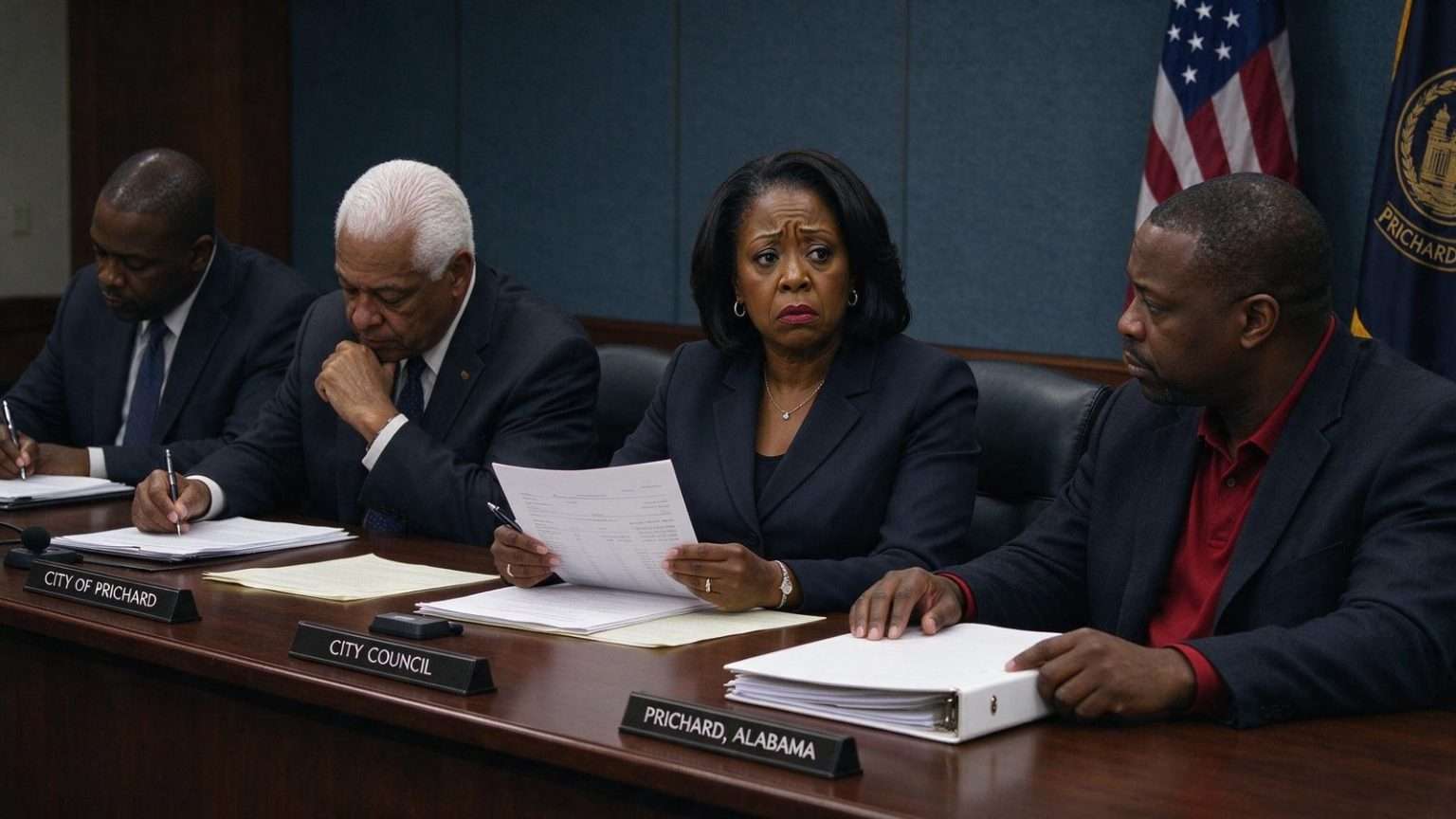
At its final meeting of 2014, the Prichard City Council approved a revised $11.4 million budget for the current fiscal year, ending months of negotiation over the small Mobile County city’s finances. The adoption came with the calendar’s help: the council faced the reality that nearly a quarter of the fiscal year had already passed without a spending plan in place. The vote closed a process that had consumed committee meetings, work sessions and more than a few heated exchanges since summer.
The plan passed over the objection of the council’s newest member, who cast the only vote against it. Councilwoman Severia Campbell-Morris, who took office in October, said she saw no reason to rush the vote. “I don’t see the house on fire here with the city of Prichard,” she said shortly after the Thursday meeting. “When we have the opportunity to stop and take a deep breath and get things in order, we should get things in order.”
Her argument framed the disagreement that had run through the entire budget season: whether Prichard’s financial situation demanded urgency or caution. To Campbell-Morris, a few more weeks of scrutiny was a small price for confidence in the numbers. To her colleagues, every week without an adopted budget was a week the city spent money it had not formally appropriated.
Since taking her seat, Campbell-Morris had repeatedly called for a certified public accountant to review the spending plan before adoption, citing the city’s revenue projections and what she described as a lack of budgeting expertise. She found little backing among her colleagues. The request for outside review carried a practical complication as well, since hiring a CPA would itself cost money the budget had not set aside, and the council’s majority saw the existing staff work as sufficient to the task.
Months of interim spending
Officials had been adjusting the budget since August. The city’s fiscal year begins in October, the same month Campbell-Morris took office, and the turnover made the timing awkward: a new council member’s first major vote was a spending plan months in the making that she had played no part in drafting. The council had pored over department requests through the fall, trimming and shifting as revenue estimates firmed up.
Because the fiscal year began in October without a new plan in place, departments had been operating off the prior year’s $10.6 million budget. Interim spending is legal under Alabama municipal finance rules but blunt: departments essentially repeat last year’s patterns while operating under last year’s assumptions. Line items drift from reality, and large purchases or hires get deferred because no current budget authorizes them.
Council President Ossia Edwards had argued at an earlier finance committee meeting that adopting a current budget was essential, because ongoing spending from outdated line items made it impossible to track expenses accurately. Edwards’ position reflected the practical strain on the city’s bookkeeping, where finance staff were reconciling two fiscal years at once. Every month of delay compounded the accounting problem, even where actual spending remained disciplined.
The golf course fight
A major sticking point was the city-owned High Pointe golf course. Campbell-Morris and Councilman Lorenzo Martin objected to roughly $148,730 earmarked for the course, which was projected to generate only about $48,600. The gap between what the course costs to operate and what it brings in made it, on paper, the city’s most subsidized amenity, and the two council members argued that a city with Prichard’s limited resources could not afford the difference.
Finance Director Cyndy Norwood responded by trimming the course’s budgeted cost to about $93,100 and shifting the remainder into the city’s real estate overhead. The reclassification acknowledged the objection without surrendering the course, moving part of its cost into the same category that carries the city’s other owned properties. Norwood’s compromise preserved the operation while addressing, at least partially, the objection that the course was being budgeted as if it stood on its own.
She noted that, apart from the court, no city department is supported by its own revenue, and that deeper cuts to the course would have meant layoffs. That comparison reframed the debate: golf courses, like senior centers and street departments, draw on the general fund, and singling out High Pointe for self-sufficiency would apply a standard nothing else in city government meets. The prospect of job losses attached the dispute to real livelihoods, which stiffened resistance to the deeper cuts Martin and Campbell-Morris favored.
The disagreement over High Pointe also touched a broader question about what a small city owes its residents in amenities versus services. Supporters of funding the course point to the seniors and working families who use it at modest greens fees, and to the maintenance obligation that would follow any decision to let it go. Critics see a luxury draining a general fund that struggles to cover basics, and the vote did not settle the argument so much as postpone it to next year’s budget cycle.
Salary savings and the bottom line
The council also found savings by setting Police Chief Bernard Parrish’s salary at $65,000 a year, some $20,000 less than his predecessor earned. The reduction reflected both the council’s fiscal caution and the negotiation leverage an open position provides. Public safety is typically the largest slice of any Alabama city’s general fund, and Prichard’s police payroll is no exception, so savings at the top of the department ripple through the budget math.
About $2.4 million of the budget was directed toward overall city overhead. That figure covers the fixed costs of running a municipal government, from utilities and insurance to the buildings and systems every department depends on. Overhead draws scrutiny in every budget season because it grows without adding visible services, and Prichard’s council spent considerable time in work sessions pressing department heads on the details behind that number.
Officials expected roughly $8.4 million of the city’s funding to come from taxes and license fees. The figure represents the core of Prichard’s revenue: sales taxes collected across the city’s commercial corridors, property taxes, and business license fees that track the local economy. The remaining balance of the budget comes from a mix of other sources, and the projections behind the $8.4 million were exactly what Campbell-Morris had wanted a CPA to stress-test before the council committed to spending against them.
The gap between projected revenue and total spending illustrates the constraint Prichard operates under every year. A city of Prichard’s size, with a modest tax base in Mobile County’s shadow, budgets close to the bone by necessity, which is why line items like the golf course subsidy and the chief’s salary drew weeks of debate rather than a single meeting’s approval.
What the adoption means
With the plan adopted, the council was not scheduled to meet again until after the new year, bringing a close to a budget process that had stretched across most of 2014 and exposed sharp divisions among Prichard’s elected leaders. The city enters the second half of its fiscal year with current numbers, current appropriations and a finance department finally reconciling one budget instead of two. Department heads can spend, hire and plan against authorizations that match the year they are in.
The divisions themselves remain. Campbell-Morris’ call for outside financial review did not end with the vote, and the concerns she raised about revenue projections will resurface the next time the city faces a shortfall, as they inevitably do. Council members on the winning side acknowledge the critique had substance even as they defended the process that produced the plan.
For Prichard’s roughly 22,000 residents, the budget’s practical meaning is continuity: police and fire protection funded, city services operating, the golf course open, and a government functioning within its means for another year. The deeper test, which every adopted budget in a small city must eventually face, is whether the projections hold. Prichard’s leaders will find out together, and the 2014 budget fight will be waiting for them when the next one begins.
The council’s newest member, for her part, left the final meeting signaling that her objections were about method as much as outcome. Her push for a CPA review was a request for an independent set of eyes on numbers the council itself had assembled, a check she argued any well-run city would welcome. The majority’s decision to proceed without it reflected confidence in the finance staff’s work, but it left the year’s most persistent budget critique on the record going into 2015.
Budget seasons like this one are, in a sense, the visible half of municipal governance. Residents see the fights over golf course subsidies and chiefs’ salaries; what they experience day to day is the outcome, in the response time of a police car, the condition of a city park, the reliability of a senior program’s funding. Prichard’s 2014 plan funds all of those things within an $11.4 million frame, and the council’s job for the rest of the fiscal year is keeping spending inside it. The next fight is already implicit in the numbers: revenue projections that must come true, a subsidy debate deferred, and a new council member who has made clear she will keep asking for the review her colleagues declined.