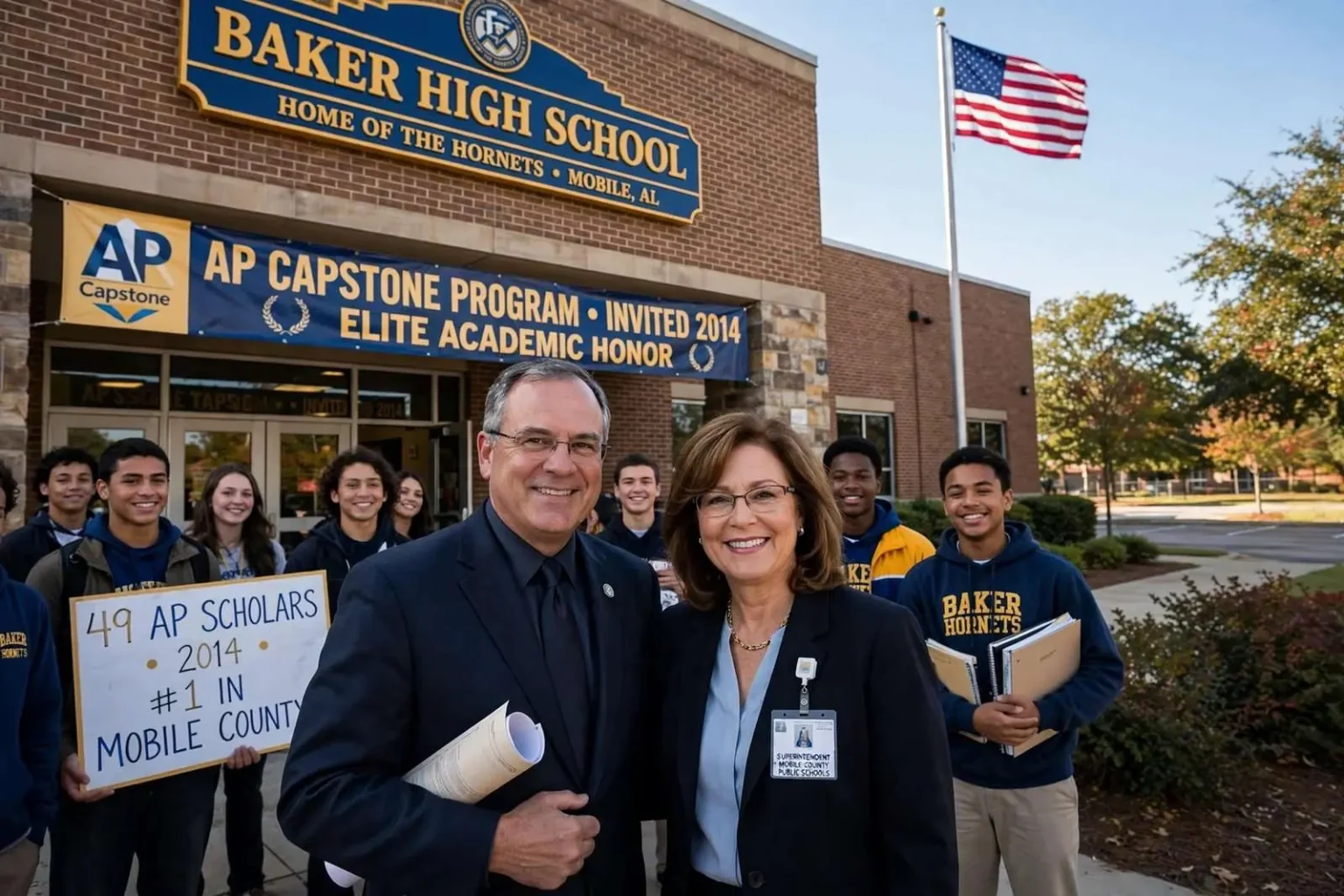
Baker High School in Mobile has been invited to join the Advanced Placement Capstone program, a distinction extended to only a handful of campuses across the country and a nod to the school’s strong track record on AP exams. Principal Clem Richardson delivered the news during a work session of the Mobile County school board, telling members the invitation grew out of years of hard work by students and teachers alike.
“This is quite an honor to be invited, and to be a pacesetter,” Superintendent Martha Peek told the board, adding that she was proud of the campus.
The invitation put Baker in select company at exactly the moment the College Board was rolling out the program nationally. AP Capstone had just launched as the newest layer of the organization’s advanced placement offerings, and schools were being admitted by invitation rather than by application alone — the College Board chose campuses it judged capable of carrying a program built on independent research and sustained academic writing. For a Mobile campus to be among the first wave placed it alongside schools far larger and better known.
A Standout Year Behind the Invitation
The recognition follows a standout year for Advanced Placement results across the district. Mobile County schools reported 144 AP Scholars for the spring 2014 exams, students who scored at least a 3 out of 5 on three or more tests. Baker led all local campuses with 49 AP Scholars, ahead of Davidson with 33 and Murphy with 31.
AP Scholar designations are the College Board’s way of rewarding students who take multiple AP exams and score well across them, and the count of such students is a rough proxy for the health of a school’s advanced academics. Baker’s 49 — more than a third of the entire district’s total — confirmed what the Capstone invitation implied: the school had built a culture in which students routinely took college-level coursework and succeeded at it. Davidson and Murphy, two of Mobile’s traditional academic powerhouses, filled out the district’s top three.
The district’s numbers also reflected deliberate work in the central office. Mobile County Public Schools, the largest system in Alabama, had spent years pushing AP access beyond the handful of campuses where it was long concentrated, and the spring 2014 results were the most visible evidence that the strategy was producing results in every corner of the county.
What AP Capstone Actually Is
Administered by the College Board, AP Capstone is described as a diploma program built to sharpen the research, writing and analytical skills students need to succeed in college. At the time of the announcement, only two other Alabama campuses carried the designation: Hoover High School and Virgil I. Grissom High School in Huntsville. Nationally the group remained small, with a handful of schools in states such as New York, Tennessee, Georgia and the Carolinas.
The program works differently from a single AP course. Students progress through a two-course sequence — a seminar course that teaches them to evaluate sources, build arguments and collaborate, followed by a research course in which they design and carry out a yearlong investigation of their own choosing. The sequence culminates in an academic thesis that students must present and defend, echoing the structure of graduate work more than anything typically found in a high school building.
Richardson compared the program’s structure to that of a doctoral degree, noting that participating students must research, present and defend an academic thesis along with meeting other requirements. The comparison, however hyperbolic it sounds, captures the program’s central idea: rather than absorbing content for an exam, students produce original work and stand accountable for it in front of an audience. College faculty who review the program say those are precisely the skills most first-year students lack.
“It will take an extra commitment on the part of the staff and students at Baker,” Peek said. That commitment is not trivial. Schools accepted into Capstone must train teachers for the seminar and research courses, schedule them alongside a full AP catalog, and sustain the program year after year before the first class of diploma candidates crosses the stage. The diploma itself is awarded only to students who complete both Capstone courses plus a set of additional AP exams with qualifying scores — a heavier load than most students anywhere carry.
A Network That Spans the World
Because the program links campuses in countries including Canada, the United Kingdom, Japan and China, the invitation also brings a measure of national and international recognition to the Mobile school, Richardson said. The global network is part of the College Board’s pitch: Capstone students’ work is benchmarked against peers worldwide, and universities abroad as well as at home recognize the diploma. For a west Mobile campus, membership in a program spanning four continents was a distinction no local school had previously held.
The international framing also mirrors what universities say they want. Admissions offices have long wrestled with comparing transcripts from schools of wildly different rigor; a diploma backed by defended research and a prescribed set of qualifying AP scores gives them a common yardstick. Baker’s students, in other words, were gaining not just a credential but a currency that travels — to out-of-state universities, to honors programs, and to the scholarship committees that weigh rigor alongside grades.
Part of a Larger Push
The honor reflects a broader push within the Mobile County system to expand access to college-level coursework. In recent years the district has grown the number of AP classes offered across its dozen high schools, giving students the chance to earn college credit before they graduate. While each AP exam carries an $85 fee, the system covers part of the cost for students who qualify for free or reduced-price lunches, and it provides study sessions and test-preparation materials to help them get ready.
That access agenda is the quiet engine behind the Capstone invitation. Programs like Capstone tend to take root where AP participation is already broad, and a district that subsidizes exam fees and runs preparation sessions is deliberately building the pipeline such programs require. The $85-per-exam fee is a real barrier in a district where a majority of students qualify for meal assistance, and the partial subsidy lowered it for the students least likely to take college-level courses otherwise.
The payoff runs in both directions. Students who score well on AP exams enter college with credits that can shorten their time to a degree and reduce tuition costs, and the district’s expansion of course offerings widened that opportunity to students who, a generation ago, would never have seen an AP syllabus. Baker’s Capstone invitation extends the same logic one step further — from access to individual courses to access to an entire credential.
For the school itself, the invitation is both reward and obligation. Richardson’s presentation to the board made clear that Baker earned its place through its students’ results, and Peek’s remarks framed the campus as a pacesetter for the rest of the district. The program will roll out in coming school years, with teachers trained and the first candidates recruited — a group of Baker students who will research, write, present and defend their way through a program offered at only a handful of high schools anywhere.
The Schools Baker Beat to the Punch
The company Baker kept in the announcement underscored how rare the invitation was in Alabama. Hoover High School, in the Birmingham suburb of the same name, and Grissom High School, in Huntsville, were the only two Alabama campuses previously carrying the Capstone designation — both large suburban schools in communities known for strong academic programs. Mobile County’s inclusion of a third school, and its placement of Baker ahead of traditional rivals Davidson and Murphy in AP Scholar counts, reset assumptions about where the district’s academic peak sat.
Davidson and Murphy, for their part, remained central to the district’s AP expansion. Murphy, the city’s oldest high school, and Davidson, long a leader in specialized academics, posted 33 and 31 AP Scholars respectively in the spring 2014 results, and both campuses continued to add course offerings. The district’s approach has been to build depth everywhere rather than concentrate excellence at one flagship, which is why the Capstone invitation to Baker was presented to the board as a systemwide milestone rather than a single-school trophy.
The geography of the honor also matters for how families choose schools. Mobile County’s dozen high schools serve students across a county that stretches from Citronelle to Dauphin Island, and advanced programs have historically been spread unevenly across that map. Every new AP section added at a neighborhood campus gives students another reason to succeed where they are, and the district’s fee subsidies and preparation sessions are designed to convert that access into actual exam participation.
What Students Can Expect From the Program
For the Baker students who will eventually enroll, the Capstone experience will look unlike any other course on their schedules. The seminar year centers on evaluating real-world arguments — assessing the credibility of sources, weighing competing claims, and constructing written and oral arguments of their own, all assessed through College Board-scored performance tasks rather than a single sit-down exam. The research year then hands students a question of their own choosing and a full academic year to investigate it, producing a written thesis and an oral defense before a panel.
Teachers of the courses undergo College Board training and act as guides rather than lecturers, since the program’s premise is that students should drive their own inquiry. That shift takes adjustment on both sides of the desk, and it is why Peek emphasized the commitment required of staff as much as students. Schools that have implemented the program nationally report a ramp-up period in which the first cohorts set the culture that later classes inherit.
The skills the program certifies — sustained research, analytical writing, public presentation and defense of an argument — are the ones universities consistently report as underdeveloped in entering freshmen. Students who complete Capstone arrive at college having already produced a miniature version of the work their degree will demand, and the diploma signals that to admissions readers without requiring translation. For Baker’s graduates, that head start may prove the program’s most tangible benefit.
Baker High School, one of the largest campuses in the Mobile County system, will now spend the coming years building the program its invitation promises — training teachers, scheduling the sequence, and recruiting the students who will become the school’s first Capstone diploma candidates. The invitation itself is only the beginning; the distinction, as Richardson told the board, lies in what the school does with it.