Grand Bay Murder Case Ends with Life Sentences After Years-Long Fight for Justice
A Mobile County man was sentenced to consecutive life terms in the 2008 Grand Bay killing of Tammy Stokes after a lengthy legal battle.
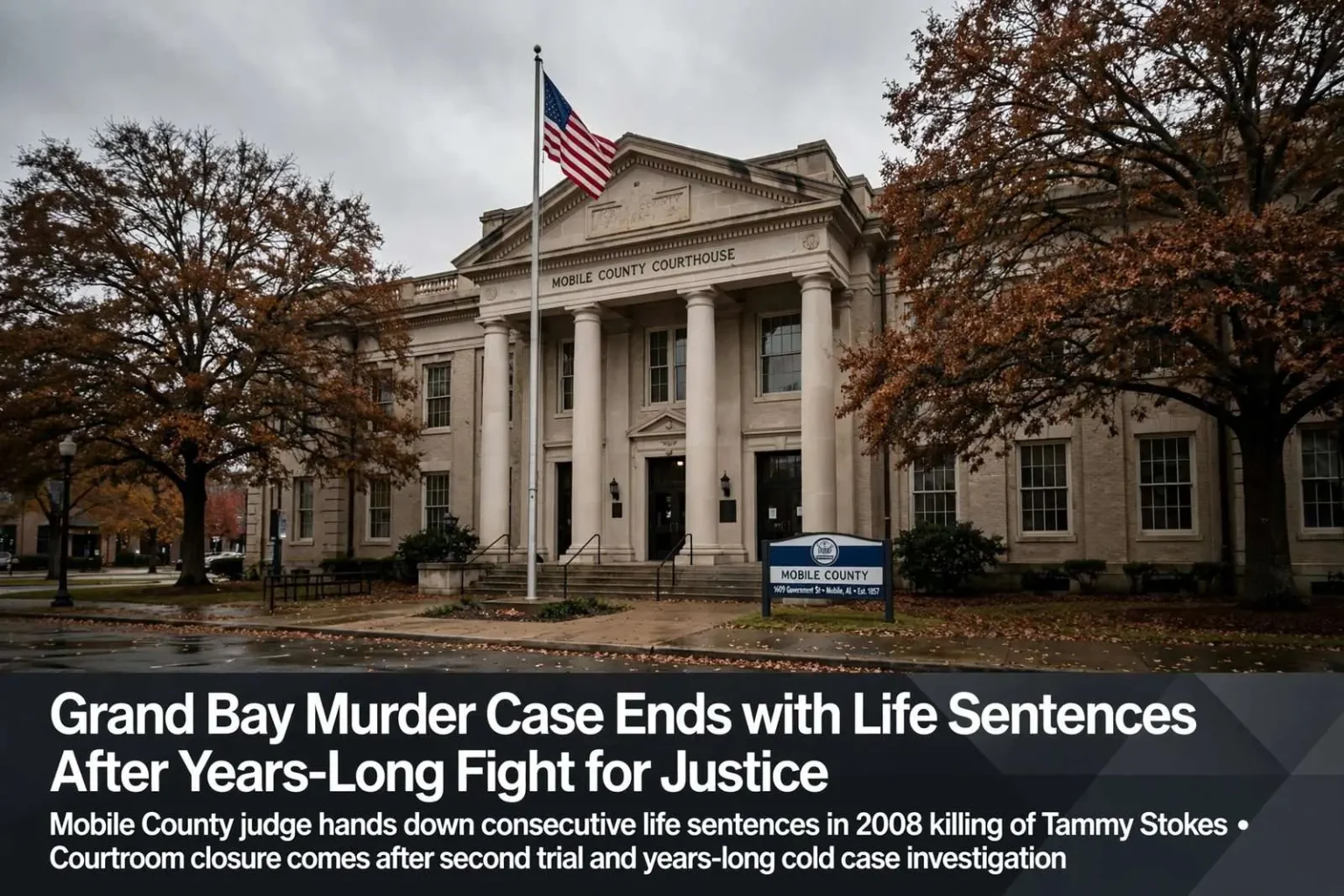
A Mobile County courtroom closed a chapter this week on one of the area’s longest-running homicide cases, as a judge handed down consecutive life sentences to the man convicted of killing a 24-year-old mother of two in Grand Bay back in 2008. Circuit Judge Ben Brooks sentenced Isaac Washington, 36, to life without parole on a felony murder conviction and a separate life sentence on a second-degree kidnapping charge, ordering the terms served consecutively along with a 20-year sentence Washington was already serving.
A jury convicted Washington after a second trial, following an earlier mistrial in the case involving the death of Tammy Stokes. The path from mistrial to conviction to sentencing stretched across years, a timeline that tested the patience of the victim’s family and demonstrated how cold-case prosecutions unfold in practice, slowly and often unevenly, before they reach a final courtroom moment.
Stokes’ death went unsolved for more than three years before Washington and a co-defendant were arrested and charged in connection with her killing. Prosecutors told jurors that Washington believed Stokes, who had served as a confidential police informant, had shared information about one of his relatives. The allegation placed the case in a category that authorities treat with particular gravity: violence against a person suspected of cooperating with law enforcement, which sends a message that can chill cooperation in other cases if it goes unanswered.
According to testimony, Stokes was taken from the trunk of a car to an isolated property in Grand Bay, where she was shot and killed. The rural geography of southern Mobile County, with its spread-out parcels and quiet roads, figured in the crime’s chilling details. The account jurors heard described a sequence that began with abduction and ended at a remote location, far from any witness who might have intervened.
A defense built on the co-defendant
Washington’s defense attorney argued throughout the case that it was the co-defendant, not Washington, who removed Stokes from the vehicle and fired the fatal shot. The strategy put the co-defendant at the center of the trial, and jurors appeared to give greater weight to the co-defendant’s account of events. That testimony proved decisive enough for the jury to convict Washington, while the co-defendant was separately sentenced to 25 years in prison for his role in the case weeks earlier.
The contrasting outcomes illustrate how the criminal justice system sorts responsibility among multiple defendants. One man took the witness stand, accepted responsibility for his part, and received a term measured in decades. The other contested his involvement to the end, was convicted of felony murder and kidnapping, and received a sentence designed to keep him incarcerated for the rest of his life. Juries weighing competing accounts of the same crime can reach conclusions that divide sharply between defendants, and that is what happened here.
At sentencing, Stokes’ young daughters were present in court, and a letter they had written to their mother’s killer was read aloud, expressing grief and anger over losing their mother. The moment gave the courtroom a direct account of what the crime had cost: two children growing up without the parent they lost in 2008, old enough now to address the man responsible but not old enough to have been spared the loss itself.
Prosecutors asked the judge to ensure Washington would never be released, regardless of any future changes to state parole laws, arguing he should not see freedom again given the nature of the crime. The request reflected both the sentence structure and the prosecutors’ concern that parole eligibility, however remote, could someday shift with changes in law or policy.
Stokes’ mother, who attended the hearing, said she had hoped for a different outcome but found some measure of relief in knowing her daughter’s killer would remain behind bars for the rest of his life. Her presence at the hearing closed a circle that began with an unsolved death more than three years before the arrests, continued through a mistrial, and ended with sentences that remove any realistic prospect of release.
Defense counsel asked the judge to consider that Washington also has two children who would grow up without their father, requesting a non-consecutive sentence that might preserve some possibility of a later life outside prison. The request was denied. Judge Brooks ordered the life terms served consecutively and stacked on top of the 20-year sentence Washington was already serving, a structure that forecloses release in any practical sense.
Following the sentencing, Washington’s attorney filed notice that he intends to appeal the conviction, citing legal arguments about the propriety of convicting a defendant of both felony murder and the lesser kidnapping charge in the same case. The appeal question raises a doctrinal issue Alabama courts have wrestled with: when a killing occurs in the course of a kidnapping, prosecutors may charge both the underlying felony and the murder that resulted from it, and defendants have argued that punishing both constitutes double punishment for a single course of conduct.
An appeal of that kind will take months at minimum, moving through the Alabama Court of Criminal Appeals. The notice preserves the issue for review, though appeals that challenge jury verdicts on the weight of the evidence rarely succeed. The legal argument about dual convictions, by contrast, is the kind of pure question of law that appellate courts can and sometimes do resolve in a defendant’s favor, which is why the defense seized on it.
A cold case that would not close
The case, which spanned from a cold investigation to a mistrial and finally a conviction, closes a chapter in one of Mobile County’s longer-running unsolved homicide cases from the late 2000s. Grand Bay, a rural community in the southwestern corner of the county, does not generate frequent homicide cases, and the 2008 killing of a 24-year-old mother stood out in the community’s memory during the years when no arrest had been made.
Cold-case prosecutions depend on evidence and witnesses holding up over years. Investigators in Mobile County continued working the Stokes case after it went cold, eventually building enough to charge Washington and the co-defendant. The first trial ended in a mistrial, an outcome that in many cases discourages further pursuit. Prosecutors here chose to try the case a second time, a decision that carries risk, since a second acquittal usually ends the matter permanently, but that ultimately produced a conviction.
The felony murder theory at the center of the case deserves explanation for readers following the appeal. Under Alabama law, a death that occurs during the commission of certain dangerous felonies can support a murder conviction even without proof that the defendant intended the death. The kidnapping charge supplied the underlying felony in this case, which is why the two convictions travel together and why the defense appeal focuses on their combination. If an appellate court were to vacate one of the convictions, the sentence structure could change even if the fundamental finding of responsibility survived.
For the Stokes family, the legal technicalities of the appeal are secondary to the outcome they watched in person. Two daughters wrote a letter to their mother’s killer and heard it read aloud in court. Their grandmother left the same hearing knowing the man responsible would die in prison. Whatever the appellate courts decide about the pairing of charges, the sentences ordered by Judge Brooks stand as the legal system’s final accounting for a crime that began with a woman taken from the trunk of a car in Grand Bay in 2008 and ended, years later, with consecutive life terms in a Mobile County courtroom.
What the case means for Mobile County
Prosecutions of crimes against confidential informants carry weight beyond a single case. When residents weigh whether to cooperate with police, the outcome of cases like this one becomes part of the calculation. A justice system that pursues such killings for years, through mistrials and retrials, sends its own message: that cooperation will be protected and that violence against those who assist law enforcement will be answered with the system’s most serious consequences.
The case also shows the role sentencing hearings play in giving families a formal conclusion. The daughters’ letter, the mother’s presence and the prosecutors’ argument about parole all formed part of a record that will outlast the courtroom moment. Judges in Alabama have discretion in structuring sentences, and the decision to run the terms consecutively, rather than concurrently, was the difference between a theoretical possibility of future release and a practical guarantee of none.
Grand Bay itself remains a community where the case is remembered. The isolated property where Stokes was killed, the trunk of the car, the informant allegation, the years of waiting for an arrest, all of it became local history during the long gap between the crime and the conviction. Rural communities along the county’s southern edge followed the trial with the attention of people who remembered when the news first broke and never saw it resolved until now.
The appeal will proceed on the schedule of the appellate courts, and its outcome will determine whether the conviction stands exactly as the jury returned it or is modified in some respect. What will not change is the essential record: a jury heard the evidence twice, the second time returning verdicts of felony murder and second-degree kidnapping, and a judge who presided over the case ordered the maximum structure the law allows. For a case that began as an unsolved death in 2008, that is a conclusion, even if the appellate paperwork is still to come.