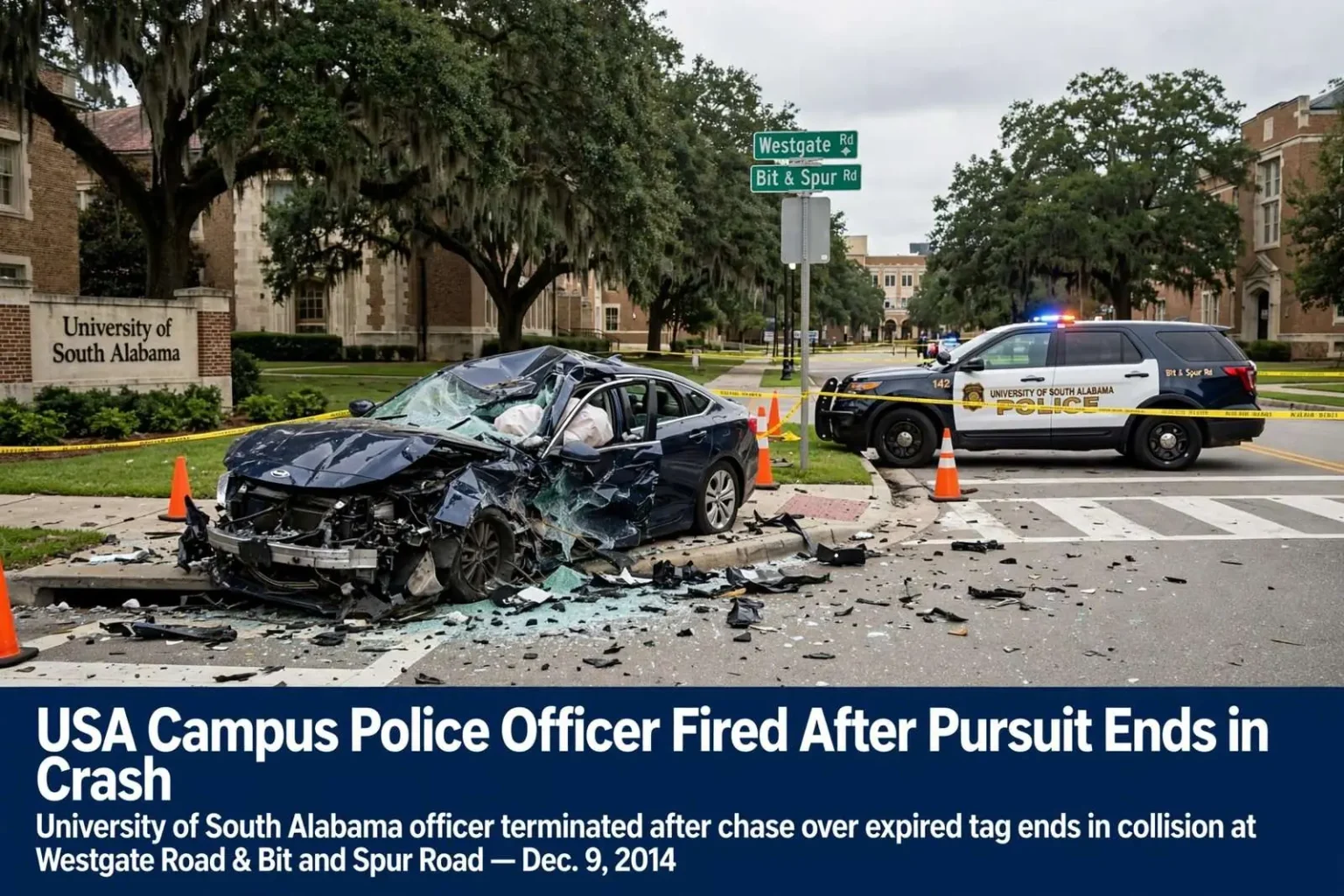
A University of South Alabama police officer has lost his job following a car chase on campus that ended in a collision, university officials confirmed. The pursuit began on a Saturday when a campus officer attempted to stop a vehicle displaying an expired tag. According to university spokesman Bob Lowry, the chase ended in a crash at the intersection of Westgate Road and Bit and Spur Road.
Two people were riding in the vehicle being pursued, and two more were in a separate vehicle that was struck when the fleeing car reached the intersection. A subsequent investigation determined the fleeing vehicle had been stolen from a business on Montlimar Drive and that officers found roughly seven grams of marijuana inside. The 17-year-old driver of the vehicle was taken to the Strickland Youth Center following the crash.
The officer involved, identified by the university as Edward Fabian Jandreau, was placed on paid administrative leave immediately after the incident while investigators reviewed whether the pursuit violated the police department’s chase policy. That review concluded with Jandreau’s employment being terminated on Dec. 9, 2014, Lowry said in a statement.
A Policy That Discourages Chases Over Traffic Violations
The University of South Alabama Police Department’s pursuit policy allows officers to engage in chases only when the need for immediate capture clearly outweighs the danger the pursuit itself creates, and states that such situations should be limited to the most serious incidents. The policy specifically discourages pursuits for traffic violations, misdemeanors, lower-level felonies and property crimes when those are the only factors involved, and requires that the circumstances justifying a chase exist at the moment it begins.
That framework places USA’s campus department in line with the growing consensus in American policing that high-speed chases over minor offenses create more risk than they resolve. Pursuits endanger not only the officers and suspects involved but bystanders — pedestrians, cyclists and other drivers on campus streets shared with students walking between classes and vehicles entering from campus entrances along major corridors. A pursuit that begins over an expired tag, under such policies, is precisely the kind of scenario the rules are written to prevent, because the underlying offense almost never justifies the potential harm of a crash.
Campus police departments face particular constraints in applying such policies. A university campus is, by design, a dense environment filled with pedestrians, and the roads threading through it — including the Westgate Road and Bit and Spur Road area where this chase ended — carry a mix of student drivers, campus shuttles and visitors unfamiliar with the layout. The potential consequences of a fleeing vehicle losing control in that setting are greater than they would be on a rural highway, which is why campus forces typically hold their officers to stricter pursuit standards than many municipal agencies apply.
How the Incident Unfolded
According to the account university officials released over the days following the crash, the sequence began when the officer attempted the traffic stop and the driver fled instead of pulling over. The chase continued until the fleeing vehicle reached the Westgate and Bit and Spur intersection, where it collided with a second vehicle carrying two occupants. Four people were involved in the crash in total — the two in the pursued car and the two in the struck vehicle.
University officials released additional details about the incident over several days following the crash, including confirmation that the pursued vehicle was stolen, information about the marijuana found inside it, and clarification of the exact crash location. The gradual release of information reflected an administrative review unfolding alongside the criminal case, with the university balancing its obligations to the investigation, the people hurt in the crash and the public it serves.
The criminal side of the case remained the province of the juvenile justice system, given the driver’s age. The 17-year-old was transported to the Strickland Youth Center, Mobile County’s secure juvenile detention facility, after the crash. Charges stemming from a stolen vehicle, marijuana possession and the crash itself would be handled through the juvenile court process, which is separate from the university’s internal employment review.
Administrative Leave and the Review Process
Placing the officer on paid administrative leave immediately after the incident is standard practice when an officer’s actions cause injury or death or violate policy, allowing the department to investigate without prejudging the outcome while removing the officer from duty pending its resolution. Paid leave in such circumstances is not a disciplinary action in itself; it is a neutral holding measure that lasts until the internal review determines what happened.
In Jandreau’s case, that review examined whether the pursuit comported with the department’s chase policy — specifically whether the officer had a lawful basis to initiate the chase, whether the seriousness of the offense justified the risk, and whether the circumstances at the moment the chase began met the policy’s threshold. The review concluded they did not, and the university terminated Jandreau’s employment effective Dec. 9, 2014.
The decision illustrates how seriously university systems treat pursuit policy violations. Because a campus officer’s mandate is fundamentally protective — safeguarding students, employees and visitors on university property — a chase that injures uninvolved people over a minor traffic violation strikes directly at the mission the department exists to serve. Terminating an officer for a policy violation of this kind also serves a preventive function within the force, signaling to every other officer that the pursuit rules are not advisory.
Context: The USA Police Department
The University of South Alabama Police Department is a full-service law enforcement agency operating under authority granted to campus police in Alabama, with jurisdiction on and around the university’s Mobile campus. Its officers are certified through the state’s peace officer training standards, and the department handles everything from traffic enforcement to criminal investigations within its jurisdiction. The university’s main campus sits in western Mobile along University Boulevard, with roads and intersections like Westgate and Bit and Spur serving the campus community daily.
Like campus departments nationally, USA’s force has adopted pursuit and vehicle operation policies shaped by national standards from organizations that study police vehicle operations. Those standards generally direct officers to weigh the known offense, the risk to the public and the likelihood of apprehending the suspect later — emphasizing that most fleeing drivers in minor cases can be identified through license plates, surveillance video or subsequent investigation, making a dangerous chase unnecessary.
That is what appears to have happened here: the vehicle’s identity was ultimately established, its driver was taken into custody after the crash, and the stolen vehicle and its contents were documented. The pursuit accomplished nothing that routine follow-up investigation could not have achieved — and it left two uninvolved people in a struck vehicle and a campus intersection as the scene of a serious collision.
What Comes Next
With Jandreau’s termination finalized, the remaining threads of the case play out in separate venues. The juvenile driver faces the courts, the occupants of the struck vehicle may pursue matters through the civil system, and the university’s internal accounting of the incident closes with the officer’s dismissal. University officials have not indicated any further policy changes, but the case stands as a concrete example of how pursuit policies are enforced when an officer crosses the line the rules draw.
The Broader Debate Over Pursuit Policies
The case arrives amid a long-running national reevaluation of police pursuits. Studies of chase-related collisions have consistently found that a large share of pursuits are initiated for minor offenses, and that crashes resulting from those pursuits frequently injure people with no connection to the original traffic stop. That research has prompted hundreds of agencies to tighten their pursuit rules over the past two decades, restricting chases to violent felony suspects or other circumstances where immediate capture is essential to public safety. Campus departments, policing environments saturated with pedestrians, have generally moved faster and further in that direction than their municipal counterparts.
Advocates for stricter rules point out that an expired-tag stop almost always yields the vehicle’s registration and often a photograph of the driver, giving investigators everything they need to seek a warrant or make an arrest later without any chase at all. When the vehicle itself turns out to be stolen, as happened here, that fact is typically discovered after the stop rather than before it — meaning the officer who declines to pursue is not letting a serious offender escape, but simply deferring the capture to a safer moment.
Departments also weigh the message a chase sends to the fleeing driver. Research and field experience suggest that pursuits over minor violations train a small population of offenders to run from every stop, escalating risk on every future traffic stop in the jurisdiction. A firm, consistently enforced no-chase-unless-serious policy breaks that cycle by removing the incentive: drivers learn that fleeing gains them nothing except additional charges, while officers who hold back are following policy rather than showing hesitation.
Accountability Within Campus Policing
The university’s willingness to terminate an officer over a policy violation — rather than settle for a suspension or retraining — reflects the accountability structures governing campus law enforcement in Alabama. University police departments answer to institutional leadership as well as to state certification standards, and employment decisions of this kind go through administrative review before taking effect. Officers subject to termination typically have appeal rights through institutional or civil service channels, though no appeal in this case has been announced publicly.
For the university community, the episode closes with the officer gone, the driver in the juvenile system and the crash fully documented. What remains is the precedent: a demonstration that the USA Police Department’s pursuit policy is enforced against its own officers when a chase over a minor violation ends in a collision on campus streets. For a department whose core mission is the safety of students and visitors, that consistency between written policy and actual discipline is the measure that matters most to the public it protects.