Crime & Public Safety Gulf Shores
Gulf Shores Police to Launch Flock Camera Transparency Portal in Coming Weeks
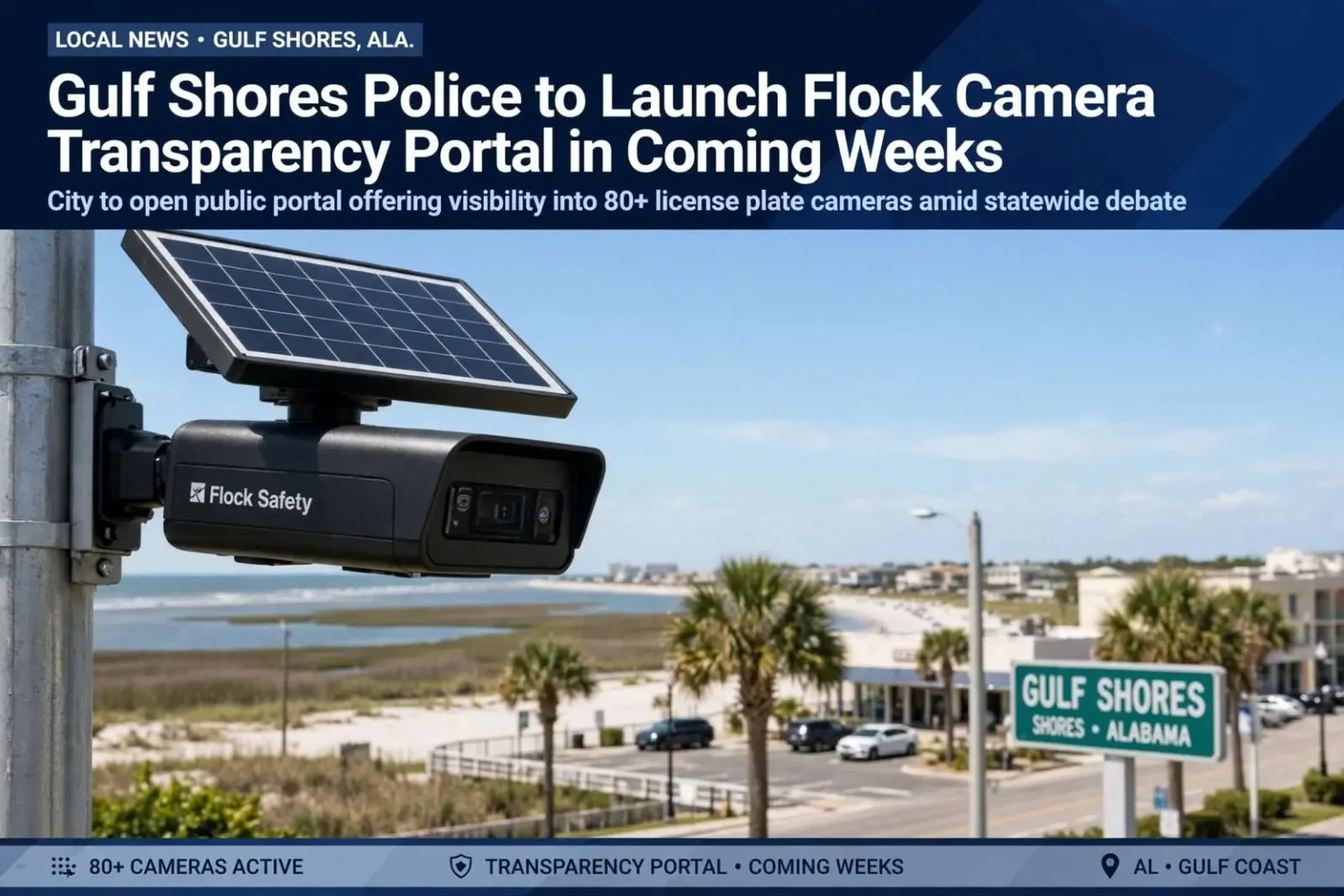
Gulf Shores police will launch a transparency portal for its network of more than 80 Flock license plate reader cameras in the coming weeks, as Chief Dan Netemeyer pushes back on what he calls misinformation.
GULF SHORES, Ala. — Another law enforcement agency is standing behind its license plate reader network — and Gulf Shores Police are preparing to pull back the curtain on how theirs is used.
The City of Gulf Shores operates more than 80 Flock cameras, and Police Chief Dan Netemeyer says the technology has helped his department solve a multitude of crimes. A transparency portal launching in the coming weeks will allow residents to see for themselves how the cameras are used.
Chief: ‘Misinformation’ Driving the Debate
Netemeyer defended the system amid a growing statewide debate over Flock cameras — a debate Walton County Sheriff Mike Adkinson has also weighed into on the Florida side of the line.
“License plate readers have been around for years,” Netemeyer said. “And all of a sudden, recently, it’s been an issue. And this issue is coming from misinformation that’s being put out there with regard to these cameras. I encourage everybody to do their own research. Make sure it’s factual.”
He stressed that the fixed cameras capture only what any passerby could see in public.
“We are not hiding anything. These cameras are in public places,” Netemeyer said. “They are taking a snapshot of a vehicle and a license plate. They’re not going into people’s homes, not tracking inside people’s homes. They’re not following people around. They are fixed objects that are tracking the street to which they are reading plates and getting descriptions of vehicles — no different than a police officer sitting there with a car camera on, filming every car that drives by.”
Training Emphasized Guardrails Against Misuse
This week, Flock officials held a training session with Gulf Shores police and city officials — and Netemeyer says the top theme was preventing abuse of the system.
“The training was more nuts and bolts of how to work the system, but the No. 1 emphasis that came out repeatedly is misuse,” he said. “Flock has a system in place, which has its own audit system that’s triggered if too many searches are being done by one individual or if the searches are outside the parameters of a law enforcement purpose.”
The upcoming transparency portal is designed to build on that accountability, giving the public visibility into how often — and for what purposes — the cameras are queried.
How the Network Came to Gulf Shores
The Gulf Shores City Council approved its contract with Flock in September 2025, and the cameras were installed in the spring. They were placed throughout the city, from parks to the beaches.
As a destination city that swells with visitors much of the year, Netemeyer says the network has become a critical tool — pointing to concrete results already.
“It’s a very powerful tool for us if you look at the crimes that have been solved already,” Netemeyer said. “We had two cases of dementia patients that we recovered in Gulf Shores within minutes. This would not have been done if officers had to drive around looking for vehicle descriptions and doing all these types of things. We’ve recovered a stolen car from another state.”
Annual Renewal Keeps the Decision Local
The contract renews every year, and the city will need to vote on it again when the council approves the budget — meaning the community’s elected leaders will get a recurring say on whether the program continues.
Until then, Gulf Shores officials are betting that transparency — in the form of the public portal — will do more to settle the debate than any single council vote.
How Automated License Plate Readers Work
Automated license plate reader (ALPR) systems like Flock Safety’s cameras use optical character recognition to photograph passing vehicles and convert license plate numbers into searchable data. Each camera captures a still image, timestamp and location, then checks the plate against databases of vehicles associated with active investigations, such as Amber Alerts, stolen vehicles or wanted persons. The technology does not use facial recognition and does not capture video in the traditional sense — it takes rapid still images triggered by vehicles passing through the camera’s field of view, then discards the vast majority of that data after a set retention window unless a plate matches a flagged record or is pulled into an active investigation.
That combination of broad, passive collection and narrow, rules-based alerting is what has made the technology attractive to police departments handling large volumes of vehicle traffic, particularly in coastal tourist destinations like Gulf Shores where the resident population multiplies many times over during peak season and officers cannot realistically track every vehicle description manually.
Flock Safety’s Rapid Expansion Nationally
Flock Safety, the company supplying Gulf Shores’ camera network, has grown into one of the most widely deployed ALPR vendors in the country over the past several years, with thousands of law enforcement agencies and homeowners’ associations now using its cameras. The company’s pitch to municipalities typically centers on solved-case statistics similar to the ones Chief Netemeyer cited — recovered stolen vehicles, located missing persons and leads generated in cases that might otherwise have gone cold. That growth has made Flock a familiar name in city council chambers across Alabama and the broader Gulf Coast, as departments in similarly sized coastal and suburban communities have signed comparable contracts to expand camera coverage along major corridors, at city entry points and near parks and beach access areas.
The subscription-based nature of Flock’s contracts — renewed annually rather than purchased outright — has also become a familiar feature of these deals nationally, giving city councils a recurring checkpoint to evaluate whether a program is delivering results proportionate to its cost, much as Gulf Shores’ own contract structure allows.
The National Privacy Debate
The rapid spread of ALPR networks has fueled a parallel and increasingly vocal debate over privacy, government surveillance and the potential for misuse. Civil liberties organizations, including the American Civil Liberties Union and the Electronic Frontier Foundation, have raised concerns for years about the aggregation of vehicle movement data, arguing that even if individual camera captures are innocuous, a dense network of cameras can allow authorities — or anyone with access to the system — to reconstruct a detailed picture of where a person travels over time. Critics have also pointed to instances in other jurisdictions where officers used ALPR systems to search for personal reasons unrelated to an investigation, or where data was shared with outside agencies in ways that residents did not expect when the cameras were installed.
Supporters, including many police chiefs who have adopted the technology, counter that the cameras only capture what is already visible in public — the same argument Netemeyer made — and that built-in audit trails make misuse both traceable and rare compared with the investigative value the systems provide. That tension between visibility and accountability is precisely what transparency portals like the one Gulf Shores plans to launch are designed to address, by giving the public direct insight into search logs and usage patterns rather than asking residents to simply trust the department’s internal oversight.
Legal Landscape for License Plate Readers
Courts have generally treated license plate reader data differently from the kind of cell-phone location tracking at issue in the U.S. Supreme Court’s 2018 decision in Carpenter v. United States, which required a warrant for long-term access to cell-site location records. Because a vehicle’s license plate is considered to be in plain public view, most courts have found that photographing it as it passes a fixed public location does not, by itself, constitute a Fourth Amendment search requiring a warrant. That legal distinction — between what a person knowingly exposes to public view and what a government track of a person’s comprehensive movements might reveal — remains actively litigated in state and federal courts as ALPR networks grow denser and retention periods lengthen, with some legislatures moving to set statutory limits on how long agencies may keep the data and who may access it.
Transparency Portals Elsewhere
Flock Safety and other ALPR vendors have built public-facing transparency portal products specifically in response to the kind of scrutiny Netemeyer described, and dozens of agencies around the country have adopted them as a standard feature of their camera programs. These portals typically publish aggregate information such as the number of camera reads processed, the number of times investigators searched the system, and the general categories of cases those searches supported — without publishing the underlying photos or personally identifying details of individual vehicles. The goal, as with the Gulf Shores rollout, is to let residents audit the pattern of use rather than any single officer’s activity, giving the public a way to independently check whether a department’s searches line up with its stated law-enforcement purpose.
Policing a City That Multiplies in Population
Gulf Shores’ year-round population is a fraction of the crowds that fill its beaches, rentals and hotels during peak tourist season, a seasonal swing that shapes much of how the department allocates resources. Camera placement near beach access points, parks and entry corridors reflects that reality: a comparatively small police force is responsible for public safety across a footprint that can see its population multiply several times over on a given summer weekend. Tools that automate routine vehicle checks — freeing officers from manually watching for vehicle descriptions tied to open cases — are part of why coastal tourist destinations along the Gulf Coast have been among the more active adopters of ALPR networks in recent years, even as the same seasonal crowds raise the stakes of getting the privacy balance right.