Mobile Man Sentenced to 60 Months for Fentanyl Trafficking in Federal Prosecution
A Mobile County man was sentenced to 60 months in federal prison for fentanyl trafficking after a 2022 search of his residence uncovered drugs, cash, guns.
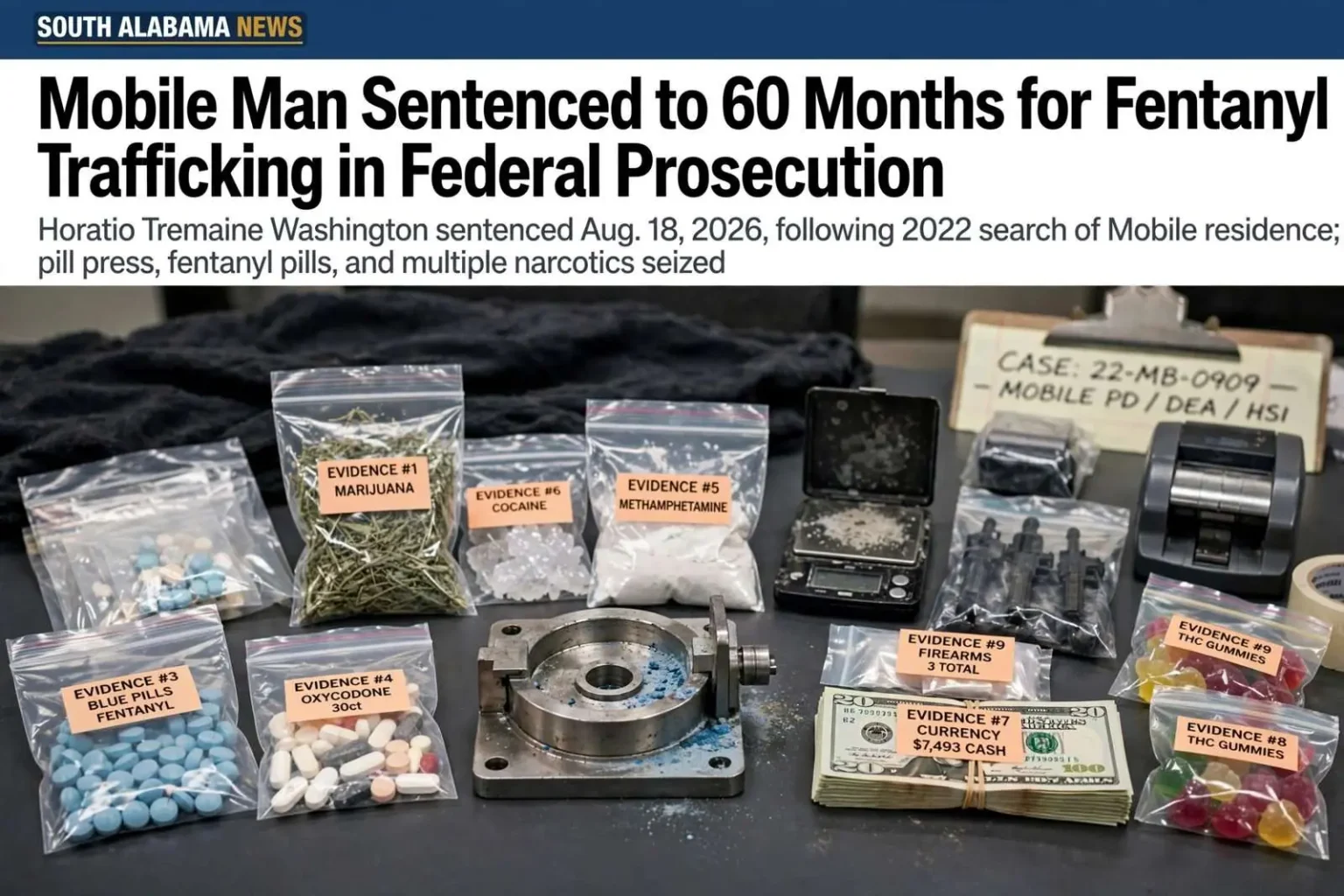
A Mobile County man has been sentenced to 60 months in federal prison for trafficking fentanyl, the U.S. Attorney’s Office for the Southern District of Alabama announced. Horatio Tremaine Washington was sentenced Aug. 18, 2026, by U.S. District Court Judge Terry F. Moorer following an investigation that began with a 2022 search of his Mobile residence.
What Investigators Found
According to court documents, Mobile Police Department officers executed a search warrant at Washington’s residence on Sept. 9, 2022. The search resulted in the seizure of a substantial quantity of drugs and related evidence, including a large quantity of marijuana, fentanyl pills, oxycodone pills, THC gummies, cocaine, and methamphetamine. Investigators also recovered two digital scales, drug packaging materials, $7,493 in U.S. currency, a money counter, three firearms, and a pill press — the kind of equipment often used to manufacture counterfeit prescription pills laced with fentanyl.
The presence of a pill press is particularly significant to investigators, since that equipment is commonly associated with the manufacture of counterfeit pills designed to resemble legitimate pharmaceuticals like oxycodone, but which are frequently laced with fentanyl at doses the person taking them has no way of verifying. That practice has been a major driver of overdose deaths nationally, since users often believe they are taking a known quantity of a prescription opioid when they are, in fact, ingesting a variable and potentially lethal dose of fentanyl.
The Sentence and What Comes Next
Following his 60-month prison term, Washington will be subject to five years of supervised release, a standard component of federal drug trafficking sentences that keeps a defendant under court supervision, subject to conditions like regular check-ins and drug testing, for years after their release from custody. Violating the terms of supervised release can result in a defendant being sent back to prison without a new criminal charge or trial.
The case was investigated jointly by the Drug Enforcement Administration, the Department of Homeland Security’s Homeland Security Investigations division, and the Mobile Police Department — a multi-agency structure typical of significant drug trafficking cases, where federal agencies bring resources like wiretap authority and interstate tracking capability that complement local police department’s on-the-ground investigative work. Assistant U.S. Attorneys George F. May and Justin D. Roller prosecuted the case on behalf of the United States.
Federal Prosecution and the Fentanyl Crisis
The sentencing highlights the ongoing crisis of synthetic opioid distribution in south Alabama and across the broader Gulf Coast region. Fentanyl, a synthetic opioid roughly 50 to 100 times more potent than morphine, has driven a dramatic increase in overdose deaths across the United States over the past decade, reshaping how federal prosecutors approach even mid-level trafficking cases.
The U.S. Attorney’s Office for the Southern District of Alabama has continued to prioritize fentanyl trafficking cases, citing the severe public health impact that even small quantities of the substance can have on a community. A single gram of fentanyl can contain thousands of potentially lethal doses, meaning that traffickers moving fentanyl in bulk — as the equipment seized from Washington’s residence suggests — can affect far more people than a trafficker dealing an equivalent weight of a less potent substance.
This case also illustrates the complex relationship between law enforcement and public health responses to the opioid crisis. While prosecutions like this one remain a central tool for federal authorities, public health officials and addiction specialists have increasingly argued that enforcement alone cannot resolve a crisis rooted in both supply and demand — meaning that communities across south Alabama also need expanded access to addiction treatment, harm reduction programs, and public education about the dangers of counterfeit and fentanyl-laced pills.
Community Impact and the Cost of Addiction
The impact of fentanyl trafficking extends well beyond the individuals directly involved in the drug trade. Families lose loved ones to overdose, emergency medical services face increased strain responding to overdose calls, and local economies suffer when addiction prevents people from participating fully in work and community life. Law enforcement officials frequently point to cases like Washington’s — involving a pill press and multiple controlled substances found together — as evidence that fentanyl has become deeply embedded in the broader drug supply, no longer confined to a single type of trafficking operation.
Effective prevention and intervention strategies, according to public health researchers, generally need to address both the supply side of the opioid market through enforcement actions like this prosecution, and the demand side through expanded treatment access, mental health services, and community-based support programs. Advocates for a more balanced approach argue that prosecutions provide only a temporary disruption to a given trafficking network unless paired with sustained investment in the treatment and prevention infrastructure that can reduce demand for illegal opioids in the first place.
How Federal Sentencing Works in Drug Trafficking Cases
Federal drug sentencing guidelines weigh factors including the type and quantity of drugs involved, the defendant’s criminal history, and the presence of firearms during the offense, all of which can push a sentence higher than a comparable state-level trafficking charge might carry. The combination of fentanyl, multiple other controlled substances, cash, and firearms found in Washington’s case reflects the kind of aggravating factors that federal prosecutors often cite when negotiating plea agreements or arguing for sentences at the higher end of the applicable guideline range.
The nearly four-year gap between the 2022 search warrant and the 2026 sentencing is not unusual for federal drug cases of this complexity, which often involve extended investigative periods to identify co-conspirators, trace financial transactions, and build a case strong enough to secure a conviction or plea agreement, followed by the standard federal court scheduling process for pretrial motions, plea negotiations, and sentencing hearings.
Officials with the U.S. Attorney’s Office for the Southern District of Alabama have indicated that fentanyl and counterfeit-pill trafficking cases will remain a top investigative priority for the office and its federal and local law enforcement partners as overdose deaths tied to fentanyl continue to affect communities across the district.
Fentanyl’s Growing Presence in the Local Drug Supply
Law enforcement officials across Mobile County and the broader Gulf Coast region have described a marked shift over the past several years in the composition of the local illegal drug supply, with fentanyl increasingly appearing not just on its own, but mixed into or pressed to resemble other substances entirely. That shift complicates both enforcement and public health responses, since a person seeking to buy what they believe is a prescription pain pill, a stimulant, or even a recreational drug like cocaine or methamphetamine may unknowingly be purchasing a product containing fentanyl, with no reliable way to know the actual dosage they are consuming.
The variety of substances recovered from Washington’s residence — spanning marijuana, prescription-style pills, THC products, cocaine, and methamphetamine alongside fentanyl — reflects that broader pattern of a diversified, multi-substance drug operation rather than a trafficker specializing narrowly in a single drug type. Investigators say that kind of diversified inventory has become increasingly common among mid-level traffickers, who often supply multiple market segments simultaneously to maximize revenue and reduce reliance on any single product line.
The Role of Pill Presses in Counterfeit Drug Manufacturing
Pill presses, like the one recovered during the search of Washington’s residence, are legal to own for legitimate pharmaceutical and industrial purposes, but their presence alongside illegal narcotics is treated by investigators as strong evidence of an operation manufacturing counterfeit pills rather than simply reselling drugs obtained from another source. The Drug Enforcement Administration has repeatedly warned that counterfeit pills made with pill presses and colored dyes can be visually indistinguishable from legitimate pharmaceutical products, making it effectively impossible for a buyer to determine whether a pill is safe without laboratory testing.
That indistinguishability has been cited by the DEA and public health officials nationally as one of the primary drivers behind a wave of accidental fentanyl overdoses among people who believed they were taking a known, regulated dose of a prescription medication like oxycodone or a benzodiazepine such as alprazolam, rather than an unregulated, unpredictable dose of fentanyl. Cases involving a pill press, as in this prosecution, are generally treated by federal prosecutors as evidence of a more sophisticated and dangerous operation than simple drug redistribution, often factoring into sentencing recommendations.
A Broader Federal Enforcement Push
Washington’s sentencing is part of a broader, sustained federal enforcement push against fentanyl trafficking across the Southern District of Alabama, which includes Mobile and Baldwin counties along with much of southwest Alabama. Federal officials have said repeatedly that fentanyl cases, in particular those involving evidence of pill manufacturing or large-scale distribution, will continue to receive prosecutorial priority given the substance’s outsized role in the region’s overdose deaths.
That prioritization reflects a broader national Department of Justice strategy that has directed additional resources toward fentanyl trafficking prosecutions in recent years, treating the substance as a distinct and especially urgent enforcement priority compared with other controlled substances, given its potency and the speed with which even a single exposure can prove fatal.
South Alabama News will continue to follow major fentanyl trafficking prosecutions in the Southern District of Alabama as they move through the federal court system.