
Alanna Royale Brings ‘Achilles’ to Mobile After Vocal Injury
Soul singer Alanna Quinn-Broadus discusses her album Achilles, made after a vocal injury, and Alanna Royale's rise in the Southeast soul scene.
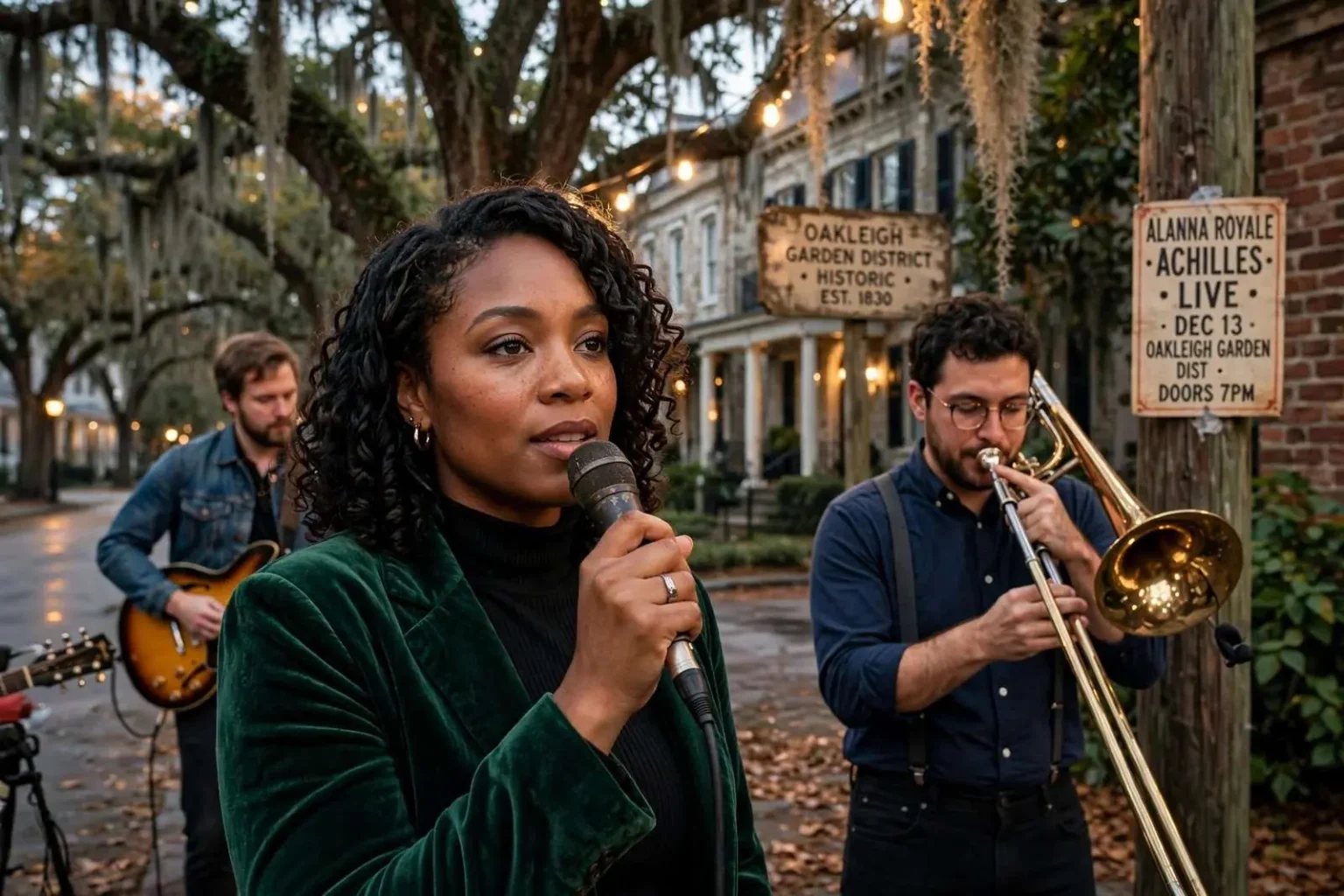
Alanna Quinn-Broadus has built Alanna Royale into one of the Southeast’s fastest-rising retro-soul acts, and the band was set to bring its latest release, ‘Achilles,’ to Mobile’s Oakleigh Garden District on Dec. 13. The Nashville-based singer, whose deep, soulful voice anchors the group, sat down ahead of the show to talk about the album and the road that produced it.
The Oakleigh Garden District, with its historic oak-lined streets just south of downtown Mobile, has become one of the city’s most atmospheric settings for live music — a neighborhood of century-old homes and small venues where touring bands can play close to an audience in a way larger stages never allow. For a soul band whose records are built on warmth and dynamics, the room matters, and the December date promised an intimate setting for material that had never been played there before.
The band arrives with a growing reputation across the region. Retro-soul — the revival style that borrows the horns, rhythm sections and vocal traditions of 1960s and ’70s soul — has flourished across the South over the past decade, and Alanna Royale’s combination of a full band and a commanding frontwoman has earned the group slots on bills throughout the Southeast and beyond.
‘Achilles’ and the Voice Behind It
‘Achilles’ arrived after Quinn-Broadus recovered from a vocal injury that nearly silenced her. She named the record for the vulnerability she confronted, calling her voice her Achilles’ heel.
For a singer, few prospects are more frightening than losing the instrument that cannot be replaced or upgraded. Vocal injuries — nodules, polyps, strain damage — have ended or paused the careers of countless performers, and recovery demands months of silence or near-silence, disciplined rest and often a complete reworking of how the singer produces sound. The album’s title turns that private ordeal into the record’s central metaphor: the strength of the band’s sound resting on its most fragile point.
After the setback, she committed to regular work with a vocal coach who, she said, changed her voice and changed her life. The coaching did more than rehabilitate; it rebuilt technique from the ground up, the kind of systematic retraining that many self-taught singers never undergo until an injury forces the issue. The voice that emerged, she suggested, is more capable than the one the injury took.
The album collects some of the first songs the band ever wrote, pared down from 14 to 10. That editing process — cutting four songs from a debut-length track list — reflects a band deciding what its record actually needed to say rather than everything it could say, a discipline that keeps a debut focused at a length listeners will absorb in one sitting.
From Near-Constant Touring to a Finished Record
Quinn-Broadus described the relief of finally finishing a full record after years of near-constant touring, and said the experience sent the group ‘straight to the moon’ about a follow-up that is already in the works. Bands that spend years on the road before releasing an album often accumulate more material than one record can hold; the band chose to bank its momentum rather than rush a second collection, planning new sessions while ‘Achilles’ was still fresh.
The touring schedule that delayed the record is also what built the audience for it. Alanna Royale’s growth followed the traditional club-circuit route — city by city, room by room — until the band’s name could anchor a bill in markets like Mobile without a national act above it. Records made after that kind of apprenticeship tend to sound like bands rather than projects, and ‘Achilles’ is the product of a group that has spent years learning its own dynamics on stage.
A Band Built by Chance
The band’s sound grew out of chance as much as design. Quinn-Broadus and her bandmates barely knew one another when they started gigging, and she recalled meeting trombonist Diego only as he walked on stage for their first show together. Two years on, she said, they are a stronger and better live act than ever.
Origin stories like that are rarer than they sound. Most bands rehearse for months before their first gig; Alanna Royale’s first show doubled as an introduction. The trombone — an instrument central to soul music’s horn-section sound — arrived in the band through that on-stage meeting, and the chemistry that could have failed on the spot instead became the group’s foundation.
Songwriting is collaborative, usually starting with a groove from Quinn-Broadus or guitarist Jarred before the rest of the band layers on its parts. ‘It wouldn’t be an Alanna Royale song’ if just one person shaped it, she said. In a genre built on ensemble interplay — horns answering vocals, a rhythm section locking under everything — that collective authorship is not just philosophy but the texture of the music itself. A soul song written by one person and arranged by session players sounds different from one built by the band that will tour it, and the band has bet its sound on the latter.
The Southeast’s Retro-Soul Moment
With the Southeast in the middle of a retro-soul resurgence led by acts such as Alabama Shakes and St. Paul and the Broken Bones, Alanna Royale has become a local favorite built on musicianship and Quinn-Broadus’s commanding vocals. The region’s grip on the revival is no accident: Alabama Shakes emerged from Athens, Alabama, and St. Paul and the Broken Bones from Birmingham, giving the state an outsized role in a sound that audiences nationwide had been craving.
That success rewrote expectations for Southern soul acts. Venues began booking horn-driven bands as headliners rather than opening acts, festivals built lineups around the style, and record buyers who had grown up on classic soul found new bands playing it with contemporary energy. For groups like Alanna Royale, the wave created stages to play and an audience pre-educated in what the music should feel like — big vocals, tight horns and rhythm sections that treat groove as the main event.
Against that competitive backdrop, a band’s durability depends on the live show. Studio production can be borrowed; stage chemistry cannot. The bands that survived the revival’s first wave are the ones whose concerts deliver what the records promise, and Quinn-Broadus’s account of the band’s two-year growth — from strangers who met on stage to a stronger live act than ever — tracks exactly with that standard.
The Mobile Show
The Dec. 13 date gave Mobile audiences a chance to hear ‘Achilles’ in the kind of room it was made for. The Oakleigh Garden District’s venues sit within walking distance of the neighborhood’s historic district, and a December Saturday in the area draws the mix of locals and visitors that Mobile’s revitalized downtown scene has cultivated over the past decade.
For the band, the show fit the pattern that produced the album in the first place — a tour stop in a city where word of mouth does the advertising, followed by the road miles that turn first-time listeners into the audience for the follow-up record now taking shape in Nashville. For local fans of the Southeast’s soul revival, it was a chance to catch the movement’s next generation in a neighborhood built for it.
Between the recovered voice at the center of the record, the catalog of first songs pared to its strongest ten, and a follow-up already underway, the band arrived in Mobile with the pieces in place for the chapter after the breakthrough — written, as always, by the whole band together.
What the Record Says
Listeners who come to ‘Achilles’ through the band’s live reputation will hear a record shaped by the stage. The songs are the first the band ever wrote — written before the audiences, the van tours and the vocal rehabilitation — and they carry the rawness of a group finding its identity in real time. Paring fourteen candidates to ten meant cutting the material that did not yet have a place in the live set, and the survivors are the songs that had already proven themselves in front of crowds.
The emotional center of the record is unmistakable. A singer naming her album after her own vulnerability is a statement about what the band’s music is for: not escapism but survival, the transformation of a frightening experience into something with a beat and a horn section. Soul music has always worked that way — grief, fear and resilience set to rhythm — and Quinn-Broadus’s injury story places ‘Achilles’ squarely in that tradition.
The follow-up already in the works will be the first record made by the fully formed band rather than the collection of newcomers who wrote the first one. Two years of touring changes how a group writes: arrangements account for the horns from the start, songs are built for the room as much as the studio, and the shortcuts a band discovers on stage find their way into the writing. Fans of ‘Achilles’ hearing the next record will effectively be listening to what the band learned between the two.
Why Rooms Like Oakleigh’s Matter
Bands in the middle of a scene’s rise often skip rooms like the Oakleigh Garden District’s on their way to bigger ones, but the small-stage circuit is where revival-style soul earns its converts. Horn-driven music compresses beautifully in a small room — the audience stands close enough to see the arrangements happen — and a band that wins over a December crowd a few hundred strong converts the most valuable kind of fan there is: the one who tells the next ten people about the show.
Mobile’s audience has proven receptive to exactly that kind of night. The city’s downtown and midtown venues have booked regional soul, funk and blues acts steadily as the local music economy has grown, and bands touring between New Orleans and the Florida Panhandle increasingly route through the Port City. A Dec. 13 show positioned the band on one of the busiest weekends of the local calendar, with holiday crowds downtown and a room full of listeners primed for the season.
The show closed out a year in which the band finished its first record, survived its scariest professional chapter and kept the touring pace that made both possible. The next chapter — the follow-up sessions, another tour, a bigger audience — was already being written before the year ended, one groove at a time.


