Semmes Celebrated Freedom and Service Members in 2008
A 2008 WKRG report covered the Celebrate Freedom fireworks, music and community event at Mary G. Montgomery High School in Semmes.
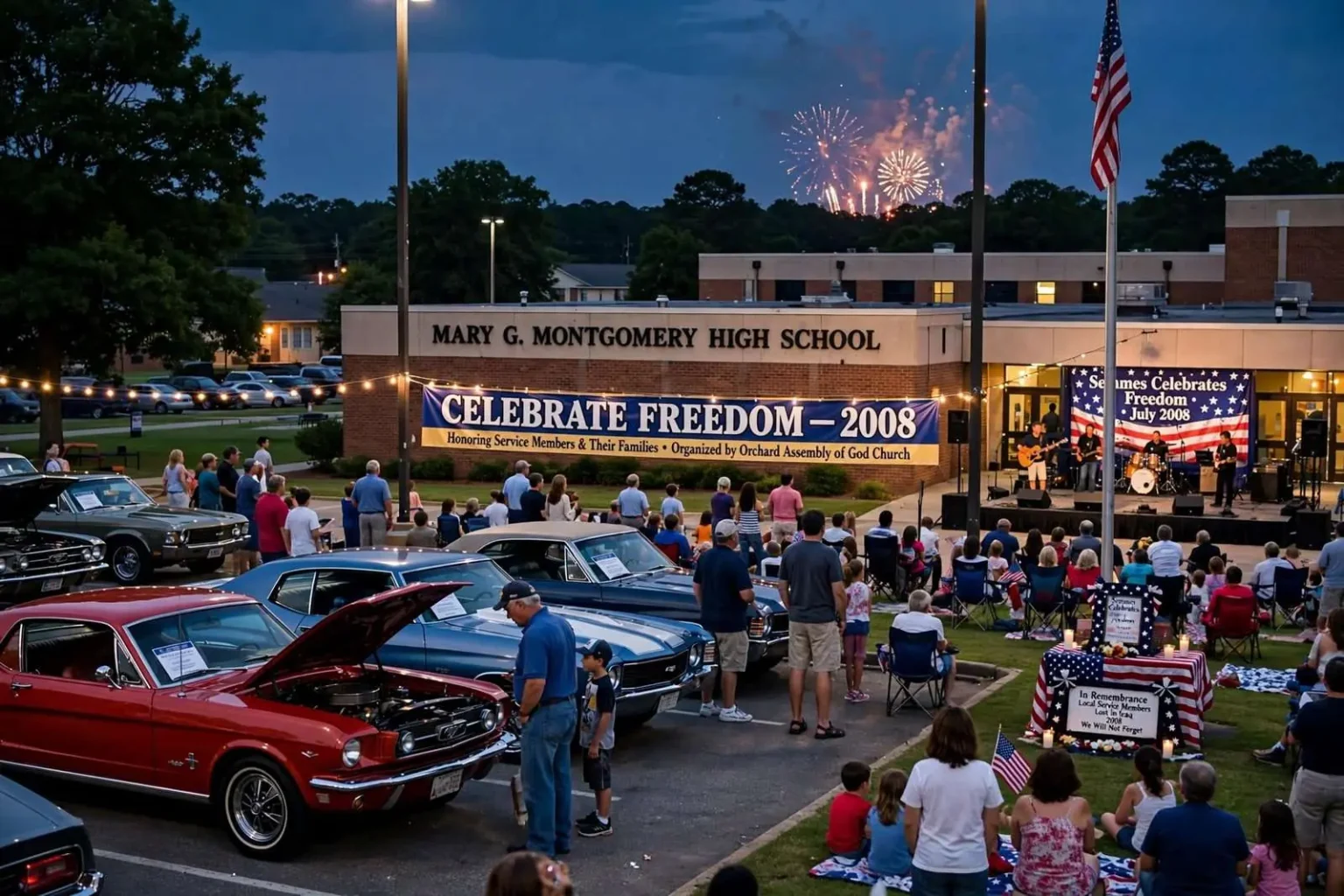
Semmes held an early Independence Day celebration at Mary G. Montgomery High School in July 2008, according to a local station report from the time. The event, called Celebrate Freedom, was organized by Orchard Assembly of God Church and included a fireworks show, car show and concert, drawing families from across the western Mobile County community.
Organizers said the event was intended to honor the country, service members and their families. Attendees came for the music and the fireworks, while some participants used the evening to remember local service members who had died in the Iraq War, which was still active that summer.
The setting was fitting for a community celebration. Mary G. Montgomery High School sits at the heart of Semmes, and its campus has long hosted the kinds of large public gatherings — festivals, benefit events, and holiday observances — that a growing but still close-knit community needs when it comes together.
Semmes in 2008 was a community in transition. Long known as the nursery center of the region, with generations of family growers supplying plants across the Gulf South, the area had incorporated as a city in 1996 and was steadily shifting from rural crossroads to suburb as Mobile’s growth pushed west along U.S. 98 and Moffett Road.
A Community Built Around Its Schools and Churches
The fact that a church organized and a high school hosted the event says much about how Semmes functioned. Civic life in the community has traditionally run through its congregations and its schools, institutions that supplied the volunteers, the grounds, and the audience for public celebrations.
Orchard Assembly of God Church was among the congregations active in community outreach in the area, and Celebrate Freedom fit a familiar pattern for churches of that era: staging family-friendly events that blended entertainment with patriotism and a message of gratitude for military service.
Fireworks, car shows, and concerts were the standard components of such gatherings across Mobile County in the years around 2008. Car shows in particular drew a broad mix — classic restorations, muscle cars, and everyday drivers polished for the occasion — and gave the event something to see in the hours before dark, when the fireworks closed out the night.
Holding the celebration in early July, ahead of Independence Day itself, allowed families to spread out their holiday activities and gave the community its own signature event rather than competing with larger fireworks displays closer to Mobile.
Honoring Service Members in Wartime
The timing of the 2008 celebration gave it a particular weight. The Iraq War remained in full swing that summer, and communities across south Alabama had felt its reach directly through deployed National Guard and Reserve units and through the casualties reported from active-duty ranks.
Local commemorations like Celebrate Freedom served as the place where those losses were acknowledged publicly. Attendees who remembered local service members who had died in the war were taking part in a tradition repeated in small communities across the state that summer — turning a holiday celebration into a moment of collective memory.
Military service runs deep in the Mobile region, home to a major Air Force base across the bay, a thriving Coast Guard presence on the river, and a long list of veterans’ organizations. For families in western Mobile County, the connection to service members is personal: neighbors, church members, and classmates, not distant figures on the news.
Recognizing military families — the spouses, parents, and children managing households during deployments — was a stated part of the event’s purpose, and that emphasis reflected the realities of a community where multiple families at any given time had someone serving overseas.
The Semmes of 2008
The Semmes that hosted Celebrate Freedom was a city finding its footing. Incorporation in 1996 had given residents local control over planning and services, but the community retained the character of its nursery-era roots: two-lane stretches of road, family farms and greenhouses, and a resistance to the dense commercial development seen elsewhere in the county.
Mary G. Montgomery High School anchored the community’s identity. The school, which takes its name from a longtime local educator, served as the point of pride for generations of graduates and the practical venue for events too large for private grounds. Its stadium and parking areas made it the natural choice for a celebration expecting a crowd and a fireworks launch site.
Growth pressures were already visible in 2008. New subdivisions were rising along the corridors leading into the community, and city leaders were working to balance that expansion with the character that long-time residents valued. Community events like Celebrate Freedom played a role in that balance, offering newcomers a way to plug into the town’s civic traditions.
The event also reflected the era’s broader pattern of patriotic observance. Seven years after the September 11 attacks, Independence Day celebrations nationwide had taken on added elements of military recognition, and communities like Semmes folded those tributes naturally into their fireworks and concerts.
Fireworks, Cars, and Community Rituals
The components of the evening — fireworks, car show, concert — formed a template that community organizers across the Gulf Coast relied on. Each piece served a distinct purpose: the car show drew attendees in the late afternoon, the concert held the crowd into the evening, and the fireworks gave everyone a reason to stay until dark.
For volunteers from Orchard Assembly of God Church, an event of that scope meant months of preparation, from securing the venue and arranging the pyrotechnics to recruiting volunteers for parking, concessions, and crowd management. Church events of that size typically doubled as outreach, introducing the congregation to neighbors who might not otherwise walk through its doors.
Local businesses in the community traditionally supported such events with sponsorships and in-kind contributions, another reflection of the way Semmes civic life wove together its commercial, religious, and educational institutions.
The report of the 2008 celebration survives as a snapshot of that moment: a growing community, proud of its service members, gathering at its high school for an evening of music, cars, and fireworks under an early-July sky.
Today, Semmes continues its tradition of community celebrations, and the city’s growth since 2008 has only added to the audiences for such events. But the core of the formula — honoring the country and those who serve it, hosted by the institutions that hold the community together — remains what it was on that summer evening in 2008.
Alabama and the Iraq War in 2008
Alabama’s ties to the Iraq War were extensive by 2008. The state’s National Guard brigades had deployed multiple times over the course of the war, and communities across south Alabama periodically gathered to send units off and welcome them home, rituals that made the war a local reality rather than an abstract headline.
The summer of 2008 also fell within the period of the surge’s aftermath, when the pace of deployments had strained military families nationwide. Events that honored those families, as Celebrate Freedom did, were part of how communities lightened the load — with public recognition, practical support networks, and the simple reassurance that neighbors remembered who was gone and why.
Gold Star families — those who had lost a service member — were a quiet presence at many such gatherings. In a community the size of Semmes, the fallen were not statistics but familiar names, and the moments of remembrance woven into the celebration carried a weight that larger city events often could not match.
Mobile County’s military connections extend beyond the war years: the region has hosted military installations for generations, and area schools have long counted military-connected children among their students. That backdrop made patriotic school-hosted events a natural fit in communities like Semmes.
Why Historical Summaries Matter
Local news coverage of community events fades quickly — stations move archives, websites disappear, and the details of ordinary civic life vanish. Historical summaries of reports like the 2008 Celebrate Freedom coverage preserve the record of how a community marked its milestones.
For researchers, students, and long-time residents, those records document more than an evening’s entertainment. They capture who organized community life, where residents gathered, and what the community chose to honor — in this case, country, service, and sacrifice.
This article is a historical summary of a 2008 community event report, preserving the details of that coverage for readers looking back on Semmes’ story. The event’s organizer, venue, purpose, and components — Orchard Assembly of God Church, Mary G. Montgomery High School, the fireworks, car show, concert, and the remembrance of local service members lost in Iraq — remain the documented heart of the story.
Community celebrations also leave practical legacies. The relationships formed among churches, schools, and city hall while planning an event like Celebrate Freedom tend to carry forward into other cooperative efforts — disaster relief after hurricanes, school support programs, and holiday charity drives that follow in later seasons.
Western Mobile County knows that pattern well. The region has weathered hurricanes that tested every community institution at once, and the volunteer networks built through celebrations and church outreach have repeatedly doubled as the backbone of recovery efforts in the aftermath.
For the families who attended in 2008, the evening offered what such nights always offer: a safe, familiar place to bring children, see neighbors, and enjoy a show. And for the families of deployed service members, it offered something rarer — a public acknowledgment, from their own community, that their sacrifice was seen.
That is the lasting significance of the 2008 report: not the size of the crowd or the scale of the fireworks, but the picture it preserves of a community that knew how to take care of its own, and did.