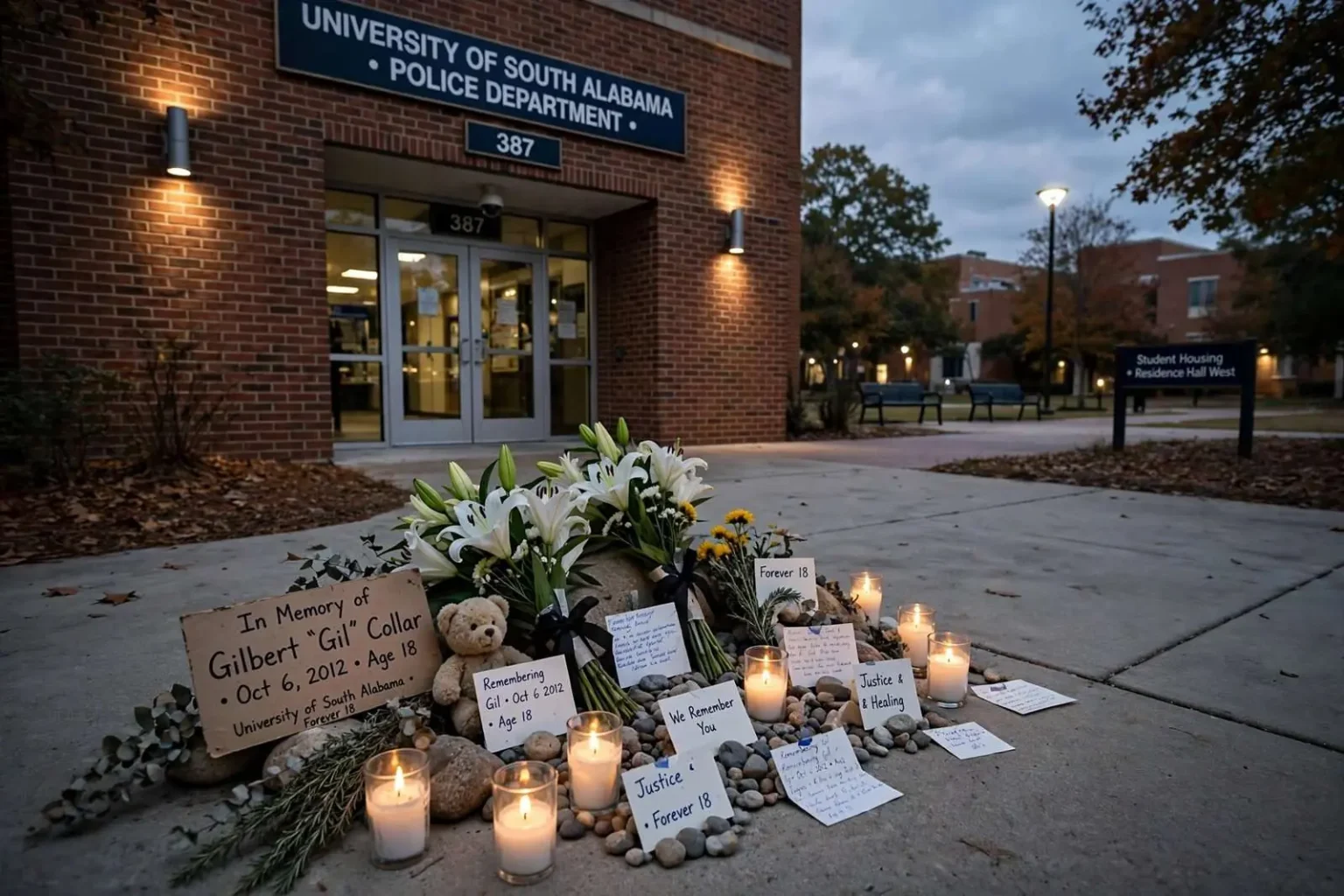
University of South Alabama campus in Mobile, site of ongoing reflection on campus safetyTwo years after Gil Collar's death, the University of South Alabama campus continues to reflect on the case.

Two years after an 18-year-old University of South Alabama freshman was shot and killed by a campus police officer, the case remains a defining moment in the school’s recent history, one that continues to surface in conversations about campus safety, mental health crises and how police respond to them.

Gilbert “Gil” Collar, a freshman from the Wetumpka area, died in the early morning hours of Oct. 6, 2012, after an encounter with a University of South Alabama police officer outside the department’s building near a residence hall. Investigators later determined Collar had ingested a synthetic drug that was not yet illegal in Alabama at the time, along with having used marijuana that night, according to law enforcement accounts from the period.

According to an attorney who represented Collar’s family, the circumstances leading up to that night remain murky in some respects, including exactly where Collar came into contact with the drug and whether he took it knowingly. What is better documented, based on surveillance footage shown to reporters by county law enforcement at the time, is the encounter itself: an unarmed, disoriented Collar approaching an officer outside the police building, the officer backing away before eventually firing, and Collar collapsing after being struck.

The shooting immediately divided the campus. Student leaders at the time organized both a vigil and dueling protests within the following week, one supporting the officer and another challenging the department’s response. National media outlets descended on the Mobile campus, and the case drew commentary from cable news figures who questioned whether a young person in crisis needed to die that night.

Collar’s parents have continued to struggle in the years since, according to the family’s attorney, compounding grief over their son’s death with a house fire that displaced them and left his mother with serious burns. Family members have said publicly that the loss remains difficult to process, even as they have tried to focus on supporting their surviving daughter.

University leaders have pointed to changes in campus safety practices in the two years since the shooting, including a broader campus-wide decline in reported crime. The officer involved in the shooting was placed on administrative leave following the incident and was later reinstated after a grand jury declined to pursue criminal charges against him; he has continued to serve on the university’s police force since that decision.

Former student leaders who were on campus at the time say the case still comes up regularly in conversations about the university police department, even as the immediate shock of 2012 has faded into a more settled, if still unresolved, chapter of campus history. Some have said the case pushed them toward a deeper appreciation for how quickly a routine campus safety encounter can turn tragic when drugs, mental distress and armed officers intersect.

See also  Mobile Carjacking Suspect Arrested After Chase, Crash

The case has also fed into broader statewide and national conversations about campus policing and how officers are trained to de-escalate encounters with people who may be experiencing a substance-induced crisis rather than posing a deliberate threat, a debate that continues to inform training discussions at universities across Alabama.

Alabama is a state in the southeastern United States bordered by Tennessee, Georgia, Florida, the Gulf of Mexico, and Mississippi. Often called the Heart of Dixie, it spans Appalachian foothills in the north and flat coastal plains in the south. Its largest cities include Birmingham, Montgomery, Huntsville, and Mobile.

Alabama’s history encompasses Indigenous roots, Spanish and French colonial settlement, a cotton-plantation economy, the Civil War and Reconstruction, and the Civil Rights Movement of the 1950s and 1960s, followed by a shift toward manufacturing, aerospace, and technology. Local news across the state frequently reflects this mix of tradition and change.

Mobile is the county seat of Mobile County in southwest Alabama and the state’s only saltwater port. Situated where the Mobile River meets Mobile Bay near the northern Gulf of Mexico, the city has long served as a commercial and cultural gateway between Alabama and the wider Gulf Coast. Founded in 1702 as Fort Louis de la Louisiane and ruled in turn by France, Britain, and Spain before joining the United States in 1813, Mobile carries a layered heritage distinct from the rest of the state.

Today Mobile anchors a metropolitan area spanning Mobile County and neighboring Baldwin County, and it remains a center for shipping, aerospace, healthcare, and higher education in the region. Its downtown and waterfront have seen sustained revitalization, while historic neighborhoods preserve architecture from its colonial and antebellum past. The city’s identity is shaped as much by its working port and industrial base as by its festivals and food culture, making it a frequent focal point for news about growth and change in southern Alabama.

Local law enforcement across South Alabama is carried out by municipal police departments, county sheriff’s offices, and state agencies that together cover a mix of urban, suburban, and rural territory. City departments handle policing within municipal limits, while sheriff’s offices provide courthouse security, jail operations, and patrol in unincorporated areas.

See also  How ALDOT and Mobile Traffic Engineers Kept 2026 Mardi Gras Season Moving

Cooperation among these agencies, and with federal partners, is central to tackling problems that cross jurisdictional lines, from drug trafficking to violent crime. Joint task forces that pair federal agents with local officers have become a standard mechanism for sharing information and concentrating resources on threats that no single agency could address alone.

Public-safety agencies in the region also contend with staffing, training, and community-relations challenges common to departments nationwide. How they allocate patrols, respond to calls, and engage neighborhoods is a regular subject of local oversight and news coverage, particularly where residents expect both accountability and visible protection.

Education in South Alabama spans public school systems in Mobile and Baldwin counties, a network of private and parochial schools, and institutions of higher learning including the University of South Alabama, Spring Hill College, and community colleges. Public-school governance rests with locally elected boards.

Boards oversee budgets, curricula, and facilities, often amid debates over funding equity and student achievement. The region’s colleges contribute not only to the workforce pipeline but also to healthcare, research, and cultural life, and education policy set in Montgomery frequently shapes what local districts can do.

Schools are also central to community stability. Enrollment trends, facility conditions, and graduation outcomes are watched closely by families and employers alike, making education a persistent focus of public attention and news coverage across the Gulf Coast.

Local journalism serves as the connective tissue of communities like those across South Alabama, informing residents about government, schools, public safety, and the events that shape daily life. Outlets covering Mobile and Baldwin County help hold institutions accountable and give voice to neighborhood concerns larger media may overlook.

In an era of shifting advertising revenue and the rise of digital platforms, community news organizations have had to adapt how they gather and deliver information. The persistence of regional reporting remains important for civic engagement, particularly on issues such as coastal development, education, and local governance that directly affect residents.

The relationship between a local newsroom and its community is reciprocal: readers supply tips, context, and a sense of what matters, while the reporting provides a shared record of decisions and events. That loop is essential to a well-informed public.

See also  Talk of a Special Session on Gas Royalties Set Up a Fight With Oil Lobbyists

The economy of the Mobile region is diversified across shipping and logistics, aerospace and shipbuilding, healthcare, tourism, and manufacturing. The Port of Mobile is one of the nation’s busiest seaports and a cornerstone of the local and state economy.

Major employers in aviation and defense contribute to a skilled workforce, while economic-development organizations aim to attract investment and jobs through incentives and infrastructure improvements. Small businesses, from restaurants to professional services, form the backbone of neighborhood commerce.

The health of the regional economy is a frequent subject of public discussion and reporting. Workforce development, recruitment of industry, and the fortunes of local retailers all feed into a broader picture of how the Gulf Coast competes and adapts in a changing national economy.

Behavioral-health care on the Gulf Coast is provided by a mix of community mental-health organizations, hospital systems, and private practitioners. Community centers play an especially important role in serving patients who might otherwise lack access to care, often coordinating with courts, jails, and social services.

Demand for these services has grown alongside heightened public awareness of mental illness and the lasting effects of disasters such as hurricanes. Workforce shortages of psychiatrists and other clinicians are a persistent challenge nationwide, and they shape how providers allocate limited staff time between direct patient care and the administrative and legal obligations that accompany treatment.

The intersection of mental health and the justice system is a national concern as well as a local one. Communities across the country have debated how best to divert people in crisis away from jails and toward treatment, a conversation that informs how courts, clinicians, and advocates approach commitment hearings and related proceedings.

Collegiate athletics are a major part of life in southern Alabama, where the University of South Alabama in Mobile fields the Jaguars across a range of sports. The university’s football program, which began competition in the 2000s, has become a rallying point for students, alumni, and residents and a source of regional pride.