Winners and Losers From Alabama’s Super Tuesday: The Politicos Weigh In
The day after Alabama's Super Tuesday primary, a panel of the area's savvier political hands sorted the winners and losers, from Trump's ceiling to a courthouse upset and incumbents who held firm.
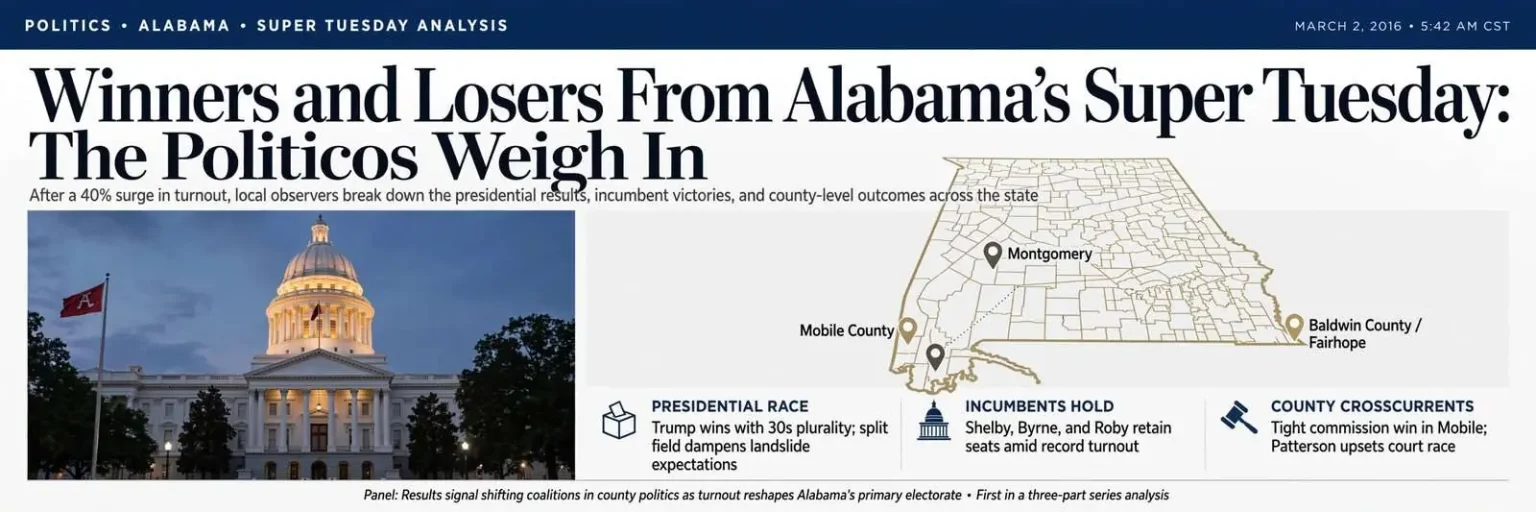
The day after Alabama’s Super Tuesday primary, the results and the strange campaign that produced them gave local political observers plenty to sort through. In keeping with a long-standing tradition, a rotating panel of the area’s savvier political hands offered their reading of the winners, the losers and those somewhere in between. Their comments are shared here without names, as is the custom. The first installment of the panel’s analysis focused on the presidential race, the fate of Alabama’s incumbents, and the county-level races that hit closest to home.
The presidential race
Several observers noted that Donald Trump, while winning Alabama, had not run up the towering numbers some in the national media had predicted, drawing largely in the 30s rather than the high 40s across much of the Deep South. Alabama is among the most Republican states in the nation in presidential years, and a Republican frontrunner running free of a serious establishment alternative might have been expected to approach a majority. Instead, the winner took the state with what the panel considered a merely solid plurality – evidence that the coalition behind him, however intense, was not the whole of the party.
One veteran read the outcome as evidence of a genuine anti-establishment mood among voters searching for an outsider – and questioned whether Trump’s rivals, chiefly U.S. Sens. Marco Rubio and Ted Cruz, could consolidate the opposition before it was too late. The arithmetic of the primary calendar favored the frontrunner as long as the anti-Trump vote divided among multiple candidates, and Alabama’s result, on that reading, showed a plurality riding high while a majority waited scattered across other candidacies.
The panel’s disagreement was over what the split meant. Some observers argued that the 30-something pluralities across the South revealed a ceiling that organizational candidates could eventually expose; others countered that expectations of consolidation ignored why voters had fled the establishment alternatives in the first place. Both camps agreed on one point: the Deep South contests, ordinarily afterthoughts on the presidential calendar, had become consequential, and Alabama’s voters knew it.
Alabama’s incumbents hold
The clearest theme was the durability of the state’s Republican incumbents. U.S. Sen. Richard Shelby dispatched challenger Jonathan McConnell without being seriously pressed, spending only a fraction of his war chest. The senior senator’s campaign was a study in dominance – overwhelming name recognition, an unmatched fundraising operation, and the accumulated goodwill of decades of federal projects steered home – and McConnell’s effort never gained the traction or the money to test it.
U.S. Rep. Bradley Byrne turned back perennial challenger Dean Young with about 61 percent of the vote, prompting one lobbyist to observe that Young’s commercials were potent but his campaign lacked the money and organization to win. Young had run against Byrne before and had once again demonstrated an ability to produce attention-grabbing advertising; what he had never assembled was the infrastructure to convert notoriety into votes across the whole district. Sixty-one percent, for a challenger with that baggage, suggested the incumbent’s margins were structural rather than personal.
U.S. Rep. Martha Roby likewise overcame a spirited primary challenge. Her race had drawn national attention as a test of whether a 2011 incident involving the president would end her career, and the Montgomery-area congresswoman survived it – evidence, the panel agreed, that time and a legislative record could outlast a single defining attack.
One Montgomery observer pointed to turnout as the real headline: nearly 900,000 votes cast, roughly 40 percent above 2012, bringing many first-time voters into the process and, in his view, strengthening the state party over the long run. Primary electorates are built over cycles, and a surge of new participants – whatever faction drew them – leaves behind names, volunteers, and habits that outlast the campaign that created them.
County crosscurrents
Closer to home, the panelists focused on the Mobile County Commission and a hard-fought circuit court race. Several judged Commissioner Jerry Carl weakened after squeaking out a 52-48 win and losing a majority of precincts, and questioned the political capital spent by Commissioner Connie Hudson and District Attorney Ashley Rich on endorsements that did not all pan out. A two-point win in an incumbent’s re-election race is less a victory than a warning, and the panel read it as a sign that the county’s political factions were shifting beneath the officeholders who thought they commanded them.
The endorsement spending raised a separate question. When prominent officeholders attach their names to a challenger or an incumbent who then loses, the currency of their endorsement is devalued for the next cycle, and the losing side remembers who opposed them. Several panelists suggested the county’s Republican leadership had overcommitted in the commission race, and would spend months repairing relationships the primary had strained.
One observer warned that Rich’s choices risked straining relationships in Montgomery at a delicate moment for a tax proposal she had requested. The district attorney’s office had sought new revenue, and the request’s prospects depended on goodwill in the legislative delegation and among state officials whose support could not be taken for granted. Endorsements made in a county race, the panel noted, are never entirely local – they follow an officeholder into every subsequent negotiation.
The circuit court result drew particular attention. James Patterson won a seat over a candidate favored by much of the local legal establishment, a result read by several as a rebuke to the courthouse’s usual power centers. Judicial races in Mobile County have long been managed by an informal network of senior lawyers who anoint successors and clear fields, and Patterson’s win demonstrated that the network’s blessing no longer guarantees anything on its own.
U.S. Sen. Jeff Sessions, an early Trump backer, was widely counted a winner for having read the moment before most of his peers. The endorsement, timed to Alabama’s own primary, put the senior senator on the winning side of his home state’s vote and positioned him as the establishment’s principal interpreter of the insurgency. Panelists who had doubted the endorsement’s wisdom weeks earlier conceded that Sessions had judged his electorate correctly.
Across the bay
In Baldwin County, one attorney tied the political mood to the school system’s finances, arguing that a tax-limiting campaign had left the schools short of money and shifted public sentiment. He counted the Fairhope city-schools movement and private academies among the beneficiaries of the turmoil, as families weighed their options. The county’s decade of growth had strained school budgets even before the tax dispute, and the prospect of further restraint was reshaping decisions in households well beyond the school board’s jurisdiction.
Not every verdict was tidy. Patterson, several noted, had won at the ballot box while alienating colleagues with aggressive tactics – a candidate who was, in the panel’s telling, both a winner and a loser on the same night. Judicial races end at the polls, but the victor must return to a courthouse full of the people the campaign antagonized, and several observers doubted the victory would feel uncomplicated for long.
With two more installments of the panel’s analysis still to come, the observers promised additional verdicts on the races that would shape south Alabama in the months ahead. The first night’s lesson, they agreed, was that no single narrative – wave, revolt, or establishment triumph – captured a primary that had scrambled expectations at every level of the ballot.
The turnout figure deserved a second look, several panelists argued, because it reframed every other result of the night. An electorate 40 percent larger than the last presidential primary did not simply reward the same candidates with more votes; it changed the composition of the voting pool, diluting the habitual primary voters whose preferences had organized Alabama politics for decades. Campaigns built on identification lists of reliable voters found those lists less reliable than usual, which is one reason incumbents with money still needed organization they had not recently exercised.
The new participants also presented the state party with an opportunity that cut across factions. Whatever had drawn them into the process – a presidential personality, an issue, or simple discontent – they had entered through a Republican ballot, and each of them was now a contact, a contributor, and potentially a future worker for the party’s apparatus. Political professionals across the South made the same calculation: surges of this size are rare, and the organizations that absorb them first inherit the advantage.
On the county level, the panel’s soberest verdicts concerned what the election had revealed about the durability of local coalitions. The commission race, the courthouse race, and the endorsement missteps all pointed in the same direction: the informal arrangements that had steered Mobile County politics for a generation were under strain, and the politicians who depended on them could no longer assume their protection. Whether the March results marked a permanent realignment or a one-cycle disturbance was the question the panel could not yet answer.
That uncertainty extended to the Baldwin County school dispute as well. The attorney’s argument – that a successful tax-limiting campaign had damaged the schools and moved public sentiment – implied a potential backlash with consequences at every future ballot, but sentiment is not the same as organization, and the panel noted that no countervailing campaign had yet formed. Between sentiment and results lies the unglamorous work of building coalitions, and the observers promised to keep watching for it as their analysis continued.