‘Underwhelmed’ by the GOP Field, Jay Cooper Enters the Baldwin Senate District 32 Race
Eastern Shore attorney and former Prichard mayor A.J. 'Jay' Cooper entered the race for Baldwin County's open Senate District 32 seat, saying he was 'underwhelmed' by the Republican field and moved more by duty than desire.
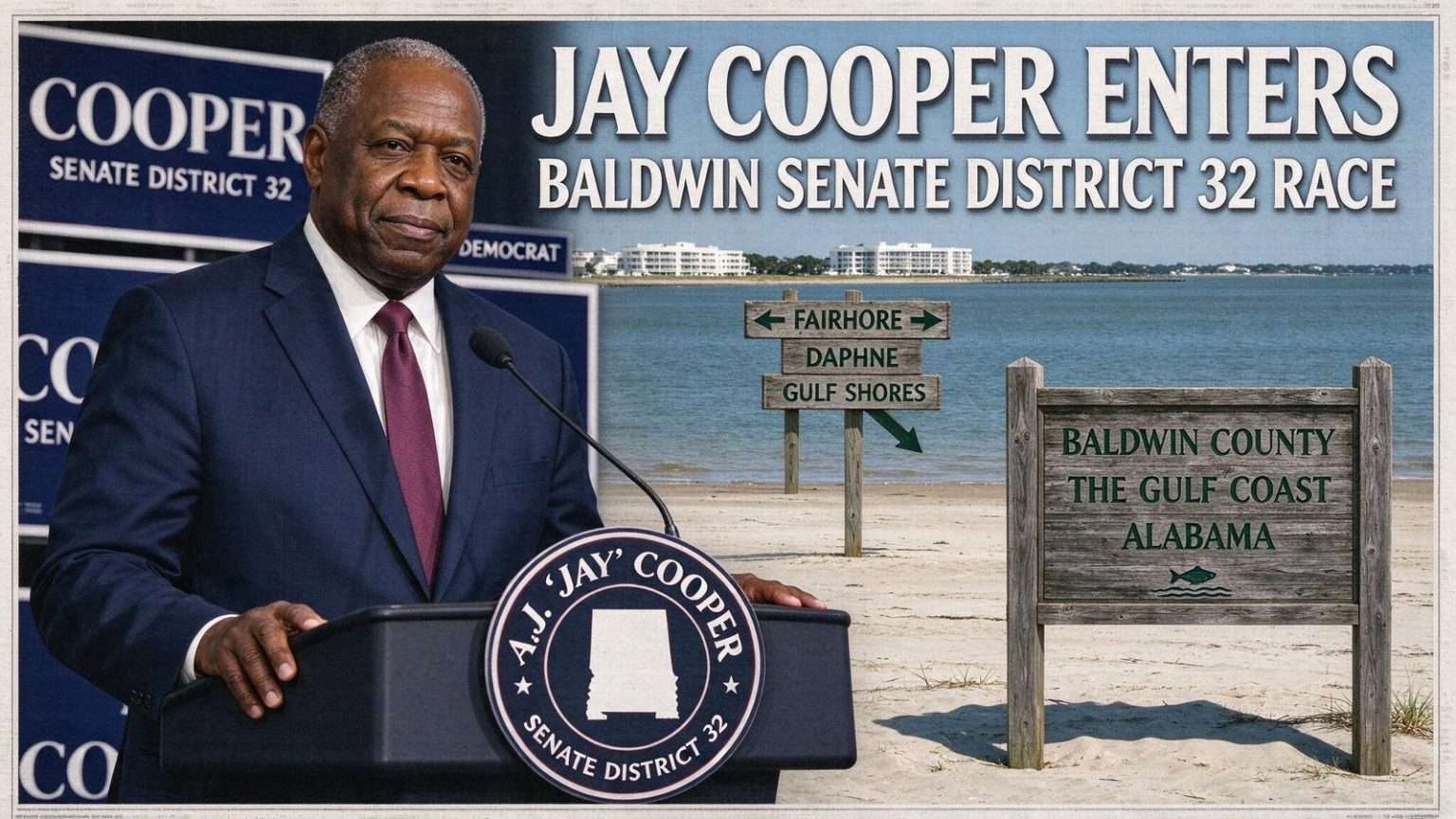
Declaring himself “underwhelmed” by the Republican field and driven more by “duty than desire,” Eastern Shore attorney and longtime Democratic figure A.J. “Jay” Cooper announced he would return to elective politics with a campaign for the vacant Baldwin County Senate District 32 seat.
Cooper said he reached the decision only after talking, in the days before the qualifying deadline, with a dozen Baldwin County residents whose politics spanned the spectrum. Their message, he said, was one of frustration: with “arrogant” officeholders, with taxes and fees that climbed even as services stagnated, and with elected officials so secretive that “citizens often didn’t find out about important matters until they were a done deal.”
The entry of a candidate of Cooper’s background into a Baldwin County race was a genuine event. District 32, which covers Baldwin County at the mouth of Mobile Bay, had for years been among the most reliably Republican Senate seats in Alabama, and Democrats rarely contested it with a serious, well-funded candidate. Cooper’s decision changed that equation, pairing a crowded Republican primary with a general-election opponent who could plausibly argue he was the most experienced person on the ballot.
A campaign built on ‘straight talk’
Education, jobs and housing topped the list of concerns Cooper said he heard, and he made them the center of his pitch. Baldwin County, he argued, “deserved better” than the choices before it. “Being the senator for District 32 is not a retirement program nor is it a place holder for career politicians,” he said.
Cooper called for a leader who would “fight for term limits” and “fight for children and teachers equally,” and who would practice “honesty in budgeting.”
He tied the county’s growth pressures to concrete concerns: affordable wind and flood insurance, housing within reach of young graduates and tradespeople as well as the elderly, and roads laid out to speed hurricane evacuation “and not just to help developers.”
Each of those concerns had a specific Baldwin County dimension. The county’s population had roughly doubled over the previous two decades, fed by retirees and second-home buyers drawn to Fairhope, Daphne, Gulf Shores and Orange Beach, and the growth had pushed home prices far beyond what teachers, deputies and young tradespeople could pay. Insurance had become the coast’s defining pocketbook issue in the years after Hurricanes Ivan and Katrina: wind premiums along the Gulf had climbed steeply, some carriers had withdrawn from the market entirely, and homeowners in coastal zones faced the paired costs of wind coverage on top of federally backed flood insurance.
Evacuation capacity was the third leg. With a single interstate spur and a handful of east-west arteries serving the beach communities, Baldwin County’s hurricane evacuation routes were a standing concern for emergency managers, and every new subdivision approved on those same corridors made the geometry worse. Cooper’s argument — that roads should be planned for evacuation first and development second — spoke directly to that tension.
Too often, he charged, the big issues, from health care and prisons to roads and taxation, became “insider” matters managed by lobbyists, leaving the public “the last to find out what really happened.” He said his campaign was still organizing, with offices planned in Bay Minette, Gulf Shores, Robertsdale and Fairhope — a footprint that mapped the county’s four corners, from the timber country of the north to the beaches of the south.
A crowded Republican field
The District 32 seat had come open when Bradley Byrne left the state Senate to become chancellor of Alabama’s two-year college system. Five Republicans were battling for their party’s nomination: former state Sen. Albert Lipscomb, County Commissioner Ed Bishop, Eastern Shore businessman Trip Pittman, state school board member and Gulf Shores real estate executive Randy McKinney, and Baldwin County GOP chairman and attorney Don McGriff.
The Republican primary was set for Aug. 7, with a runoff, if needed, on Sept. 11. Cooper and the eventual GOP nominee were to meet in the general election on Oct. 16.
The special-election calendar compressed everything. Candidates had to introduce themselves, raise money and organize a county with distinct political regions — the Eastern Shore’s suburban precincts, the agricultural center around Robertsdale and Foley, and the resort communities along the Gulf — in a matter of weeks rather than the year or more a regular cycle allows. The crowded field virtually guaranteed a runoff, which meant the Aug. 7 vote was really a qualifying round, and the Sept. 11 head-to-head would decide the nomination in a low-turnout contest dominated by the parties’ most committed voters.
The field itself mapped the county’s factions. Lipscomb carried the record of a former senator from the southern end of the county. Bishop brought county-government experience and its network. Pittman represented the Eastern Shore’s business establishment. McKinney combined a State Board of Education seat with real estate roots in the beach economy. McGriff, as county GOP chairman, entered with the party organization itself. Each carried a constituency; none could claim the whole county.
Byrne’s departure for the chancellorship was itself a sign of the moment. The two-year college system, one of the largest in the nation, had spent recent years under intense scrutiny over its governance, and the state had turned to Byrne — a former state board member known for reform-minded instincts — to lead it. His move out of Senate District 32 created the vacancy and, with it, the rare open seat through which a Democrat could argue the county deserved a genuine contest.
A long record in and out of office
Cooper brought an unusually national resume to a county Senate race. Born Algernon Johnson Cooper Jr. in Mobile in 1944, he lived on the Eastern Shore with his wife, Fairhope artist BJ Cooper, in a home his family built in 1946.
He was best known locally as the former mayor of Prichard: elected in 1972 to lead the city of some 45,000, he became the first Black candidate in Alabama since Reconstruction to defeat a white incumbent.
Prichard, just north of Mobile, was then one of the state’s most consequential Black-majority cities, and Cooper’s election there in 1972 made him a statewide and national figure at 28 years old. The milestone carried historical weight: Alabama had seen Black officials by the handful during Reconstruction, but a century of disenfranchisement had followed, and a Black candidate unseating a white incumbent mayor in 1972 marked how completely the Voting Rights Act era had rewritten the state’s politics in a single decade.
From there his career reached well beyond Alabama. Cooper was a founder and the first president of the National Conference of Black Mayors, which by then counted more than 800 members.
His political apprenticeship had begun on the staff of U.S. Sen. Robert F. Kennedy of New York, and he later worked on Robert Kennedy’s presidential campaign and on the re-election bid of Sen. Albert Gore Sr. of Tennessee.
The Kennedy connection dated to Cooper’s student years, and it placed a Mobile native inside the orbit of one of American politics’ most famous families at its most turbulent moment. After Kennedy’s assassination in 1968, Cooper carried the organizing skills of that campaign back south, working for Gore Sr.’s 1970 re-election effort in Tennessee — a race that tested the same coalition of labor, Black voters and New Deal liberals that Cooper would later help assemble in Alabama municipal politics.
The National Conference of Black Mayors grew out of that era’s organizing. In the early 1970s, the number of Black mayors in American cities was climbing rapidly — Carl Stokes in Cleveland and Walter Washington in Washington had broken the barrier a few years earlier — and newly elected Black executives needed an institution of their own to share expertise on municipal finance, federal grants and administration. Cooper, as a founder and its first president, helped build what became a durable national network of hundreds of member mayors.
After two terms as Prichard’s mayor, Cooper joined Secretary Moon Landrieu at the U.S. Department of Housing and Urban Development, then returned to Capitol Hill as executive director of the Congressional Black Caucus Foundation and later as a staffer on the House Ways and Means Committee, where he worked on the Tax Reform Act of 1986.
The 1986 tax act, signed under President Reagan after a rare bipartisan negotiation, was the most sweeping rewrite of the federal tax code in a generation, and a staffer who worked on it at Ways and Means had seen the legislative process at its most complicated. Cooper later became a partner in a Washington law firm in 1988, practicing litigation, legislative and administrative law and public finance — the last of which, ironically, is the daily bread of any state senator who has to balance education budgets against constitutional revenue limits.
Active in Eastern Shore civic life, Cooper served as vice-president of the Eastern Shore Democrat Club, general counsel of the Point Clear Cemetery Association and a trustee of Twin Beech AME Zion Church, which was marking its 140th anniversary. Those affiliations rooted him in the Fairhope and Point Clear communities he would be asking to support him, and in the historic Black institutions of the Eastern Shore whose histories long predated the area’s resort-boom decades.
His “professional, social, political and familial associations,” he said, brought “a powerful national network of relationships to problem solving.”
With his entry, District 32 voters faced a general-election choice between a deep Republican bench and a Democrat with decades of experience, and, by his own telling, more sense of obligation than ambition. Whether Baldwin County’s fast-growing, heavily Republican electorate would reward that experience was the question the Oct. 16 election would answer — but for the first time in years, the county’s Senate race would be argued in full, in every corner from Bay Minette to the beach.