What Is a Double-Dipper? Alabama’s Political Class Can’t Quite Agree
The phrase 'double-dipping' echoed through Alabama politics, but a survey of legislators, educators and attorneys found no agreement on what it actually meant, or whether it was a problem at all.
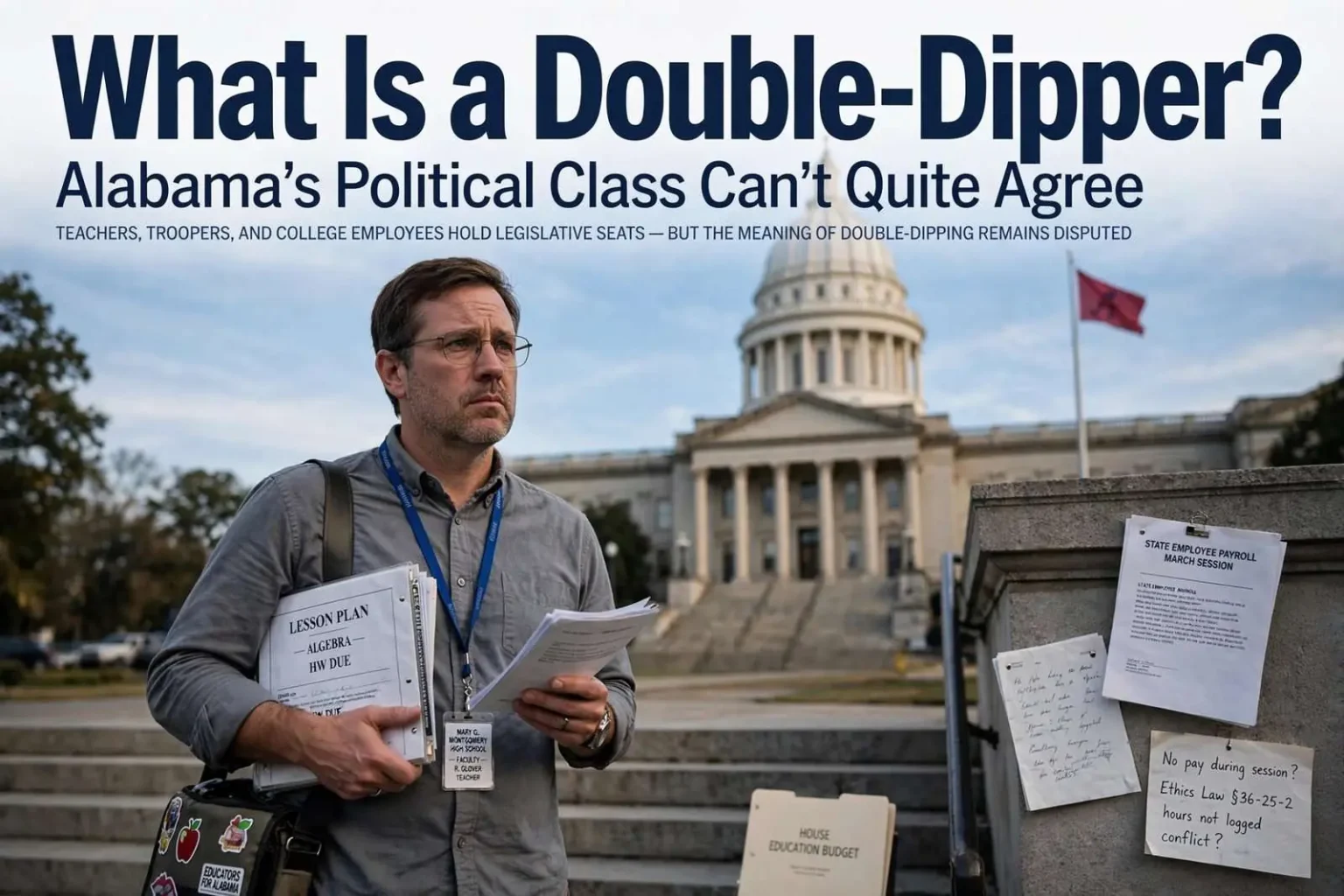
Few phrases had lodged themselves in Alabama’s political vocabulary quite like “double-dipping.” It surfaced in campaign ads, floor debates and State House hallway conversations. Yet for all its currency, the term meant strikingly different things to the lawmakers, educators, lobbyists and attorneys who used it, as a wide-ranging survey of officials across the state made plain. At its simplest, a double-dipper was described as a public employee who also held elected office, drawing two government paychecks at the same time.
But almost no one who weighed in was content to leave the definition there. To a schoolteacher in the Senate, double-dipping meant being punished for public service he had not chosen to abandon. To a county commissioner, it meant a legislator on a community college payroll. To a retired business owner in Gulf Shores, it meant anyone with a state salary and a state seat at once. The word carried an accusation of cheating in every usage, and that was exactly the problem: a term that flexible could be aimed at nearly anyone, and in Alabama politics it usually was.
Alabama’s Legislature is built on the assumption that its members live ordinary working lives. The state has long had a part-time citizen legislature, with annual pay historically measured in the tens of dollars per session day — a figure so small that virtually no one serves for the salary. Members keep their day jobs as teachers, troopers, funeral directors, bankers and farmers, and gather in Montgomery for sessions and committee weeks. That arrangement is a point of pride to defenders of the system and a structural hazard to its critics, because a legislator’s day job is very often a government job, and the two employers compete for the same forty hours.
The educators in the crosshairs
Much of the debate centered on teachers and two-year college employees who served in the Legislature. State Sen. Rusty Glover of Mobile, who identified himself as the only K-12 teacher then serving, said he was docked roughly $13,000 in teaching pay for the days he spent in session, and warned that the lost retirement contributions would follow him for years. In his view, the abuses lay elsewhere, among employees who were not docked when they were away in Montgomery. That distinction, between those who lost pay and those who did not, ran through many of the responses.
Glover taught at Mary G. Montgomery High School in Semmes, in the western reaches of Mobile County, and his arithmetic made the point better than any speech could. A legislator who teaches loses his classroom salary for every day the Senate sits — a sum he put at several hundred dollars a day — plus the retirement credit that would have accrued on it. Multiply that across a four-month session and the cost of public service becomes concrete: a teacher-legislator effectively pays for the privilege of representing his district, while a legislator whose employer keeps paying him while he sits in Montgomery pays nothing.
State Rep. Spencer Collier of Bayou La Batre, a former state trooper, argued that the answer was enforcement, not a blanket ban. “The ethics law says you can’t draw pay at the same time during the same hours,” Collier said. “We just need to enforce what’s in place.” He pointed to Glover, who he said lost several hundred dollars a day teaching at Mary G. Montgomery High School in Semmes, as an example of someone plainly not gaming the system.
Collier’s argument reflected his own working history. A trooper who entered the House did not resign his badge; the rules of the Department of Public Safety and the state ethics law required that he not be paid as an officer during the hours he served as a legislator. In his telling, the law already drew the right line — no simultaneous pay for the same hour — and the scandal-mongering around the word “double-dipping” painted honest men with the same brush as the few who actually bent the rules. Enforcement, he insisted, was a matter for the Ethics Commission, not for a prohibition that would empty the State House of working people.
A conflict of interest, critics said
Others saw a deeper problem. Randy McKinney, a Gulf Shores real estate executive who sat on the state Board of Education, said Alabama needed 140 legislators “that do not have a conflict of interest.” He complained that lawmakers who drew salaries from the two- and four-year college systems were, in effect, voting on the budgets and policies of their own employers, and that the arrangement had corrupted legislative decision-making on education funding for years.
McKinney’s position carried weight because of where he sat. The state Board of Education, meeting in Montgomery, governs the Alabama Community College System — the two-year colleges — and appoints its chancellor. A board member watching legislators collect paychecks from the very institutions his board oversaw had a front-row view of the conflict he described. His number, 140, was simply the size of the full Legislature, and his point was that the ideal of a conflict-free chamber was exactly that: an ideal Alabama had never approached.
The concern was not hypothetical. Over the preceding years, questions had mounted about legislators holding positions at community colleges, four-year universities and other state entities, sometimes with duties that were difficult to document and salaries that arrived regardless. Critics argued that such jobs functioned as rewards for legislative loyalty, distributed by institutions whose budgets depended on the General Fund and on the goodwill of the members voting on it. Defenders countered that most of those employees did real work and that a state whose legislature is part-time will inevitably draw its members from public employment, since those are the jobs with the flexibility to allow service in Montgomery.
The shadow of the two-year college scandal
Any discussion of double-dipping in Alabama arrives carrying baggage from the state’s two-year college system, and the officials surveyed knew it. Years earlier, the community college system had been rocked by a scandal involving nepotism, ghost jobs and legislative influence, culminating in a sweeping settlement that forced dozens of employees — many of them related to sitting legislators — off the payroll. Federal investigators had documented positions created for the relatives of lawmakers, institutional schemes in which employees collected pay for work they did not perform, and a culture in which the system’s leadership and the Legislature had grown intertwined.
That history changed the tone of every conversation that followed. When a legislator appeared on a two-year college payroll after the scandal, no explanation could fully cleanse the association. Reformers pressed for rules requiring legislators to disclose any state employment, and for college systems to stop hiring sitting members or their families. College presidents testified before legislative committees, resignations followed, and the phrase “double-dipping” became shorthand for an entire era in which public employment and public office had fed each other.
The survey of officials made clear how uneven the memory of that era remained. Some legislators spoke of it as old news, a wound that had healed and left the system cleaner. Others treated it as the defining fact of the debate, the reason any legislator-college employee combination deserved scrutiny by default. Lobbyists and attorneys who worked around the State House tended toward the middle: they described the scandals as real but contained, and argued that the cure — blanket bans — would do more damage than the disease by draining the Legislature of teachers, nurses, engineers and law enforcement officers.
What the word was actually used for
In practice, “double-dipping” functioned less as a description than as a weapon. In primary campaigns, it appeared in ads against incumbent legislators with state jobs. On the floor, it surfaced whenever an education budget fight turned bitter. In hallway conversation, it was a way of suggesting corruption without naming a crime. Because the term had no fixed legal meaning, no one could be charged with it — and no one could be cleared of it either.
Attorneys who followed the Ethics Commission made the sharpest distinction. The ethics law, they noted, prohibits a public employee from being paid by the state for hours also worked in another state capacity, and requires disclosure when legislators have employment that could conflict with their duties. Those are bright lines. What the public called double-dipping was often something else: simultaneous but separate employment, retirement collections layered on a new salary, or a part-time job at an institution that happens to depend on the Legislature. Ugly optics, in some cases; perfectly lawful in most.
Educators pressed the point hardest, because they bore the costs most visibly. A teacher-legislator like Glover lost pay and retirement credit on the record; a college employee whose institution quietly continued his salary while he served sat in the same chamber without any such loss. To the teachers, the injustice was not that some colleagues held two public roles — it was that the state treated identical service in opposite ways depending on who signed the paycheck.
Administrators in the two-year system, for their part, argued that their employees who served in Montgomery took leaves, forfeited hours or made up class time, and that the abuses had been swept out with the scandal settlement. The dispute, in other words, could not be settled by definition alone; it required records, disclosures and enforcement that the system had not consistently produced.
The options on the table
The reform debate that swirled around the term produced a short list of possible cures, each with its own constituency. One approach would ban legislators from holding any state or education employment outright — the cleanest rule and the one that would most radically change who serves. A second would require unpaid leave for the duration of legislative service, with the job held open, eliminating the paycheck while preserving the career. A third would rely on disclosure and enforcement, letting the Ethics Commission police simultaneous pay and requiring every legislator’s state employment to be listed publicly.
Supporters of the ban argued that only a bright-line prohibition could restore public trust, and that Alabama’s experiment with a working Legislature had produced exactly the entanglements the state had spent a decade untangling. Opponents answered that a ban would turn the Legislature into a chamber of retirees, lawyers and business owners — people with no stake in public education, public safety or public health — and that a citizen legislature’s strength is precisely that its members live the policies they vote on.
Between those poles sat the enforcement camp, represented most plainly by Collier: enforce the hours rule, publish the payrolls, and stop confusing lawful service with fraud. Their argument carried a practical appeal, since Alabama had already built the legal architecture; what it lacked was consistent application.
What it means for the state
Whatever resolution eventually emerges, the argument over double-dipping is at bottom an argument about what kind of legislature Alabamians want. A citizen legislature costs the state almost nothing in salaries and embeds working people in its lawmaking. It also, as the survey showed, manufactures conflict after conflict that a professional legislature would avoid by design. Every dollar of reform, every rule about leave and disclosure, flows from that trade-off.
For the educators, troopers and county officials who answered the survey, the stakes were personal. A docked paycheck of thirteen thousand dollars is not an abstraction, and neither is a district that loses its only classroom teacher in the Senate because the word “double-dipping” made his service politically toxic. The state will keep debating the term because it names a real problem — legislators employed by the governments they legislate — while smearing the honest service that makes Alabama’s part-time Legislature possible. Sorting one from the other is the work the Ethics Commission, the college systems and the voters have been left to do.