Bridge or Barrier? Mobile Reckons With Its City Council Super Majority
For 20 years Mobile's mayor-council government has required five of seven votes to pass most measures. Officials past and present disagreed sharply over whether the super majority built consensus or blocked progress.
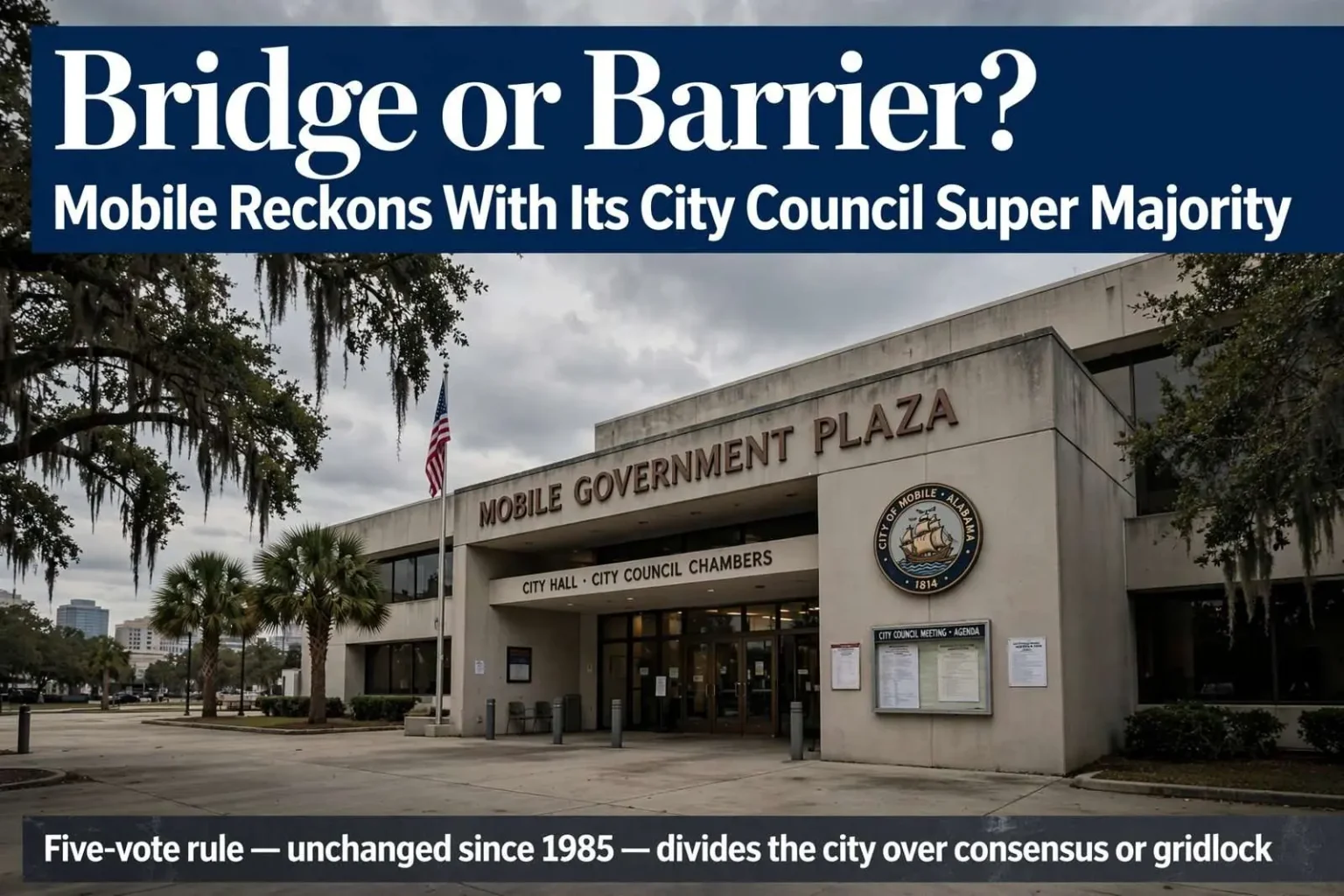
Among the peculiarities of Mobile’s government is a rule that sets it apart from most cities in the Southeast: to pass nearly any measure, five of the seven City Council members must vote yes. Only the annual budget, which requires a simple majority, escapes the so-called super majority. Two decades after it was written into the city’s mayor-council government, Mobilians still argue over whether the provision has been a bridge to consensus or a barrier to getting things done.
Under ordinary majority rules, four votes on a seven-member council are enough to pass an ordinance, award a contract or approve a zoning change. Mobile’s charter demands a fifth. In practice, that means no significant action at City Hall can succeed without at least one member of the council’s minority caucus — or, viewed from the other side, that any three members together can stop almost anything. Every contested project in the city, from road contracts to annexations, is negotiated in the shadow of that arithmetic.
Born of the 1985 transition
The rule traces to the late state Sen. Michael Figures, who added it to the legislation that led Mobile to adopt its mayor-council form of government in 1985. Figures, a veteran of the city’s politics, wanted to ensure that a black minority would hold real influence at City Hall rather than the mere appearance of it, having watched black officials repeatedly outvoted on the three-member county commission and the five-member school board.
The concern was grounded in hard experience. Under Mobile’s old three-member city commission and in county government, representatives of the city’s black community could win a seat and still lose every substantive vote, 2-1 or 4-1, leaving the office symbolic. Figures’s answer was structural: rather than trust goodwill or future election cycles, build a voting threshold into the charter that made the minority’s support mathematically necessary for almost everything the city does.
When the bill was vetted, the late Arthur Outlaw, then the heavy favorite to become mayor, told legislators he had no objection, and the super majority passed with scarcely a protest. The absence of a fight at the creation shaped the rule’s first decades: it arrived with the new government itself, and questioning it came to feel like questioning the 1985 settlement that had replaced the old commission with district-elected council seats.
The mayor-council form that the rule anchored changed the city’s politics permanently. Seven district-elected council members now answer to defined neighborhoods — from the wealthy western suburbs to the historic downtown districts to the working-class eastern shore communities — while the mayor is elected citywide. The super majority is the hinge between those two bodies: a mayor with four council allies can still be stopped at five; a council faction with three votes can still block.
The case for it
Several officials, past and present, defended the rule as a builder of consensus.
Council veteran Bess Rich argued that requiring five votes drew more members into the process and encouraged negotiation, making decisions more stable because more people had bought in. Rich, who represented a west Mobile district and built a reputation as a careful watchdog of city spending, contended that under a simple majority rule, major projects could pass on slim coalitions and be reversed four years later, while a five-vote requirement forces the winning side to do the persuading first.
County Commissioner Sam Jones, one of several candidates in that summer’s mayor’s race, credited the provision with giving voice to minorities of every kind, not only racial ones, and called the era since 1985 among the most progressive in the city’s history. Jones, a former city councilman and mayor pro tem who had moved on to the county commission, argued that the rule protects geographic minorities as much as racial ones — a single district’s concerns about a landfill, a road or a rezoning cannot simply be voted into oblivion by the other six.
Former Councilwoman Irmatean Watson recalled using the rule as leverage to win a program monitoring city contracts with minority and women-owned businesses. Her experience became the standard illustration of the provision’s purpose: a council member who could not pass an item alone could still ensure that nothing passed without it, and that bargaining position translated directly into policy — in Watson’s case, participation goals on city contracting that might otherwise have died in committee.
Defenders also pointed to the record of big projects that did get done. Under the five-vote rule, the city rebuilt its downtown, landed major waterfront investments, expanded the convention center and rebuilt neighborhoods after hurricanes. None of it required unanimity, but all of it required broad agreement, and backers argue that is precisely why the agreements held.
The case against it
Others insisted the provision had outlived its purpose. Former Councilman Charles Chapman, who led the council in its early years, argued that the rule had become a tool for obstruction — that three members aligned against a project could stall it indefinitely, and that developers and businesses took note of which districts were seen as veto points when they decided where to invest.
Chapman’s generation had seen both sides of the arithmetic. The council he led had used the threshold to guarantee inclusion in the city’s earliest post-1985 decisions, and had also watched measures with clear majority support die for want of a fifth vote. His conclusion, shared by a line of critics since, was that the protection the rule provided had been achieved just as well by district elections themselves — and that the cost of the extra threshold now fell on every taxpayer who waited on a delayed project.
Critics of the rule made several distinct arguments. First, that Mobile’s demographics had changed dramatically since 1985: the city’s black population was large enough that district elections alone — the other major reform of 1985 — guaranteed minority representation, making the extra vote threshold a belt-and-suspenders arrangement whose belt had long since been fastened. Second, that the rule inverted over time: what was designed to protect a minority could also protect a narrow faction, and the difference depended entirely on which three members happened to hold the veto.
Third, and most practically, that the threshold slowed the ordinary business of government. Routine measures — consent agendas, standard contracts, housekeeping ordinances — required the same coalition-building as contested ones, and the council’s docket filled with items deferred week after week while a fifth vote was found. Observers of other Southern cities noted that Birmingham, Montgomery, Huntsville and New Orleans all managed their affairs on simple majority votes without collapsing into minority oppression, and asked why Mobile alone needed five of seven.
Business leaders were frequently cited on both sides of the argument. Some developers said the rule created uncertainty — a project that clears four votes is still nothing in Mobile, and the final vote can be held hostage to unrelated demands. Others countered that the same dynamic guaranteed predictability, because no coalition could steamroll a neighborhood or rush through a rezoning over broad council opposition.
The 1985 settlement, reconsidered
The debate over the super majority is really a debate over the whole 1985 settlement. The mayor-council form, the seven district seats and the five-vote rule were designed together, in a city still healing from a divisive era of at-large elections and single-member district litigation. Nearly three decades on, the question is whether the mechanisms that made the transition work have become constraints on the government they created.
Amending the rule would not be simple in any case. The super majority is written into the city’s charter framework under state law, and changing Mobile’s governmental structure requires action in Montgomery — the same channel through which Sen. Figures originally inserted the provision. Any change would need a legislative sponsor, local approval and the political will to reopen arguments that many in the city’s political class considered settled.
The practical consequences show up in small places as well as large. A street-paving contract, a fireworks ordinance, a nonprofit’s request for city sponsorship — each waits for its fifth vote, and aldermanic-style bargaining spreads across the whole agenda. Council members who master the count become more powerful than their seniority or district size would suggest; those who cannot count to five sometimes watch projects in their own districts stall for want of allies elsewhere on the council.
That summer, with a mayor’s race underway and the rule’s defenders and critics speaking from experience — a council veteran, a county commissioner running for mayor, a former councilwoman who had used the leverage, and a former councilman who had chafed under it — the discussion was less a legal fight than a referendum on how Mobile governs itself. The five-vote rule remained on the books, exactly where it had been since 1985, requiring anyone who wants to move the city to first count to five.