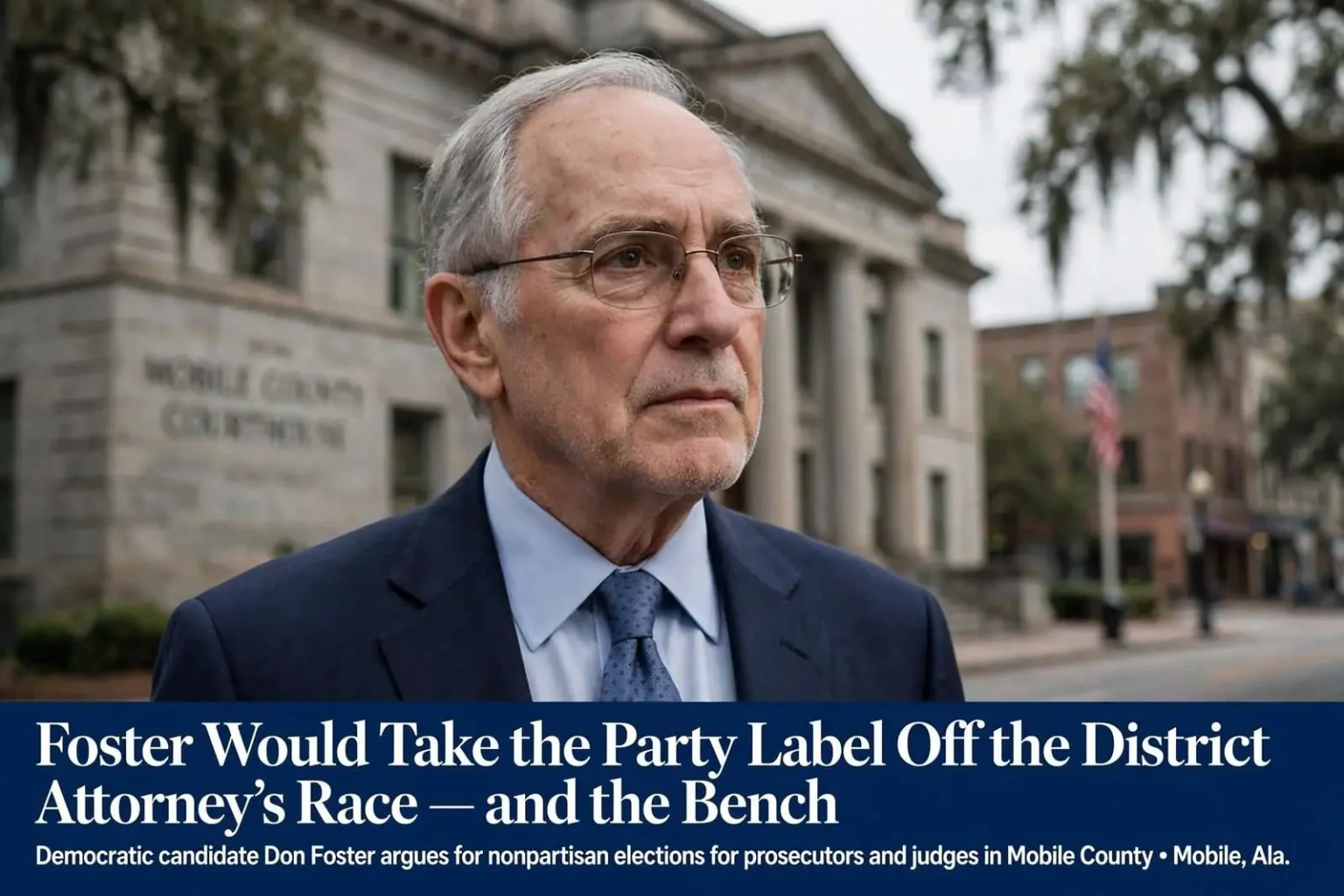
Don Foster will appear on the November ballot as the Democratic candidate for Mobile County district attorney. If it were up to him, there would be no party label beside his name at all — and none beside any judge’s, either.
A candidate arguing against his own ballot line
Foster, a former U.S. Attorney for the Southern District of Alabama appointed during the administration of President Bill Clinton, is not a reluctant Democrat. He qualified for the race under the party’s banner and is running with the party’s support. But on balance, he says, the legal system would be better served — and public confidence in it more easily maintained — if its most visible figures, prosecutors and judges, did not hold their offices as political partisans of either party.
It is an argument with a long pedigree in Alabama, and one that tends to surface loudest in years when judicial campaigns turn expensive and nasty. Alabama elects its judges in partisan contests, from district court through the state Supreme Court, and it elects its district attorneys the same way. Candidates for the bench raise money from lawyers who appear before them and from the interests those lawyers represent, and they run under a party symbol that tells voters, in effect, how they are expected to rule.
The concern is not hypothetical. In judicial races across the state, campaign spending has climbed for years, and the receipts tell the story: trial lawyers, business groups and party organizations all invest in bench seats because the bench decides questions they care about. Voters, meanwhile, see a landscape in which a candidate’s party is often the only signal they receive about a judge’s philosophy — even though a judge’s actual work, interpreting law rather than making it, has no legitimate partisan dimension at all.
What the district attorney’s office actually does
The scale of the office helps explain why the label matters. The Mobile County district attorney prosecutes every felony and misdemeanor case in the county’s state courts — a docket that runs from shoplifting and DUI through assault, robbery and capital murder, across circuit and district courtrooms in downtown Mobile and the satellite courts that serve the rest of the county. The office also handles grand jury presentations, juvenile matters, worthless-check and bad-check diversion programs, and the victim-services work that follows families through the life of a case. Its lawyers appear in courtrooms daily in front of judges the public rarely thinks about until a case makes the news.
Because the district attorney sets charging policy for the entire county, the office’s choices ripple outward: which drug arrests get prosecuted, how domestic violence cases are handled, when death-penalty notices go out. Those choices affect thousands of defendants and victims a year — and none of those people appear on the district attorney’s ballot as constituents. That imbalance, reformers argue, is exactly why the office should be insulated from the appearance of political calculation: the people most affected by a prosecutor’s judgment often have no vote in who holds it.
The practical case
The office Foster seeks makes the point neatly. A district attorney decides which cases to charge, which to plead and which to take to a jury. Those choices land on individual defendants and individual victims, and the public is entitled to believe they were made on the evidence rather than on the politics. In a partisan system, however, every high-profile prosecution invites the suspicion that party advantage played a part — a suspicion that has attached itself to more than one investigation in Mobile County over the years, fairly or not.
Removing the party label would not eliminate politics from prosecution, but it would remove one obvious source of doubt.
Foster speaks from experience on both sides of the distinction. As U.S. Attorney for the Southern District of Alabama, he held one of the most powerful prosecutorial jobs in the region — a post he reached through presidential appointment rather than election, accountable to the Department of Justice rather than to an electorate. Federal prosecutors, whatever their other pressures, do not run for office, and Foster’s argument is essentially that the state system should work more like the one he served: professional prosecutors, chosen on qualifications, judged on outcomes.
The counterargument is equally familiar. Partisan elections, their defenders say, are the only accountability mechanism voters have over prosecutors and judges, and removing the label would simply hide politics rather than remove it — candidates would still raise money and court factions, but under a banner of neutrality that makes the connections harder to see. Alabama’s constitution has been amended hundreds of times precisely because voters here like direct control over their officials, and judicial elections are part of that tradition.
The race ahead
Foster, 63, will face the winner of the June 1 Republican primary, in which assistant Mobile County District Attorney Ashley Rich and Mark Erwin, a former Mobile County GOP chairman and Saraland municipal judge, are competing for the nomination. The seat is open because incumbent District Attorney John Tyson Jr., a Democrat, chose not to seek re-election after holding the office since 1994.
Tyson’s departure marks the end of a long era. Sixteen years in office — spanning four presidential administrations, a generation of prosecutors trained in his office and thousands of cases — made him a fixture of Mobile County government and, unusually for a Democrat in a county trending the other way, an officeholder who kept winning countywide. His decision not to seek re-election opened the first truly contestable race for the office in well over a decade, drawing a crowded field on the Republican side and giving Foster, the lone Democrat, a chance to make his case in the county’s most consequential local race.
Whether nonpartisan elections would help Foster politically is a separate question from whether he believes in them. Mobile County has trended Republican in countywide races, and Tyson has been the exception rather than the rule — the only Democrat to hold a non-judicial, countywide elective office in recent memory. Three local circuit judges still hold their seats as Democrats.
Foster’s party, in other words, is unlikely to be his strongest asset in November, which gives his argument a certain irony: a Democrat arguing for nonpartisanship in a county where nonpartisan races would probably help Democrats. He frames the question the other way around — not what the arrangement does for his candidacy, but what the current arrangement does for public confidence in the courts and in the district attorney’s office.
Changing the system takes Montgomery
Changing the system would take an act of the Legislature, not a promise from a candidate. Bills to make judicial elections nonpartisan have been introduced in Montgomery before and have gone nowhere.
The obstacles are structural as much as philosophical. The parties have no institutional appetite for giving up the ballot label, which helps them fund and organize races up and down the ticket. Incumbent judges who won under one party’s banner are reluctant to support a change that might be read as an admission about how they got there. And any measure that reaches the Statehouse has to compete with the broader, recurring debate over whether Alabama judges should be elected at all — a debate that resurfaces after every expensive judicial campaign and has repeatedly produced proposals for appointment-and-retention systems rather than merely nonpartisan ones. Neighboring states have watched the same argument and moved in different directions, which reformers here cite as proof that change is possible — and opponents cite as proof that Alabama can keep the system it knows.
Foster’s position is therefore a statement of principle rather than a plank he could deliver from the district attorney’s office. It does, however, tell voters something about how he intends to campaign: as a prosecutor first and a Democrat second, in a county where the second half of that formulation is the harder sell.
What voters will actually decide
The November contest will still be fought on ordinary terms — party against party, experience against experience — whatever Foster’s views on the system that stages it. The Republican primary between Rich and Erwin offers voters a genuine choice of backgrounds: a career prosecutor from inside the office, and a former party chairman with judicial and political experience of his own. The winner inherits both an open seat and, for the first time since 1994, the challenge of succeeding rather than replacing.
Whoever wins will take office with the same discretion Foster describes — the power to charge, to plead and to try — and the same obligation to exercise it in a way that a divided electorate can trust. Foster’s argument is that the system should make that trust easier to earn. Whether voters agree may say as much about the county’s politics as about his candidacy.