Democrat James Anderson Courts Wary Conservatives in Attorney General Bid
Democratic attorney general nominee James Anderson campaigned through Mobile, making the case that his mainstream record should appeal to conservative voters who have drifted toward the Republican column.
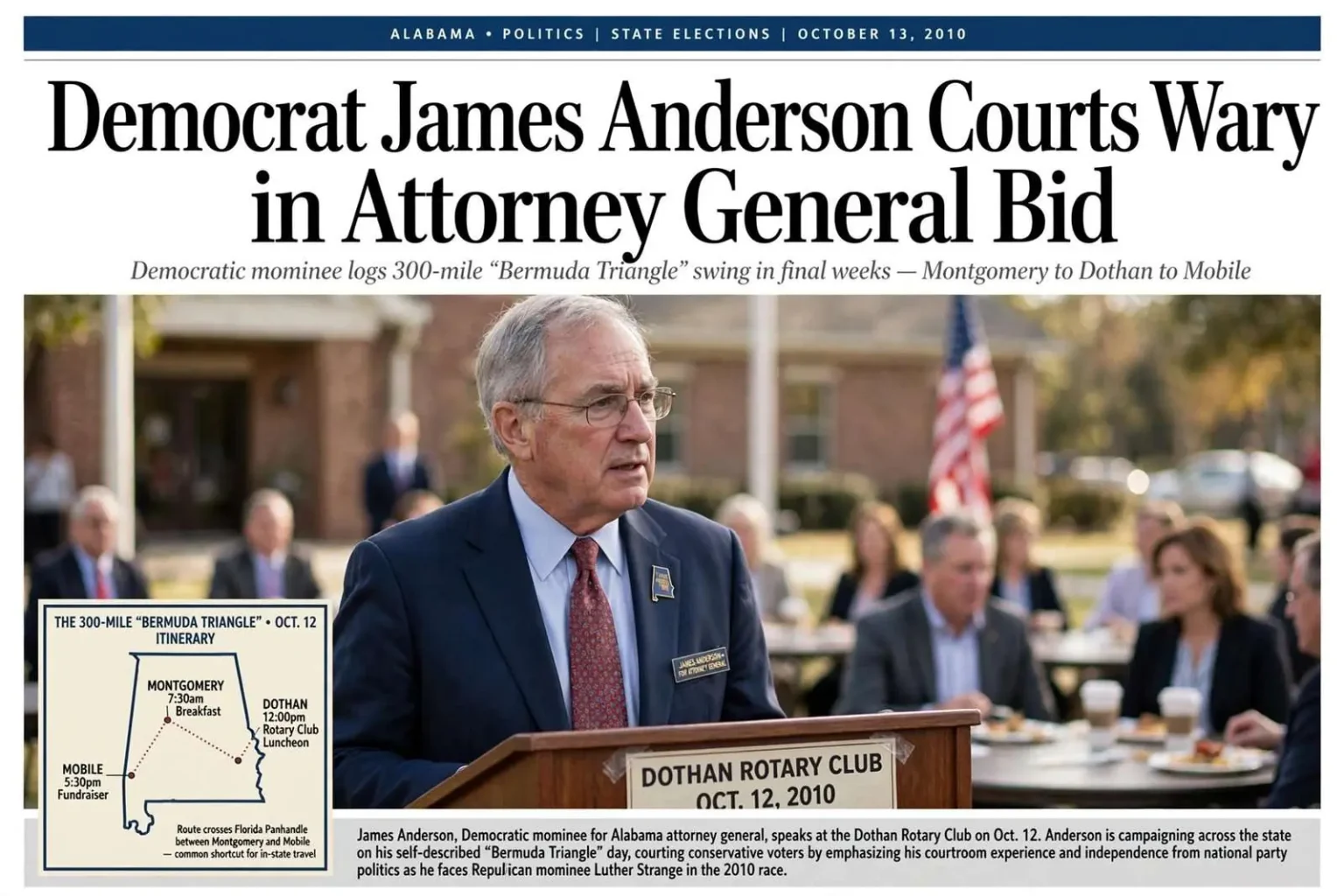
Democratic nominee for attorney general James Anderson dubbed one grueling campaign day his “Bermuda Triangle,” a Tuesday, Oct. 12 itinerary that carried him from a breakfast meeting in Montgomery to a Rotary Club luncheon in Dothan, then to an early evening fundraising reception in Mobile and back to headquarters in Montgomery late that night. The route stitched together three of the state’s population centers in a single stretch of daylight, the kind of itinerary that only a statewide campaign in a geographically sprawling state produces in its final weeks.
Fittingly, during a phone conversation as he drove through Florida en route to Mobile, the call dropped a couple of times — a small malfunction that seemed to amuse rather than irritate a candidate who had spent months shuttling across the state. The Panhandle detour is a quirk of Alabama geography: the fastest route between Montgomery and Mobile hugs the edge of Florida for a stretch, so even in-state travel can carry a candidate across a state line and into somebody else’s cell towers.
The 2010 attorney general’s race had settled into a study in contrasts between Anderson, a veteran Montgomery lawyer and former state official, and Luther Strange, a Birmingham attorney and lobbyist who emerged from the Republican primary as his party’s nominee. Alabama’s attorney general occupies one of the most visible offices in state government, charged with representing state agencies in court, issuing formal opinions that guide county and municipal officials, and leading prosecutions in matters ranging from public corruption to consumer fraud. Campaigns for the office tend to turn on questions of experience, independence and law enforcement credibility rather than the broader ideological disputes that dominate top-of-ticket races.
A second Bermuda Triangle
Anderson used the phrase to point to another metaphorical Bermuda Triangle: the exodus of white conservatives from the Democratic Party rolls in Alabama and across the South. Over the previous two decades, that migration had remade the electorate of both parties, draining the Democratic Party of the conservative white voters who once anchored its county committees and legislative delegations and delivering them to a Republican Party that had grown from a regional minority into the state’s dominant force.
He knew he would need support from voters who had migrated to the Republican side of the ballot, and he strained to emphasize a mainstream background that, he argued, did not differ markedly from theirs, except for his label as a Democrat and their alienation from national Democratic Party policies. The pitch was straightforward: judge the candidate by his courtroom record and his Alabama biography, not by the letter beside his name or the positions of a national party he had no role in steering.
His Republican opponent, Luther Strange, would counter that a Democrat is a Democrat. The argument reflected the harsh arithmetic of the year, in which the national political environment leaned heavily against Democratic candidates and Alabama Republicans worked to make every race a referendum on the party in power in Washington. For Anderson, the challenge was to make the election a conversation about qualifications rather than a down-ballot expression of national sentiment.
Anderson sought instead to frame the contest not around party labels but around a Washington insider versus an experienced Alabama public servant. He hammered Strange at every turn as a lobbyist rather than a lawyer, while pointing to his own extensive courtroom background. In Alabama political vernacular, “lobbyist” is an accusation with a long history, conjuring the image of a hireling who works the halls of government on behalf of paying clients, and Anderson’s campaign pressed the charge in debates, in advertisements and in the stops of a schedule that covered the state from the Tennessee line to the coast.
The framing carried a specific point about the office itself. The attorney general represents the state in litigation, defends its laws, and must decide which investigations to pursue — decisions that inevitably touch politically connected interests. A candidate whose career had been built representing clients before government, Anderson argued, entered that office with a different set of instincts than one who had spent his career on the other side of the courtroom as a practicing lawyer and prosecutor’s counterpart.
Service over ambition
Anderson reflected on the nature of running for office, saying partisan tides ebb and flow so that timing matters to any candidate’s decision. Yet a would-be public servant, he argued, has to offer his record for service rather than time it to his own ambition. The distinction captured his case for the race: that a career of public work qualifies a person for office regardless of the year’s political weather, and that waiting for a favorable cycle would say something unflattering about the motives behind the candidacy.
He recounted advising his son, a student at Cumberland School of Law weighing whether to seek a class leadership post, that opportunities to contribute come along only so often. Cumberland, the Birmingham law school with roots stretching back more than a century, has trained generations of Alabama lawyers, and the conversation between father and son about a student election became, in the retelling, the hinge of the entire campaign.
After the call, Anderson said, he realized he needed to practice what he preached and phoned his son back to say he had decided to run for attorney general. The anecdote became a staple of his appearances, a way of answering the unspoken question of why a man well past the usual age of political ambition would submit to the grind of a statewide race: because he had given his own son the advice and could not, in conscience, decline to follow it.
A model in Baxley
Anderson cited the example of Bill Baxley, the Democrat who won the attorney general’s office in 1970 at the age of 28 and built one of the most consequential records in the office’s modern history. Baxley’s tenure demonstrated what the office could accomplish under an attorney general willing to use it aggressively: groundbreaking prosecutions, reorganization of the office’s operations, and a willingness to pursue powerful interests regardless of the political cost. For a Democrat running in a hostile year, invoking Baxley served a double purpose, tying the campaign to a period when the office was a national model and reminding voters that Alabama Democrats had once defined law enforcement leadership in the state.
The comparison also made a point about independence. Baxley’s most famous work — the reopening of the Birmingham church bombing case, prosecuted on evidence decades old — required an attorney general who answered to no faction and feared no backlash. Anderson’s argument, implicitly, was that the office demanded that same quality, and that a former lobbyist whose clients had included interests before state government would bring a different relationship to the powerful than a courtroom lawyer who had spent a career opposing them.
The final weeks of the campaign carried Anderson across the state on schedules like the Oct. 12 “Bermuda Triangle” marathon, with stops calibrated to reach the constituencies each county offered — Rotary clubs and chambers of commerce in the mornings, senior centers and courthouse squares at midday, fundraisers and fish fries in the evenings. A statewide campaign in Alabama is measured in windshield miles, and the candidate who logs the most of them, particularly in the small towns where local newspaper coverage still matters, earns a kind of credibility that advertising cannot buy.
The Oct. 12 schedule itself said something about how the campaign was allocating its resources. Montgomery anchored the day because it is the seat of state government and a media market that reaches much of central Alabama; Dothan delivered the Wiregrass, a region where candidates who show up repeatedly earn reputations for respect; and Mobile supplied the fundraising depth that comes from a large legal and business community with a stake in the office. Covering all three in one day was theater, but it was also a literal map of the coalition Anderson was trying to assemble in the campaign’s closing stretch.
Behind the travel log lay the larger problem the campaign could never fully escape: the year’s national tide. Republicans in Alabama were favored in races up and down the ballot, and every public survey pointed to a difficult night for Democratic nominees. Anderson’s answer was the one his biography offered — that the attorney general’s office is a lawyer’s job, not a partisan one, and that when voters compared two resumes in the privacy of the booth, experience would matter more than the party label printed beside each name.
Whatever the outcome on Election Day, the campaign stood as one of the last full-throated arguments for a certain tradition in Alabama politics: the Democratic nominee who campaigns as a mainstream, courthouse-to-courtroom Alabama lawyer, asks conservative voters to look past the label, and points to the record rather than the era. That tradition had elected attorneys general and governors for generations. Whether it could still command a majority in the Alabama of 2010 was precisely the question the votes of Nov. 2 were set to answer.