Councilman Thomas Sullivan Reports Late Fundraising in District 2 Fight
Seeking a fifth term on the Mobile City Council, District 2 incumbent Thomas Sullivan raised nearly $15,800 in the closing weeks and entered election week with about $7,000 on hand.
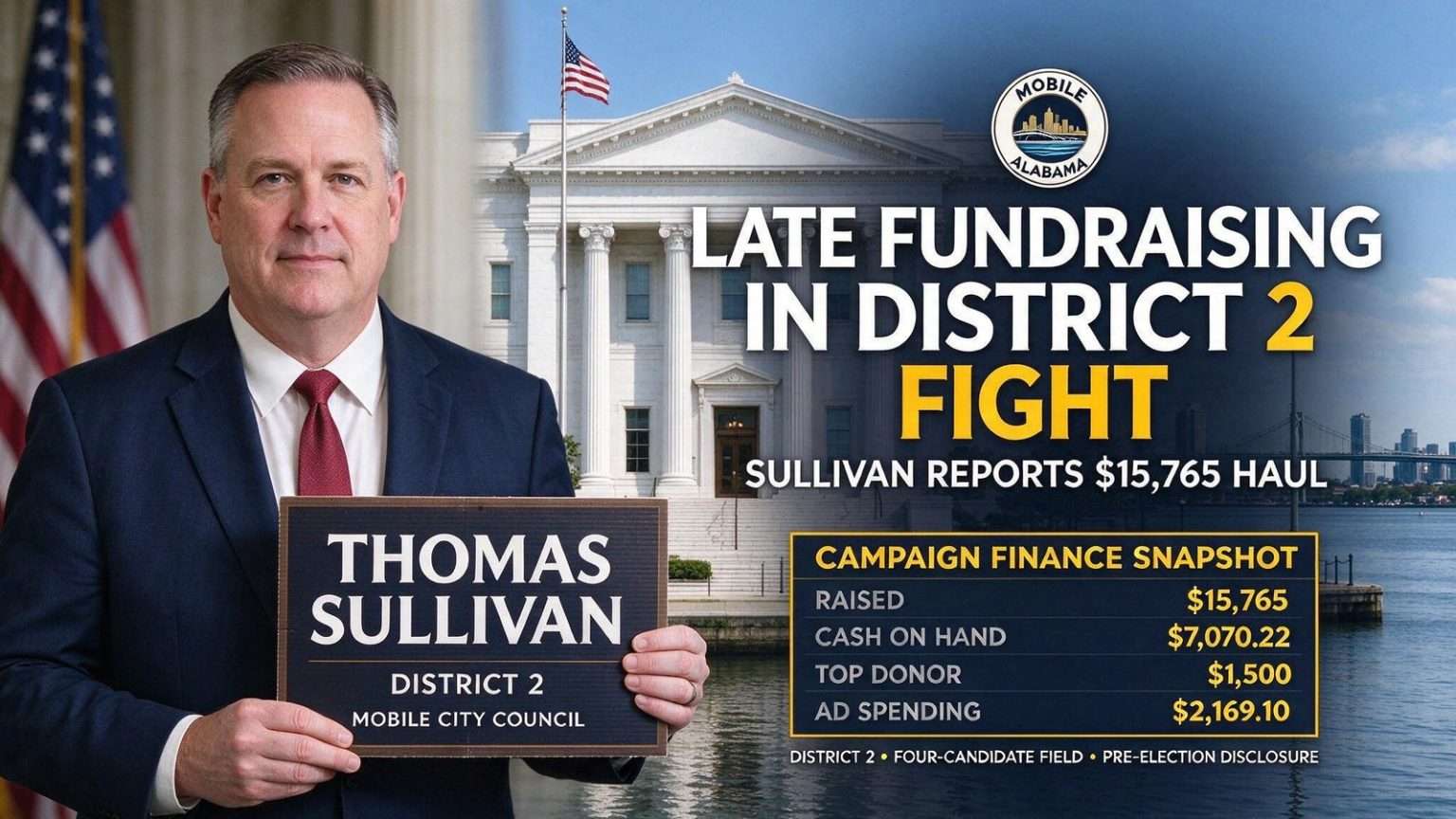
Mobile City Councilman Thomas Sullivan raised $15,765 during the weeks leading up to Tuesday’s city elections as he sought to claim a fifth four-year term at City Hall, according to his final pre-election financial disclosure. The report, filed in the closing days of the campaign, gave voters the most complete picture yet of the money behind his bid to keep the District 2 seat he has held for years, and it revealed a fundraising operation that reached well beyond the neighborhoods of his own district.
Sullivan opened the reporting period with a balance of $589.27 and spent $9,284.05, leaving his campaign with $7,070.22 on hand as voters prepared to go to the polls. The figures meant the veteran councilman was raising money at a rapid clip in the final stretch, pulling in more than twenty times what he had in the bank at the start of the period while still spending heavily on advertising designed to reach as many voters as possible before Election Day.
Under state law, candidates for municipal office must file financial disclosure statements 45 days before the election and again between 10 and five days before it, giving the public a snapshot of each campaign’s finances during the crucial final stretch. The two-report rhythm is intended to let voters see who is funding a candidacy before they cast ballots, and in a competitive race like the one in District 2, those final disclosures often draw close scrutiny from opponents, local media and civic groups watching how much outside money flows into city races.
A crowded District 2 field
Sullivan faced a competitive field in District 2, with challengers William Carroll, Johnny Burroughs and Jeffery Jones all vying for the seat. The presence of three opponents meant the incumbent could not simply rely on the advantages of incumbency; he needed the resources to introduce himself to voters again, remind them of his record, and respond to whatever messages his challengers were delivering at forums, on doorsteps and through their own advertising.
District 2 stretches across a diverse swath of Mobile, taking in long-established neighborhoods where generations of families have watched the same councilman come and go from community meetings, along with corridors of new commercial development where the city’s growth has been most visible. Elections in the district have historically turned on turnout, name recognition and the ability of candidates to connect with voters on issues ranging from sidewalks and drainage to public safety and economic development. A four-way contest only sharpened the need for each campaign to communicate clearly and often.
The incumbent’s disclosure reflected the breadth of his support, drawing on individual donors, political action committees and local businesses. That mix — professionals, companies, trade associations and party-connected committees — is typical of a well-established Mobile politician, and it suggested that Sullivan’s campaign was funded by a coalition rather than a single faction or industry. It also meant the campaign entered the final days with a deep bench of donors it could return to if the race stretched into a runoff.
Who backed the incumbent
Among Sullivan’s financial backers were James W. Wilson, Henry R. Seawell and the group of Brenda Kennedy, Deborah and Jacqueline Johnson, each contributing $1,000, along with Mobile Auto-PAC, also at $1,000. The Mobile Area Association of Realtors gave $1,500, the largest single contribution listed in the report. The realtors’ association has long been an active player in municipal elections across the region, typically supporting candidates viewed as friendly to property owners, development and a healthy housing market.
Other supporters included MBI, LLC at $750; DVA/HC PAC, J.H. Faulkner, Volkert and Associates, Charles Munden, T. Keith King, the Atchison Law Firm and Gulf City Lodge, each at $500. The list mixes the names of individual businessmen and professionals with organized interests — a political action committee tied to the local hospitality community, a longtime engineering and consulting firm with deep roots in Gulf Coast infrastructure work, a law firm, and a civic lodge that has been part of Mobile’s institutional fabric for generations.
Former Republican state senator Perry Hand of Gulf Shores appeared among the mid-level donors, alongside James M. Grodnick, R.W. Summerford and Joseph B. Pierce. Hand’s inclusion was notable because it illustrated how Sullivan’s support crossed party and geographic lines; a council seat in Mobile is a nonpartisan office, and donations from a Baldwin County political figure underscored how municipal campaigns in the port city draw on friendships and business relationships built across the entire region.
Several contributions came from out of state, including donors in Oakland, California; Tucson, Arizona; Chester, New Jersey; and Scottsdale, Arizona, each giving $450. Contributions of that size from distant cities often reflect family ties, friendships or business connections rather than organized interest in Mobile city government, but their presence in the report showed the reach of the campaign’s network. Smaller gifts from neighborhood churches, convenience stores and area families rounded out the report, grounding the fundraising totals in the day-to-day life of the district itself.
The blend of large and small donations also carries practical significance for a campaign’s closing strategy. Big checks from political committees and businesses fund the expensive final advertising push, while the steady accumulation of smaller gifts provides the cash flow needed for printing, yard signs, and last-minute get-out-the-vote efforts. Sullivan’s $15,765 in the period, layered on top of his modest opening balance, meant the campaign had enough resources to stay on the air and on doorsteps through Election Day without waiting for a runoff to replenish its accounts.
Where the money went
Sullivan’s expenditures leaned heavily on advertising and communications. The campaign reported spending $2,169.10 with Griffice Printing, $1,030 with Cumulus Broadcasting, $900 apiece to Property Realty Inc. on two occasions, $865 to On Media, $820.25 to a local television station, $512.27 to BellSouth and $420.75 to another local television station. Each line item pointed to a different channel in the campaign’s effort to reach voters — printed materials for direct mail and handouts, radio spots on one of the Gulf Coast’s largest broadcasting groups, outdoor and billboard placements through On Media, and television commercials on the local affiliates that dominate the Mobile market.
The spending underscored the value both sides placed on television and radio in the closing days of a municipal campaign. Even in city races where turnout is a fraction of what it is in statewide elections, broadcast advertising remains one of the few ways to reach thousands of voters quickly in the final week, and the two local television station payments showed Sullivan’s campaign was buying time in the medium that matters most in the last days before polls open. The BellSouth expenditure, meanwhile, reflected the telecommunications and utility costs that accumulate over the life of a campaign office.
The two $900 payments to Property Realty Inc., coming at different points in the period, suggested either repeated service or a payment schedule spread across the reporting window. Whatever the specific purpose, the pattern of expenditures — printing leading, broadcast close behind, and smaller communications costs filling the gaps — is a familiar one for incumbent campaigns working to convert financial advantage into visibility precisely when voters are paying attention.
The road to a possible runoff
Sullivan, who had represented District 2 for years, was working to fend off a well-funded challenge and preserve his standing at City Hall. A fifth term would place him among the longest-serving members of the council, a position that carries weight in budget negotiations, committee assignments and the behind-the-scenes relationships that determine how city projects move forward. Longevity on the council translates into institutional knowledge — of drainage districts, capital improvement cycles, and the personalities of past administrations — that challengers, however energetic, cannot match in a single campaign.
If no candidate captured a majority on Tuesday, a runoff would follow, extending the contest and the fundraising that fueled it into the weeks ahead. Alabama municipal law requires a majority to win without a second round, and in a four-candidate field, the arithmetic makes a runoff a real possibility. A runoff would change the campaign’s economics almost overnight: contributions reported in this final disclosure would be spent, and both Sullivan and whichever challenger advanced would need to begin raising money again, returning to the same donor lists documented in these pages.
For voters in District 2, the disclosure offered a final measure of the campaign before Election Day — who stood behind the incumbent, how much the contest cost, and where the money went. For Sullivan, the $7,070.22 remaining on hand represented both a war chest for whatever came next and a sign that, even after weeks of spending, his coalition of donors had put him in position to contest the seat through Election Day and beyond.