University of South Alabama Spring Hill
USA Health System Could Be Mobile’s Big Winner as Health Care Law Takes Hold
The University of South Alabama has long carried most of the region's indigent care at a loss. With coverage expanding under the new federal law, that arithmetic may finally change.
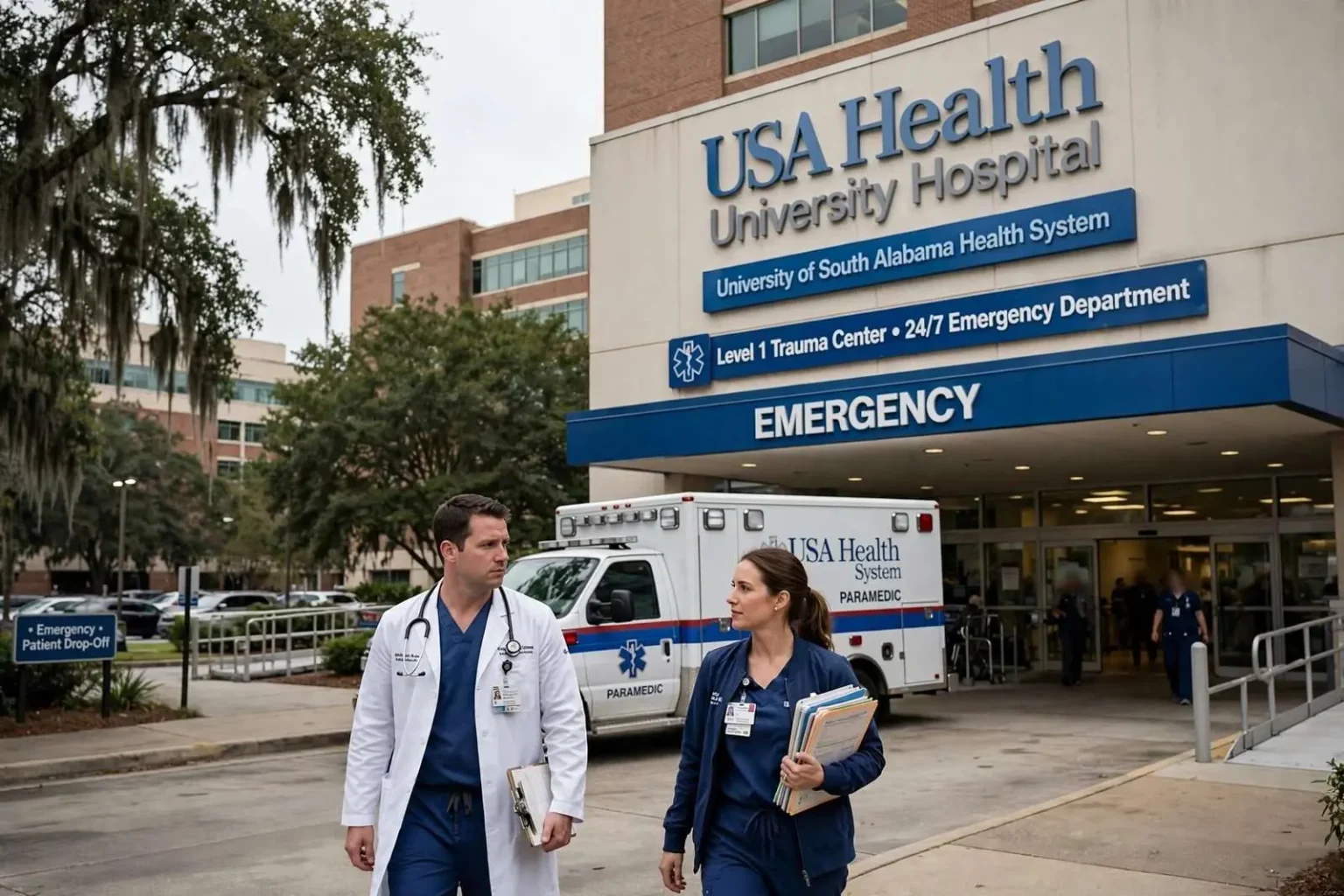
The University of South Alabama Health System may turn out to be the Mobile area’s biggest institutional beneficiary of the federal health care overhaul signed into law last month — not because of anything it will do differently, but because of what it has been doing for decades without being paid for it.
Carrying the load
USA has long provided the lion’s share of indigent care in the Mobile area. That burden grew heavier 23 years ago, when Providence Hospital relocated from its longtime home on Spring Hill Avenue at Catherine and Lafayette streets to Airport Boulevard in west Mobile, shifting a major hospital away from the neighborhoods where the uninsured are concentrated. Since then, the university’s hospitals have absorbed the cost of treating patients who cannot pay — care delivered at considerable losses, year after year, and funded in practice by everyone else.
Under the new law, with insurance coverage broadened substantially, a significant share of those patients would arrive with a payer attached. USA stands to be compensated for care it has traditionally provided for free.
The mechanics matter as much as the headline. Hospitals do not simply write off the cost of the uninsured; the burden is distributed across the system in ways most patients never see. Insurers build it into their rates, paying hospitals slightly more on covered cases to offset the uncompensated ones. Governments make supplemental payments designed to soften the blow for institutions that carry the heaviest loads. And the hospitals themselves ration — deferring equipment purchases, delaying expansions, tightening staffing — wherever the losses bite. When coverage broadens, each of those pressure points eases a little, and the institution doing the most charity care stands to feel the relief first and most.
What the law changes
The overhaul expands coverage on two main tracks: a broadened Medicaid program for lower-income households and new insurance marketplaces with subsidies for families above that line, alongside rules that bar insurers from turning away the sick. For an institution like USA, both tracks matter. Many of the patients who arrive at its emergency departments with no coverage at all — the working poor above the poverty line, the self-employed, the temporarily uninsured — fall squarely into the population the marketplace subsidies are designed to reach. Others, including many adults without children, would move onto Medicaid for the first time in states that implement the expansion. Either way, the same person who last year generated a write-off arrives next year with a card.
Hospital leaders also watch a second-order effect: the law trims some existing payments that were designed to compensate hospitals for treating the uninsured, on the theory that fewer uninsured patients will need the offset. If coverage expansion outpaces those payment cuts, hospitals come out ahead; if implementation stalls, they can end up squeezed from both directions. That is the knife’s edge USA’s financial planners are working on as the regulations take shape.
‘Many questions remain’
Just how much that will be worth is anyone’s guess at this stage. USA spokesman Keith Ayers said an actual figure will not be known for some time.
“We have traditionally provided the lion’s share of indigent care,” Ayers acknowledged. “At this point, we are awaiting the writing of regulations in the bill to determine the likely outcomes, but at this time it is hard to tell anything definitive. Certainly, receiving compensation for care provided is a move in the right direction, but many questions remain.”
That caution is warranted. Much of what the legislation actually does to hospital finances will be determined not by the statute itself but by the regulations that follow it — and by decisions made in Montgomery about how Alabama implements coverage expansions.
Which coverage mechanisms apply, how income thresholds are set, what happens to the existing payment programs that partially offset indigent care — each of those choices lives in the rule-writing process, and each moves the arithmetic for USA by millions of dollars in one direction or the other. Hospital finance officers across the country spent the weeks after the bill’s signing building models with wide error bars, and USA’s caution is simply an honest reflection of that uncertainty.
Why it matters locally
The stakes for Mobile go well beyond one institution’s balance sheet. USA operates the region’s teaching hospitals and its trauma center, and it trains physicians who then practice across south Alabama, from Baldwin County to Washington County. A health system that is chronically underpaid for the care it delivers is a health system with less capacity to invest in residency slots, equipment and emergency services that the entire region depends on.
A trauma center, in particular, cannot run on optimism. It requires surgeons, specialists and staff on call around the clock, imaging and operating rooms maintained at a moment’s notice, and helicopter and ambulance networks ready to move patients from across the region — all of it sustained whether or not the patients who arrive can pay. For patients brought in after highway crashes from Baldwin County or farm accidents in Washington County, the question of insurance never enters the first hour of care. The economics of keeping that capability in Mobile are carried, in the background, by the institution that hosts it.
The teaching mission works the same way. Residents and students learn in the wards and emergency rooms of the university’s hospitals, and a meaningful share of them stay to practice in the region after training. The pipeline from training to practice is one of the few reliable ways rural south Alabama gains physicians at all, and it runs through hospitals whose finances must support education as well as care. Every dollar of uncompensated care absorbed competes directly with the next residency slot or the next teaching position.
Uncompensated care also shapes where hospitals choose to locate. Providence’s move west a generation ago was a business decision with lasting consequences for how emergency care is distributed in Mobile. If the economics of treating uninsured patients change, so may the calculations that drove that decision.
An uncertain political backdrop
The law arrives in an Alabama that is, politically, deeply hostile to it. Every Republican in Congress opposed it, along with a bloc of Democrats that included Alabama’s own Artur Davis, now running for governor. Attorneys general in several states have filed suit against the coverage mandate, and the state’s congressional delegation has promised to seek repeal.
That political weather matters for a practical reason: institutions plan differently when the ground under a program may shift. A health system deciding whether to expand a clinic network, add residency positions or finance a new imaging suite does so against the assumption that the coverage expansion will hold. If repeal efforts or court challenges succeed, the planning assumption changes — but the patients do not disappear.
None of that changes the underlying arithmetic at USA’s hospitals. Patients without insurance still show up. The bills still come. Whoever pays them, someone does.
That arithmetic has been the quiet constant of the Mobile health market for a generation. Providence’s westward move left the central-city neighborhoods — where poverty and uninsurance run highest — more dependent on the university’s facilities, and every year since has deepened the pattern. Emergency departments cannot turn away patients in crisis regardless of ability to pay, and the clinics that keep chronic illness from becoming an emergency-room visit serve the same population at even thinner margins. The result is a system in which one institution’s losses are, in effect, the region’s subsidy for itself.
Waiting on the rules
For now, USA is doing what hospital administrators across the country are doing: reading the statute, waiting on the regulations, and running the numbers several different ways.
The modeling, in practice, involves working through scenarios. If the expansion reaches most of the uninsured patients currently treated free, the change to the health system’s bottom line is transformative — money redirected into teaching, trauma coverage and facilities. If Alabama’s implementation narrows the expansion, or if legal challenges delay it, the relief shrinks accordingly. Between those poles sits a range of outcomes, each requiring slightly different decisions about hiring, capital spending and program investment.
What is not in dispute is the direction of the principle. For decades, the region’s health care has been financed partly by an unacknowledged tax on its teaching hospital. If the new law works as designed, that hidden subsidy becomes an explicit payment — and the institution that has quietly absorbed the cost of care for Mobile’s poorest patients finally sees the ledger move its way. Until the regulations arrive, the university will keep doing what it has always done: treating the patients who come through the door, and waiting to learn who pays.