Davis Hits Byrne Over PACT, and 48,000 Alabama Families Are the Audience
Artur Davis attacked Bradley Byrne over a remark about the state's legal obligation to the failing PACT college tuition program, opening a general election fight months before either man had won a primary.
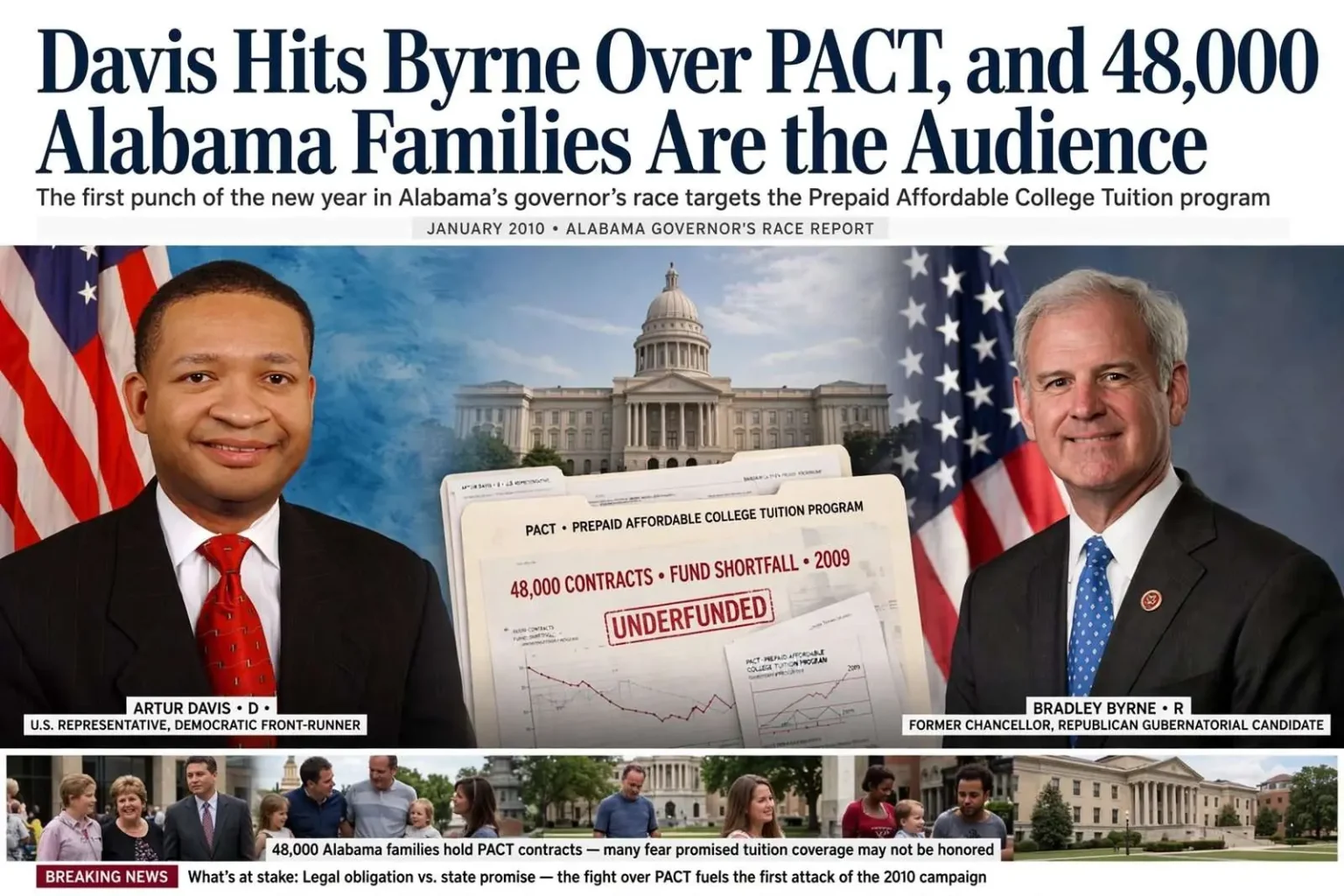
The first punch of the new year in Alabama’s governor’s race was thrown across the party line, months before either combatant had won a nomination — and it landed on the most sensitive subject in state government. A spokesman for U.S. Rep. Artur Davis, the Democratic front-runner, distributed a release with a headline framed as a question: “If Bradley Byrne Thinks PACT Contracts Have No Legal Standing, How Can 48,000 PACT Families Trust Him to Stand Up For Their Interests?”
The release was aimed at Bradley Byrne, one of the leading candidates for the Republican nomination for governor. Byrne, a Mobile-area attorney and former educator who had served as chancellor of Alabama’s two-year college system, was campaigning on a platform of restraining state spending and overhauling the way Montgomery did business. The Davis campaign seized on remarks Byrne made about the Prepaid Affordable College Tuition program — known across Alabama simply as PACT — and turned them into the first hard exchange of the 2010 campaign season.
The question at the center of the fight was deceptively simple. When the PACT program ran short of money, did the state of Alabama owe the 48,000 families who had bought contracts a legally enforceable promise — one that could be enforced in court if the fund could not pay? Or was the state’s duty a matter of policy and good faith, one that depended on whatever solution the Legislature chose to pass? Byrne’s answer, as the Davis camp read it, leaned toward the second view, and that was the opening the Democrats attacked.
What PACT was, and what went wrong
The Prepaid Affordable College Tuition program was created to let Alabama families lock in the cost of a college education by paying in advance, years ahead, at prices set when the contract was signed. Roughly 48,000 families had bought in. The program’s assets were invested, and the investments were expected to grow fast enough to cover tuition when the children came of age.
The program, created by the Legislature and administered through the office of the state treasurer, had been marketed for years as the surest way for ordinary Alabama families to beat rising tuition costs. Grandparents bought contracts for grandchildren. Young couples bought them for infants, reasoning that a single payment made the day a child was born would spare them whatever tuition looked like eighteen years later. For nearly two decades the pitch worked, and PACT became one of the state’s most trusted savings vehicles.
Then the market collapsed. By 2009 PACT was badly underfunded, tuition at Alabama’s public universities had risen sharply, and the program faced the prospect of being unable to pay what it had promised. Families who had done exactly what the state told them to do — save early, pay in advance — were told their contracts might not be honored in full. The political fury was bipartisan and enormous.
The arithmetic behind the crisis was straightforward. The fund’s holdings had been weighted toward investments that were hammered by the 2008 financial collapse at precisely the moment Alabama’s public universities were raising tuition by double-digit percentages year after year. The gap between what the fund held and what it owed to contract holders widened each semester, leaving the program unable to guarantee that every child’s tuition would be covered when the time came.
The remark Byrne made
The comment that drew the attack came while Byrne was guest-hosting the Dale Jackson Show, a north Alabama talk radio program. “I’m not telling you there’s a legal obligation on behalf of the state to fix this problem,” he said. “There’s not.”
The Davis campaign said Byrne was reverting to his previous career as a lawyer, reaching for a technicality to take the state off the hook for a program that had been marketed to families as a binding obligation. In the campaign’s telling, the distinction between a legal obligation and a moral one was exactly the kind of lawyer’s dodge that had made ordinary Alabamians cynical about Montgomery, and it was a poor foundation for a candidate asking PACT families for their votes.
The context Byrne’s camp supplied
The Byrne campaign produced context of its own, distributing the fuller exchange from the radio appearance and arguing that the snippet the Davis campaign circulated had stripped away the circumstances. In their view, Byrne was describing the actual state of the law as he understood it — that the contracts, whatever their moral weight, did not by themselves create an enforceable claim against the state treasury — rather than declaring that Alabama families should be left to fend for themselves. The episode became a case study in how a single sentence from a radio appearance can be recast as a campaign issue, and how little control a candidate has over the way his words are packaged once they leave the studio.
For PACT families, though, the debate was not an abstraction. They had written checks to a state-created program on the strength of brochures and legislative promises, and by the time the 2010 race began many of them were watching to see whether any candidate, of either party, would commit to making them whole. Every statement about the program’s legal footing was read by contract holders as a signal about whether the state intended to honor its word.
Ivey’s burden
State Treasurer Kay Ivey, herself a Republican candidate for governor, was the titular head of the program, and she was carrying it through the campaign like an anchor. As treasurer she had inherited responsibility for a fund whose obligations exceeded its assets, and every candidate in the Republican field knew that PACT was a subject Ivey could not avoid and that her rivals would not let her avoid it. Her efforts to steer the program through the shortfall became a standing test of her stewardship, invoked in debates and forums across the state.
The pressure was not unique to Ivey. The PACT shortfall was one of the few issues in Alabama politics that cut across regional and party lines, because contract holders lived in every county and came from every income bracket. A position on PACT could cost a candidate votes in Huntsville, Mobile, Birmingham and the Wiregrass at the same time, which is why the Davis campaign judged the issue worth firing the year’s first shot over.
How the state responded to the shortfall
By the time the governor’s race heated up, state leaders were already working to contain the damage. The Legislature and the treasurer’s office negotiated a rescue designed to guarantee that existing contracts would be honored for undergraduate tuition at Alabama’s public colleges, funded through a combination of state appropriations and a restructuring of the program’s obligations. New enrollment in the prepaid plan was suspended, ending the practice of selling contracts at prices the fund could no longer safely underwrite, and the state moved toward absorbing the program’s liabilities directly.
Those steps mattered to the politics as much as to the finances. Once the state committed to honoring existing contracts, the argument among candidates shifted from whether the promises would be kept to who could be trusted to keep them. Byrne’s remark about the absence of a legal obligation landed in that landscape, and the Davis campaign’s release was built to make voters ask whether the commitment was durable or conditional — whether it would survive the next budget crunch or vanish the first time money got tight.
What it means for the families watching
For the 48,000 households holding PACT contracts, the governor’s race carried consequences no other campaign issue matched. A governor and a Legislature aligned on funding the program could finish the rescue and close the book on the shortfall; a state government that treated the contracts as optional could reopen the question with every budget cycle. The Davis release was written for that audience specifically, framing the entire contest as a referendum on whether Alabama’s word, once given, could be counted on.
It also offered a preview of the campaign to come. The PACT fight gave both parties a template: run against the other side’s answer to the program, and claim the allegiance of the families whose savings were hanging in the balance. In a state where trust in Montgomery had been worn thin by years of fiscal crises, the candidates who spoke most plainly about honoring the state’s promises were likely to hold the advantage among the voters with the most at stake.
The wider field watches the exchange
The volley between the Davis and Byrne camps was also being scored by the rest of the field. On the Democratic side, Davis’s rivals for the nomination watched him take the aggressive position on an issue with genuine emotional reach, and had to decide whether to match his tone or differentiate themselves in other ways. On the Republican side, the other candidates for the nomination — Treasurer Kay Ivey among them — had to weigh whether defending Byrne helped them or whether distance from the remark served them better, given that every Republican in the race would be judged by PACT families against the party’s own treasurer.
The exchange also illustrated a structural reality of Alabama campaigns: with the primaries still months away, candidates from opposing parties had time and incentive to fire at one another before their own nominations were settled. Davis, as the Democratic front-runner, could spend ammunition on a Republican rival without spending much on his own primary field, and the Byrne camp’s counterpunch was calculated with the same logic in reverse. Both campaigns understood that the general-election argument was being drafted months early, in public, one release at a time.
A state still measuring its word
Behind the horse-race coverage sat a question Alabama had been forced to ask itself repeatedly in recent years: how binding is a promise made by state government? The PACT episode followed a string of budget shortfalls, proration rounds and trust fund raids that had taught residents to hedge their confidence in Montgomery’s commitments. A program built on decades-long contracts was the purest test yet, because its promises could not be kept retroactively and could not be quietly rewritten without tens of thousands of families noticing at once.
That is why the fight over Byrne’s sentence carried more weight than an ordinary campaign skirmish. The Davis campaign’s headline was not really about one candidate’s radio appearance; it was about whether the state’s contracts meant what they said. The Byrne campaign’s response was not really about a missing snippet of tape; it was about whether a candidate could be trusted to tell voters the unvarnished truth about what the law required. Each side was arguing about trust while technically arguing about contracts.
The road ahead for the campaigns
Both candidates still faced long roads before a general election could put the PACT question to voters directly. Davis had to consolidate the Democratic nomination, and Byrne had to survive a crowded Republican primary in which the PACT issue, the two-year college system he once led, and his record in Montgomery education circles would all be examined closely. Whichever pairing emerged from the primaries would inherit the same electorate of contract holders, and the same pressure to say plainly what the state owed them.
For now, the first punch of the new year had done its work. It put the state’s most sensitive financial promise at the center of the governor’s race months before either party had picked a nominee, forced a candidate to explain a sentence he might otherwise have let pass, and reminded 48,000 Alabama families that their contracts were not just a budget problem but a political one — with the answer due from whoever won the office in November.