Byrne Brings His Jobs Plan to Brookley as the Governor’s Race Comes to Mobile
Bradley Byrne chose Brookley Field to unveil his economic plan on the first working day of 2010, while rival Bill Johnson addressed the Mobile County Republican Executive Committee the same evening.
The race for governor of Alabama arrived in Mobile on the first working day of the new decade, with two Republican candidates in the city on the same day and the same argument between them: who could be trusted to bring jobs to a state that had lost a great many of them. The recession that closed the 2000s had emptied plants and construction sites across Alabama, and the primary electorate that would pick the next governor in June was in no mood for optimism without a plan attached.
Byrne picks his backdrop
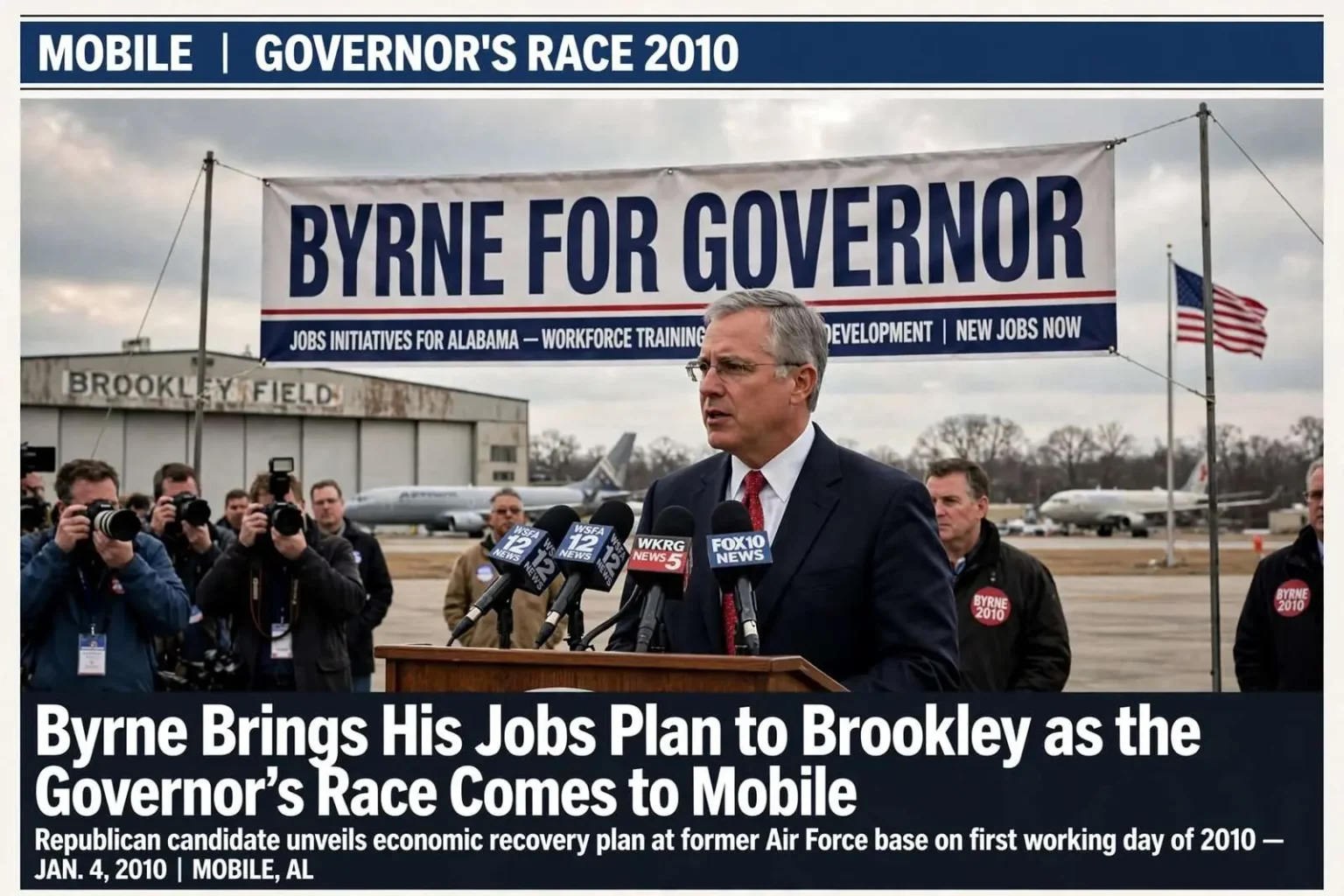
Bradley Byrne unveiled what his campaign called a comprehensive plan for growing Alabama’s economy and creating jobs at a news conference at Brookley Field. The location was the message. Brookley, the former Air Force base on the western shore of Mobile Bay, was the site where Northrop Grumman and EADS proposed to assemble the Air Force’s next aerial refueling tanker — a $40 billion contract then in the middle of a bitter, nationally watched fight. It was also home to an Airbus engineering center and to the aircraft maintenance operation that was the largest private employer in Mobile. No single piece of ground in Alabama carried more freight as a symbol of industrial hope.
“That’s why I’ve chosen to introduce my new Job Initiatives for Alabama at the beginning of the first work week of 2010,” Byrne said. Nothing, his campaign argued, transcended the economy as an issue facing the state. The plan itself — rolled out in stages through the primary — emphasized workforce training, targeted incentives and streamlining the state’s economic development machinery, themes calibrated to a business community that had watched recession-era unemployment climb.
Byrne, a Baldwin County Republican, had a claim on the subject. As chancellor of Alabama’s two-year college system — the job Gov. Bob Riley handed him to clean up a corruption-riddled institution — he had chaired the state Work Force Planning Council and dealt directly with the training pipeline that manufacturers ask about first. The two-year colleges, through Alabama Industrial Development Training, had helped land the state’s automotive plants and would do the same for any aerospace assembly line, and Byrne had run the system through its most difficult decade. He was widely seen as the candidate of the Riley political operation, with all the advantages and the resentments that implied.
Johnson takes the fight to the party
The same evening, Bill Johnson addressed the Mobile County Republican Executive Committee at 7 p.m. at Christ United Methodist Church on Grelot Road. The committee, which ordinarily met at Westminster Presbyterian Church, was rotating its meeting locations around the county for 2010 — a small effort at broadening a party organization that was about to have its best year in living memory. Applications for membership in the committee and the county GOP were available at the meeting.
Johnson’s candidacy was the oddest in the field. He had served in Riley’s cabinet as executive director of the Alabama Department of Economic and Community Affairs, and he had built his campaign on attacking the sitting Republican governor’s ethics — alleging lapses within the administration, including the renewal of a multimillion-dollar unbid computer consulting contract. It was an unusual strategy: running as a Republican in a Republican primary against a popular two-term Republican governor who was not on the ballot.
Riley’s team had settled behind Byrne. Johnson was betting that the governor’s accumulated enemies — and every two-term governor has them — would find him. The bet was harder to place than it looked: Alabama primary voters had rewarded the Riley brand through two elections, and the two-year college scandal Byrne had been sent to clean up had, by 2010, made the name associated with the cleanup a credential rather than a liability. Johnson’s path ran through Tea Party-era distrust of the political establishment, and he pressed it at every county committee that would host him.
The Mobile County stake
Both men were courting a county that mattered. Mobile County contained the largest concentration of Republican primary voters in south Alabama, and the local party organization was, that January, in the business of counting them. The county’s Republican roll had grown for a generation — from the courthouse realignment of the 1980s through the suburban boom of West Mobile and the Eastern Shore — until a Mobile County Republican primary could decide statewide contests on its own.
The Republican primary field also included Tim James, former Chief Justice Roy Moore, state Treasurer Kay Ivey and state Rep. Robert Bentley of Tuscaloosa. Each carried a distinct constituency: James with his name and his government-reform pitch, Moore with the evangelical base that had twice elected and twice removed him from the state’s highest court, Ivey with statewide officeholder recognition, Bentley with a low-spending, late-surging campaign built on a promise not to take a salary until unemployment fell. Primaries were set for June 1, and with such a crowded field, a runoff was all but inevitable — which made January’s organization-building, like the county committee’s membership push, the quiet arithmetic that would decide the nomination.
What Brookley meant
For Mobile, the day’s real interest lay less in the speeches than in the venue Byrne chose. Whoever won the governorship would inherit the state’s role in the tanker fight, in the ThyssenKrupp steel investment north of the city, and in whatever came of Brookley. The tanker contract pitted the Northrop Grumman-EADS team against Boeing in a competition that had already been awarded, protested and re-opened; Mobile had staked its industrial future on winning it, and the next governor would be the state’s chief advocate when the Pentagon made its decision again.
ThyssenKrupp’s carbon and stainless steel mill rising in Calvert, north of the city, was the other monument of the moment — the largest single industrial investment in state history at the time, employing thousands in construction and promising thousands more in permanent jobs. Between the steel mill on the river and the potential tanker line on the bay, southwest Alabama was assembling the most consequential economic development run in its history, and the gubernatorial candidates all understood that Mobile’s runway was where their jobs plans would be tested.
Standing on that runway to announce a jobs plan was a promise, and everyone in the room understood it as one. The first working day of 2010 gave Mobile two Republican candidates, one message and a stage built from the city’s own industrial ambitions — the campaign’s opening argument that the state’s next governor would be judged by what got built on the ground around him.
Byrne’s Brookley event and Johnson’s committee appearance bracketed the same day from two directions — one candidate standing on the industrial future, the other pressing his case among the party’s most reliable activists. Both approaches addressed the same audience in the end: the Mobile County Republicans who would vote in June and decide which version of the party’s message would carry the state.
The Mobile County stake
Both men were courting a county that mattered. Mobile County contained the largest concentration of Republican primary voters in south Alabama, and the local party organization was, that January, in the business of counting them. The county’s Republican roll had grown for a generation — from the courthouse realignment of the 1980s through the suburban boom of West Mobile and the Eastern Shore — until a Mobile County Republican primary could decide statewide contests on its own.
The Republican primary field also included Tim James, former Chief Justice Roy Moore, state Treasurer Kay Ivey and state Rep. Robert Bentley of Tuscaloosa. Each carried a distinct constituency: James with his name and his government-reform pitch, Moore with the evangelical base that had twice elected and twice removed him from the state’s highest court, Ivey with statewide officeholder recognition, Bentley with a low-spending, late-surging campaign built on a promise not to take a salary until unemployment fell. Primaries were set for June 1, and with such a crowded field, a runoff was all but inevitable — which made January’s organization-building, like the county committee’s membership push, the quiet arithmetic that would decide the nomination.
What Brookley meant
For Mobile, the day’s real interest lay less in the speeches than in the venue Byrne chose. Whoever won the governorship would inherit the state’s role in the tanker fight, in the ThyssenKrupp steel investment north of the city, and in whatever came of Brookley. The tanker contract pitted the Northrop Grumman-EADS team against Boeing in a competition that had already been awarded, protested and re-opened; Mobile had staked its industrial future on winning it, and the next governor would be the state’s chief advocate when the Pentagon made its decision again.
ThyssenKrupp’s carbon and stainless steel mill rising in Calvert, north of the city, was the other monument of the moment — the largest single industrial investment in state history at the time, employing thousands in construction and promising thousands more in permanent jobs. Between the steel mill on the river and the potential tanker line on the bay, southwest Alabama was assembling the most consequential economic development run in its history, and the gubernatorial candidates all understood that Mobile’s runway was where their jobs plans would be tested.
Standing on that runway to announce a jobs plan was a promise, and everyone in the room understood it as one. The first working day of 2010 gave Mobile two Republican candidates, one message and a stage built from the city’s own industrial ambitions — the campaign’s opening argument that the state’s next governor would be judged by what got built on the ground around him.