Nearly 100 Young Professionals Set a Causeway Fundraiser for Bradley Byrne
A host committee of nearly 100 young professionals organized a December 2009 reception at Felix's Fish Camp on the Causeway for Republican gubernatorial candidate Bradley Byrne.
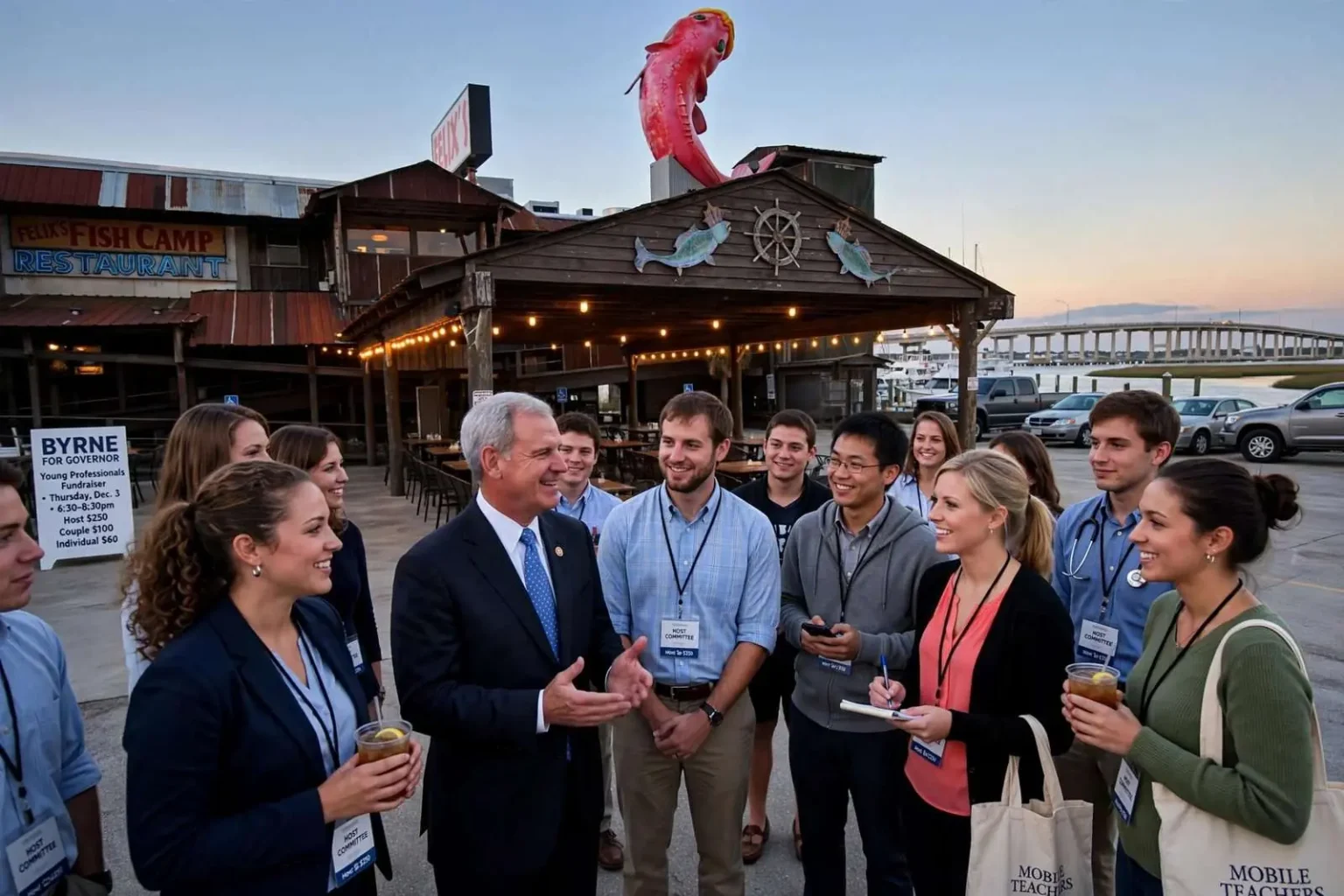
Republican candidate for governor Bradley Byrne was set to be feted on the Causeway in early December 2009 by a constituency that campaigns often court and rarely organize: nearly 100 young professionals from Mobile and the Eastern Shore. The reception was scheduled for 6:30 to 8:30 p.m. Thursday, Dec. 3, at Felix’s Fish Camp, the Battleship Parkway landmark at 1530 Battleship Parkway that looks out over the Mobile Bay causeway.
Admission was set at $250 for hosts, $100 per couple and $60 for a single ticket — a price structure designed to be within reach of people early in their careers rather than at the peak of them. The tiers told the story the committee wanted to tell: this was not a $1,000-a-plate downtown ballroom event but a fundraiser built so that a young attorney, nurse, teacher or small-business owner could sign on without a partner’s approval or a second mortgage.
A different kind of host committee
The committee’s composition was its message. Alongside the young lawyers, bankers, physicians and business owners were four members of the Mobile Bar Pilots — David Bender, David Berault, Chris Brock and Reid Key — whose profession, guiding deep-draft ships across the bar and up the channel to the state docks, is as old as the port itself and as tied to its fortunes. The pilots’ presence on a gubernatorial host committee was a nod to how much coastal Alabama depends on the working waterfront: every ship that calls at the Port of Mobile passes under pilotage, and the pilots’ livelihood rises and falls with the port’s tonnage.
The roster ran through many of the families whose names recur in Mobile civic life — Delaney, Mostellar, Otts, Pipes, Stimpson, Shields, Stubbs, Summersell, Walton, Wilkins — but here it was the next generation signing the invitation. In a city where surnames carry history, a host committee of heirs to established families sends a double signal: the old guard’s children were choosing a candidate, and they were doing so in their own names.
Forbes Sirmon was listed as providing music. The details of the evening — the Causeway setting, the live music, the cash bar of a fish camp rather than the ballroom of a hotel — were as much a part of the pitch as the candidate himself.
What the campaign wanted from it
For Byrne, the event served a purpose beyond the money raised. In a Republican primary field that included Tim James, State Treasurer Kay Ivey and former Riley cabinet member Bill Johnson, all of whom were courting the same donors along the coast, a candidate needed to demonstrate breadth as well as depth.
A committee of 100 people under 40, each bringing friends and each visible on social networks then coming into their own as political tools, offered a different kind of proof — that the campaign had reach into the working professional class, not merely into its parents’ drawing rooms. In 2009, Facebook and Twitter were new instruments in Alabama politics, and a young committee whose members could share an invitation with hundreds of contacts in an afternoon gave a campaign reach that traditional fundraising structure could not buy.
There was a tactical layer as well. Every name on a host committee is a commitment, and commitments beget commitments: friends follow friends onto lists, and a committee of 100 in Mobile and Baldwin counties can seed committees of similar size in Birmingham, Huntsville and Montgomery. Campaigns build these lists early precisely because December is when holiday giving decisions get made — before the primary year’s pace takes over.
Byrne, a resident of the Eastern Shore who had served on the state school board and then as chancellor of Alabama’s two-year college system, was running as a reformer. His tenure at the two-year colleges had been marked by conflict with legislators and employees over conflicts of interest, and he had emerged from it with a national profile among conservatives and a set of adversaries at home.
That record cut two ways in a primary. The fights over two-year college hiring and double-dipping — practices Byrne had moved to restrict as chancellor — made him enemies in the Legislature, some of whom were positioned to help his rivals. But they also gave him a story to tell coastal donors in a fish camp: that he had cleaned up a system, taken the heat for it, and could be trusted to do the same in Montgomery. For young professionals who had watched the two-year college and legislative scandals unfold in the newspapers, the reformer’s résumé was the product being sold.
The setting
The choice of Felix’s Fish Camp was itself a small act of local politics. The Causeway restaurants — Felix’s among the best known — sit on the narrow strip of highway between Mobile and Baldwin counties that floods in hurricanes and fills with traffic on holiday weekends. The U.S. Highway 90 stretch along the Mobile Bay causeway predates the interstate tunnels and the Bayway, and it remains the route that knits the two counties together — the corridor a Mobile commuter and a Baldwin County commuter cross in opposite directions every morning.
They are, in a practical sense, the meeting ground of the two counties, which together form the base any coastal candidate must consolidate before he can go looking for votes in Cullman or Huntsville. Baldwin County had been growing into one of the fastest-growing counties in the state, its eastward suburbs pulling a share of Mobile’s professional class across the bay, and a fundraiser that both sides of the bay could call local was worth more than its geography.
Felix’s itself carried the right associations. It is the kind of place where oysters and boats and Saturday afternoons mix, where a candidate can work a room without a stage, and where the constituency being courted — people who sail, fish and fish camp along the bay — could feel at home. Tickets, in the end, are about the candidate, but venues are about belonging.
The field around the event
The 2010 Republican primary was still six months away, and the campaign calendar for December was crowded with holiday receptions of exactly this kind. James, the son of a two-term governor, was building his second run for the office on a personality-driven platform; Ivey, the state treasurer, held the establishment and statewide-network advantages; Johnson carried the ties of the Riley administration into the race. Each would spend the winter rolling out endorsements and coastal committees of their own.
What distinguished this one was the age of the people whose names were on it — a bet by the Byrne campaign that the generation just beginning to accumulate professional standing in Mobile would turn out, contribute, and bring others with them. The wager reflected a broader shift in Alabama campaigns of the period: with social networks making peer-to-peer persuasion cheap, a committee of 100 young names could outperform a longer list of established check-writers whose giving was already committed across the field.
The price structure reinforced the bet. At $60 a head, the single-ticket tier sat close to what the same crowd might spend on a weekend on the water; at $100 a couple, it courted young households; and the $250 host level was set where a rising attorney or physician could write the check personally. None of the tiers required the corporate or PAC money that sustains big-ticket events — this was an exercise in building a donor base from the first dollar.
For the attendees, the evening offered something campaigns rarely package for people in their twenties and thirties: access. A fish camp reception on a Thursday evening puts the candidate across the table, not on a stage, and the questions a young banker or ship pilot asks a candidate for governor are different from the ones a party chairman asks. Campaigns count on those conversations converting into ambassadors — the person who talks to a candidate at a fundraiser becomes the person who persuades a dozen friends.
The Bar Pilots’ participation also illustrates how coastal Alabama politics runs through the port. The pilots, the dockworkers, the shipbuilders and the shipping agents may differ on most things, but they share a stake in whoever controls the state’s approach to the docks, the channel, the roads and the coast itself. A governor in Alabama has real influence over port policy and over the state’s role in coastal issues, and the coastal professional class has long practiced a kind of politics that measures candidates by what they will do for the bay and the ships on it.
Organizers directed those wanting more information to call the restaurant at (251) 343-3200. The number was Felix’s own — one more signal that the campaign wanted the event to feel less like politics than like a Causeway evening with a purpose. Whether the bet paid off would be measured in June, when the votes were counted. What was certain on the first Thursday of December 2009 was that a candidate running as a reformer had put a hundred young names on an invitation, hung it on a Causeway fish camp, and asked a constituency that campaigns usually take for granted to sign on early.