Judge Defers Ruling on Nodine Bond as Federal Gun Charge Takes Priority
A Baldwin County judge put off a decision on reducing Stephen Nodine's $500,000 murder bond, ruling that the question would wait until federal authorities held a detention hearing on a separate firearms charge.
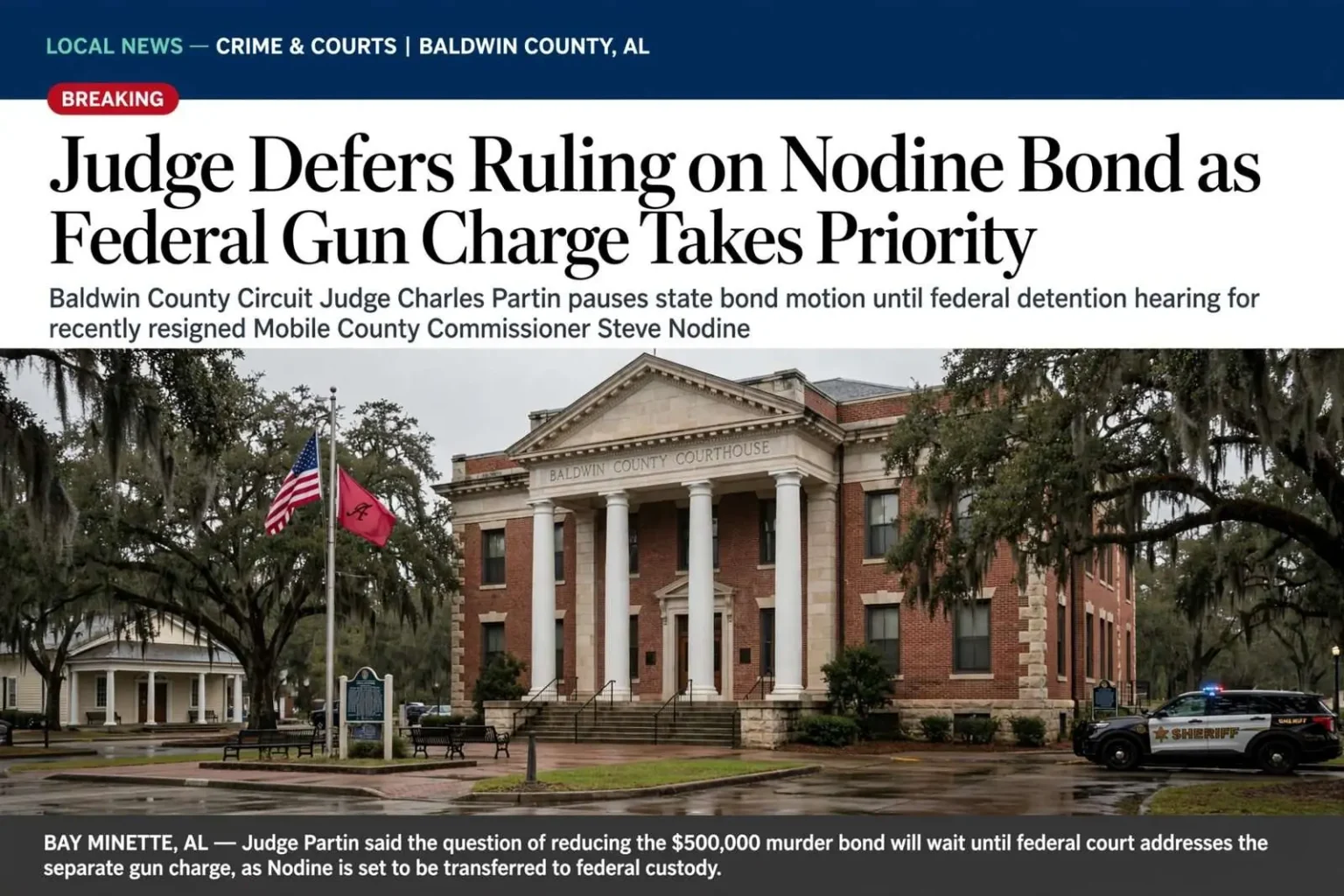
Baldwin County Circuit Judge Charles Partin deferred action Tuesday morning on a request by recently resigned Mobile County Commissioner Steve Nodine to reduce the $500,000 bond set on a murder charge, saying the question would have to wait until a federal court addressed a separate gun charge. Because Nodine “will be transferred to federal custody, and the federal authorities will conduct a detention hearing with respect to the federal gun charge,” Partin wrote, “The Court takes the motion under submission and will make a ruling after the federal detention hearing.”
The order, issued in writing from the Baldwin County courthouse, acknowledged something that both prosecutors and defense attorneys already understood: with a federal case now stacked on top of the state charges, the ordinary sequencing of bond arguments had been turned inside out. No state-court ruling on bond could accomplish what the defense wanted as long as federal authorities held Nodine, and the federal government had not yet had its say on whether he should be released at all.
The charges
Nodine, 46, was charged with murder in the May 9 shooting death of Angel Downs, 45, outside her townhouse on Fort Morgan Road in Gulf Shores. Downs and Nodine had a long relationship. He entered a not guilty plea. The Gulf Shores address places the case in one of Baldwin County’s most heavily visited coastal communities, a city whose year-round population of residents and seasonal influx of visitors share the same roads, the same emergency services and the same courthouse system in Bay Minette.
The murder charge is not the only case against him. Nodine also faced state drug charges in Mobile County, arising from an investigation that began after mechanics at the county garage found marijuana and prescription pain medication in his county-issued truck shortly before Christmas of the previous year. What began as a routine service visit at the county garage became, within weeks, the start of investigations that reached into two counties, two court systems and, ultimately, the United States District Court.
According to reports at the time, Nodine’s use of the painkiller Lortab exceeded recommended daily dosages. In the course of those inquiries it also emerged that Nodine possessed a number of firearms, including a .9 mm Glock handgun issued by the Mobile County Sheriff’s Office. The combination — documented narcotics use and possession of weapons, one of them county property — set the stage for the federal intervention that now overshadowed the state bond question.
Under federal law, it is unlawful for a person addicted to a controlled substance to possess a firearm, and federal prosecutors added that charge to the list confronting him. The statute requires no showing that the weapon was used in any offense, and federal prosecutors routinely bring it when an investigation documents both drug use and gun possession. In Nodine’s case, the county-issued Glock and the evidence gathered in the drug investigations gave federal authorities everything the charge requires.
Why the sequence mattered
The stacking of state and federal cases created a procedural knot. A defendant held in federal custody cannot simply post a state bond and walk out; the federal detention question has to be resolved first. Federal custody is not a parallel lane that runs alongside state release — it supersedes it. A defendant can hold a valid state bond, paid and approved, and still sit in a federal facility because a federal magistrate has not yet ruled on pretrial release under federal standards.
Partin’s order recognized that reality and left the state bond question open until the federal court acted. The judge could have denied the reduction motion outright, but taking it under submission preserved the motion for a later ruling, effectively deferring the state’s answer until the federal system produced its own. The order also signaled to both sides that the state court saw no utility in litigating a bond question that would be mooted — one way or the other — by the federal detention hearing.
For Nodine, the practical effect was that a reduction in the murder bond, even if granted, would not have secured his release. The defense had asked the state court to lower the $500,000 figure set on the murder count, arguing that the amount effectively precluded release while he awaited trial. But even a substantial reduction would only have changed what Nodine would owe the state court, not whether he walked free, because his liberty in the near term depended entirely on the federal magistrate’s answer.
For prosecutors in Baldwin County, the federal charge added a second set of constraints on a defendant they had described as a flight and safety concern. Whatever the state court decided about bond, federal detention would accomplish the same objective — holding the defendant pending further proceedings — under a different body of law, with federal standards governing how long he could be held and on what showing. The federal case, in effect, gave the state prosecution a form of security the state itself could not impose.
The arrangement also illustrated the practical hierarchy that emerges when parallel prosecutions intersect. State judges control state bonds; federal magistrates control federal custody. Neither court can command the other, and a defendant caught between them can find that every courtroom has ruled in his favor and he is still not free. The federal detention hearing, once scheduled, would be the first occasion for the full weight of Nodine’s circumstances — the murder charge, the drug evidence, the firearms, his family and employment ties — to be weighed under the federal release standards that govern whether he stays in custody.
A political career already ended
Nodine had resigned his District 2 seat on the Mobile County Commission days earlier, on the eve of a deposition in an impeachment case that had been filed against him in Mobile. The resignation ended the impeachment proceeding, which existed only to remove him from office, and triggered a special election set for July 13. The impeachment mechanism in Alabama exists for exactly this purpose — to remove an official who will not or cannot be removed by the ordinary electoral calendar — and its end came not through a trial verdict but through the commissioner’s own signature.
The timing, on the eve of sworn testimony, drew notice from those following the proceedings. A deposition in an impeachment case would have placed the commissioner under oath, answering questions under penalty of perjury about the conduct underlying the charges, with a transcript that would follow him into every courtroom where his cases were pending. The resignation foreclosed that avenue, and with it the impeachment case itself, which had no other remedy available than removal from office.
Once one of the most visible Republicans in Mobile County government, Nodine had been a driving force in county road and infrastructure spending and a frequent presence in local political fights. District 2 stretches across a large share of west Mobile, and the commissioner’s office sits at the center of decisions about paving, drainage and capital projects that shape how one of Alabama’s fastest-developing counties grows. Supporters credited him with pushing road and infrastructure investment; critics had long described his political style as combative.
The collapse of his career over a matter of weeks left the three-member county commission short a member at a moment when it faced budget pressure and the beginning of the economic damage from the Deepwater Horizon oil spill. The spill’s economic fallout — lost tourism revenue, fishing closures and claims against coastal businesses — was beginning to reach county government just as the commission lost one of the three votes that decide everything it does. With the seat vacant, the remaining commissioners had to navigate budget season and the spill response with a two-member body.
A three-member commission operates by simple majority, which means a vacancy does not merely reduce the body’s capacity — it changes the arithmetic of every vote. Two commissioners can act, and a single commissioner who dissents cannot stop them. In a period when the county was preparing to respond to oil-spill damage and to set a budget under uncertain revenues, the absence of the District 2 voice left the county’s west-side constituencies without a vote at the table.
The special election set for July 13 gave District 2 voters the chance to fill the seat quickly by local standards, but a summer election for a commission seat would draw a crowded field and turn on name recognition more than on any extended campaign. Whoever won would serve the balance of the term, inheriting budget votes and spill-response decisions made, in part, before their election.
What was still ahead
The federal detention hearing, once scheduled, would determine whether Nodine remained in custody pending trial on the firearms count. Federal detention hearings follow the framework of the federal pretrial release statute, under which a magistrate weighs the nature of the charges, the weight of the evidence, the defendant’s history and characteristics, and the danger any release would pose. In a case combining a state murder charge, documented narcotics use and firearms possession, prosecutors would argue for detention; the defense would argue for supervised release.
Only after that would Judge Partin rule on the bond motion in the murder case. The state court’s deferral meant that the Baldwin County proceedings — and the timeline toward a murder trial — now waited on a federal courtroom across the bay. For the Downs family and for Gulf Shores residents who followed the case, the sequencing added weeks of delay before the state case could advance on its own footing.
Nodine’s attorneys in the state cases were Mobile criminal defense lawyers Dennis Knizley and John Conrad Williams. Knizley is among the region’s best-known defense attorneys, with decades of high-profile cases in Mobile and Baldwin county courtrooms, and his pairing with Williams gave the defense experienced representation on both sides of Mobile Bay.
None of the allegations against Nodine had been tested at trial. He maintained his innocence on all counts, and under law was presumed innocent unless and until proven otherwise. The distinction matters in a case that has generated weeks of headlines: charges, however serious, are accusations, and the evidence behind them will be tested by cross-examination, by suppression motions and by the standard of proof beyond a reasonable doubt before any verdict is entered in any courtroom.
What the coming weeks would settle first was procedural, not substantive: where Nodine slept at night, and under whose rules. The federal detention hearing would answer the custody question. Partin’s deferred ruling would answer the bond question. And only then would the state murder case resume its ordinary course — toward hearings, motions and, eventually, the trial that will determine what actually happened outside a townhouse on Fort Morgan Road.
The case’s reach across two courthouses, two counties and two systems of law made it unlike anything the region’s court watchers had seen in recent memory. A county commissioner’s service visit to the county garage before Christmas had become, by summer, a murder case in Baldwin County, drug charges in Mobile County and a federal firearms prosecution — all awaiting answers that judges in three courtrooms had not yet given.