Sparks Stays in the Governor’s Race, Passing Up an Open Congressional Seat
Ron Sparks scheduled a three-city announcement tour and let speculation build that he might abandon the governor's race for the 5th District. The scheduling itself gave away the answer.
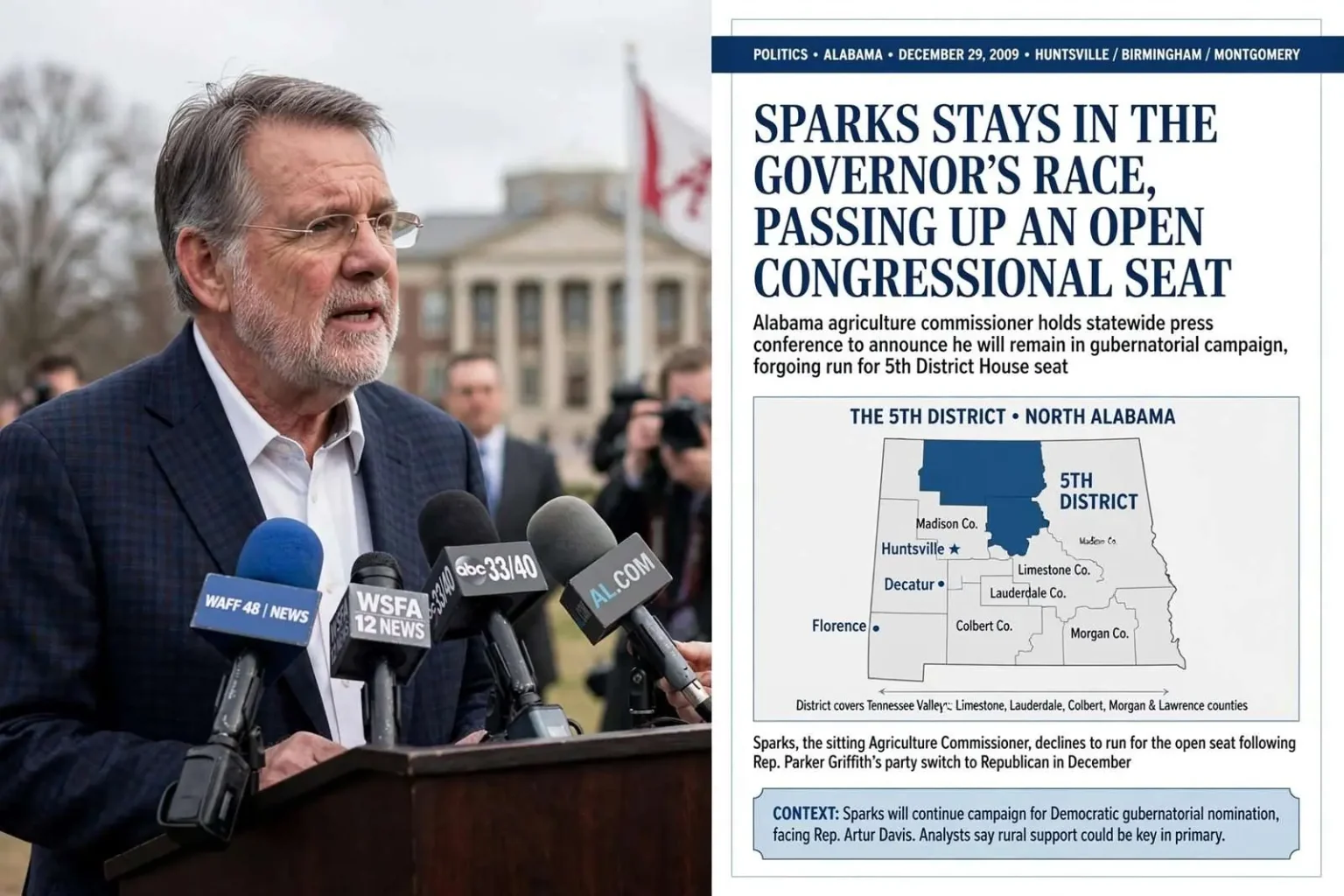
Agriculture Commissioner Ron Sparks scheduled news conferences in Huntsville, Birmingham and Montgomery for Tuesday, and by the time the first one began, anyone reading the itinerary already knew what he was going to say. Sparks was expected to announce that he would remain a Democratic candidate for governor rather than run for Congress in Alabama’s 5th District, the north Alabama seat left without a Democrat when Rep. Parker Griffith jumped to the Republican Party.
The announcement closed out a week of speculation that had swept through Alabama political circles after Griffith’s party switch opened a congressional seat that had belonged to Democrats for decades. For a sitting statewide official looking up at the front-runner in a governor’s race, the temptation was obvious and widely discussed.
The logic of the schedule
Sparks had done nothing to discourage the speculation, and there were reasons to entertain it. The 5th District had suddenly become the most conspicuous opportunity in Alabama Democratic politics: an open lane in a district the party had held for decades, against an incumbent whose own new party regarded him with suspicion.
Sparks did not live in the district, but the Constitution does not require a House member to reside in the district he represents — only in the state. The tell was the travel. Two of the three announcement stops — Birmingham and Montgomery — lie well outside the 5th District. A candidate about to launch a congressional campaign does not hold his kickoff in two cities where no one can vote for him.
Huntsville, the third stop, is the district’s population and economic anchor, home to NASA’s Marshall Space Flight Center and the Redstone Arsenal, and any Democrat contesting the 5th would need to build a coalition there while holding down the smaller towns of the Tennessee Valley that fill out the rest of the district.
The 5th District stretches across the Tennessee Valley, taking in Huntsville, Decatur, Florence and the surrounding towns of Colbert, Lauderdale, Limestone, Madison and Morgan counties. Its politics had been shifting for years — registered Democrats remained on the rolls in large numbers, but many of them voted Republican in federal races — and Griffith’s switch was widely read as an acknowledgment of that drift rather than a cause of it.
What the speculation did produce, at no cost, was several days of coverage and three television markets’ worth of free airtime for a candidate who badly needed both. In a gubernatorial campaign that had yet to draw sustained attention, a storyline that put the candidate’s name in headlines across north and central Alabama was worth as much as any early campaign ad.
Political observers noted the symmetry of the timing. Griffith’s switch had dominated the news cycle for days, and a candidate weighing a run for his seat could count on reporters to chase every move. By choosing to announce in three cities on a single day, Sparks kept the storyline alive through one more cycle before closing the door on it.
The race he stayed in
Sparks was the underdog. Most political observers rated U.S. Rep. Artur Davis of Birmingham the favorite for the Democratic nomination, and Davis had the fundraising, the national attention and the endorsement of Mobile Mayor Sam Jones to support that assessment.
Davis, a two-term congressman whose district covered Birmingham and the Black Belt, had built a profile that reached well beyond Alabama. His campaign emphasized new ideas and generational change, and he had spent the preceding months assembling an organization aimed at making him the state’s first African-American nominee for governor.
Sparks, for his part, carried a different kind of resume. As agriculture commissioner he was known to rural voters across the state, and his campaign pointed to his work on issues such as rural health care, an interest that grew out of his time in office and his travels through Alabama’s small towns.
Sparks’s own biography gave him a claim on the rural vote that no rival could match. A native of Fort Payne, he had come up through DeKalb County politics before winning statewide office, and his tenure as agriculture commissioner included stints as president of the national association of state agriculture departments — credentials that resonated with the farm constituencies his department served.
A clearer picture was a month away. Annual campaign finance reports were due Jan. 31, covering contributions through Dec. 31, and they would supply the first hard numbers in a contest that had until then been argued largely on impressions.
Those reports would matter for reasons beyond momentum. A challenger facing a better-known opponent needs money early to buy television time and build an organization, and donors watching the race from outside the state would read the January numbers as a signal of whether Sparks could compete.
Why South Alabama was watching
Sparks’s base was rural and agricultural, and much of it lay in the counties that stretch north and east from Mobile Bay — Washington, Clarke, Monroe, Escambia, Baldwin. As agriculture commissioner he had spent eight years traveling to county fairs, farm bureau meetings and catfish ponds, and he had built the kind of personal network that does not show up in polls of likely primary voters in Birmingham.
That network mattered in a statewide primary, where turnout is thin and every county committee, cattlemen’s association and farm bureau breakfast counts. Rural Democrats who had met Sparks at a fairground or a co-op meeting were the kind of voters who might not follow a Birmingham congressman’s campaign closely but would turn out for a familiar name on the ballot.
Davis’s strength lay elsewhere: in the Black Belt, in Birmingham, and in the national donor networks that a congressman with a Harvard law degree and a prominent profile could reach. The primary would test whether the older Alabama Democratic coalition, assembled county by county, could still outvote the newer one.
For south Alabama Democrats, the decision was watched with particular interest. Sparks’s name would anchor the statewide ticket in the region, and local party operatives understood that his presence at the top of the ballot could lift down-ticket candidates in courthouse races from Washington County to the Baldwin County line.
The Alabama Democratic Conference, the Black political organization founded in the civil rights era, had long served as the gatekeeper for Democratic primaries in much of the state. Candidates who earned its backing could count on a network of precinct workers and church announcements in the neighborhoods where Democratic margins were built; candidates who passed on the organization’s overtures generally paid for it in June. Davis’s strategy had bet that his candidacy could transcend the old intermediary structure, and the primary would test that bet.
The answer, when it came on June 1, was emphatic and surprised nearly everyone. Sparks defeated Davis decisively, carrying the nomination that the front-runner had been expected to take comfortably — a result that turned partly on Davis’s estrangement from the Alabama Democratic Conference and other Black political organizations, whose endorsements he had declined to seek.
The episode also illustrated how quickly openings appear and disappear in Alabama politics. Within a single week in December 2009, one party’s congressional map had been redrawn by a defection, another party’s gubernatorial field had gained a potential escape route, and a candidate’s itinerary in three cities had become the most closely read document in state politics. By summer, all of it had resolved in ways none of the December speculation anticipated.
The June result rewrote the assumptions that had governed coverage of the race through the winter. Davis’s campaign, built on the expectation that establishment endorsements and national fundraising would carry the day, unraveled at the ballot box, and Sparks’s rural and blue-collar coalition — the same one he had been quietly assembling since his days touring county fairs — proved broader than anyone had measured.
The seat he passed up
The 5th District, meanwhile, went to Republican Mo Brooks, who beat Griffith in the GOP primary and held the seat in November. Whether a Sparks candidacy would have changed that is one of the unanswerable questions of the 2010 cycle.
Griffith’s own arc was a cautionary tale about party switching. A Democrat who had won the seat in 2008, he changed parties in December 2009 citing his disagreement with national Democratic leadership, then found himself challenged within his new party by voters and activists who had never forgiven his old affiliation. Brooks, a former Madison County commissioner and prosecutor, defeated him soundly in the Republican primary the following June.
The district’s long Democratic history — stretching back through generations of north Alabama officeholders — ended not because of Sparks’s decision but because of the political realignment sweeping north Alabama, where conservative Democrats had been migrating to the Republican Party for a generation.
For the moment, in the last week of December 2009, Sparks did what candidates do with a decision already made: he announced it three times, in three cities, on the same day.
The episode remains a footnote in the story of Alabama’s 2010 elections, but a telling one. A candidate who weighed his options in public, milked the attention for a week, and then stuck with the race he had chosen went on to win his party’s nomination for the state’s highest office — a result few outside his rural base would have predicted on the Tuesday he made his decision official.