University of South Alabama Prichard
Gary Cooper Quits USA Fundraising Drive, Charging the University Has Failed Black Mobile
Retired Marine general and banker J. Gary Cooper resigned from the University of South Alabama's capital campaign, accusing the school of neglecting the Black community. President Gordon Moulton answered point by point.
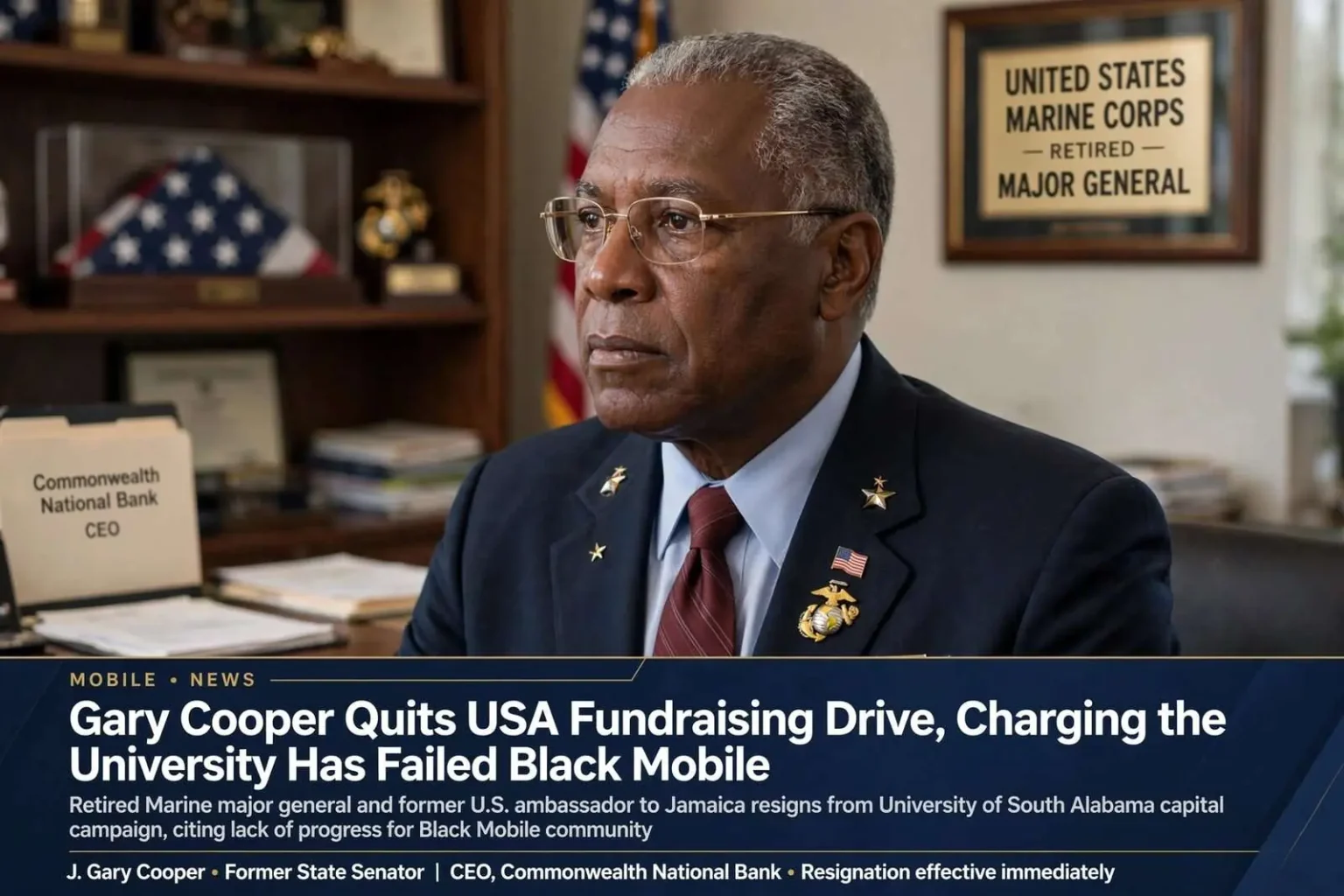
J. Gary Cooper is not a man Mobile institutions expect to lose.
A retired U.S. Marine Corps major general, a former state senator, a onetime U.S. ambassador to Jamaica and the chief executive of Commonwealth National Bank, he had agreed to lend his name and his considerable standing to the University of South Alabama’s capital fundraising campaign. Then he resigned from it, in a letter to USA President Gordon Moulton that accused the university of holding a “negative reputation in the minority community” and of failing to meet its obligation to Black Mobile.
The resignation was effective immediately. “Given the institution’s current leadership and direction, I cannot in good faith continue to be affiliated with the University’s Fundraising Capital Campaign,” Cooper wrote.
Six charges
Cooper said he had raised his reservations with Moulton before agreeing to join the campaign, and had since concluded that conditions were “far direr than previously realized.” He laid out six areas of failure:
- Faculty. An absence of senior, tenured African-American professors across most academic areas, particularly business, engineering, information sciences and much of Arts and Sciences. “Most departments do not have a single African-American,” he wrote, calling that unacceptable for a public university in a community more than 40 percent Black.
- Leadership and retention. No discernible program for minority retention and advancement, and a perception among African-Americans that the university had failed to deliver on promises made when they were recruited.
- Administration. No African-American serving as a dean or a vice president.
- Procurement. Little minority business participation in purchasing, and, by the reports he had received, no welcoming atmosphere for minority firms.
- Hillsdale Heights. Poor stewardship of university-owned housing there, which he said had contributed to declining property values and quality of life.
- Isolation. A university that provides “little or no outreach or services” to the inner city areas of Mobile and Prichard while concentrating its academic programs in West Mobile.
Cooper copied the letter to the USA Board of Trustees, the Mobile County legislative delegation and the Legislative Black Caucus.
Moulton’s rebuttal
Moulton replied at length, in three and a half single-spaced pages, and did not concede the premise. He acknowledged that African-Americans were under-represented among USA’s faculty, deans and vice presidents, but attributed the gap to market forces rather than inaction, noting that the university had recruited African-Americans and other under-represented groups for decades.
While the Mobile and Baldwin County area was roughly 30 percent African-American, he wrote, only about 5 percent of all doctoral degree holders nationally were African-American, and competition within that pool was fierce. As a state institution with a limited budget, USA was at a disadvantage in bidding for those candidates.
Still, he said, USA’s African-American faculty share had grown past 4 percent, against a national average of 3.2 percent among public doctoral institutions, and two African-American women were joining the finance faculty that fall. USA administrators, he said, were 8.17 percent African-American, close to the 9.4 percent national average.
Moulton pointed to a consent decree entered more than two decades earlier, under which USA agreed to remediate vestiges of past discrimination, and to the Diversity Committee it produced. Eleven members strong, six of them African-American faculty, staff or students, the committee was preparing a Strategic Diversity Plan for public comment in September and a likely trustee vote in December.
On minority business participation, Moulton called Cooper’s charge perplexing, saying the university’s Minority and Women-Owned Business Procurement Program had increased participation by 50 percent in dollars spent since 2003, and asking Cooper for specifics he could investigate. The isolation charge he found hardest to reconcile.
More than 40 percent of USA’s employees worked at its two hospitals, USA Children’s and Women’s and the USA Medical Center, both in inner-city Mobile near Prichard. More than 30 percent of hospital employees were African-American, he said, and the hospitals served more African-American patients than any other in the area.
About 17 percent of USA students were African-American, he added, against 12.5 percent nationwide, with the freshman class at 18 percent. Moulton also noted the irony at the center of the dispute: to the extent Cooper’s grievances had merit, the remedy would be best funded by exactly the campaign Cooper was quitting.
A million-dollar certificate of deposit
Beneath the exchange lay a business transaction. USA had declined to renew a $1 million certificate of deposit with Commonwealth National Bank after the bank’s bid fell short of rates offered by Compass Bank and Whitney Bank.
Commonwealth had held the CD for six consecutive years. Told it could keep the business by coming within.35 percent of the competition, the bank declined, and USA moved the money into commercial paper yielding 5.30 percent.
USA spokesman Keith Ayers noted that Cooper was a Commonwealth director with a personal financial interest in a bank that had just lost a million-dollar piece of university business, and said the university had a fiduciary duty to take the better return. Cooper’s letter, Ayers said, “was written shortly after the bid incident, and one must hope that they are unrelated.” Cooper did not deny the connection, but he reframed it.
What angered him was not losing the money, he said, but being told his bank had been outbid by a bank from Louisiana. “A school supported with my tax money in a city that is 40 percent minority and for a few points you go to a bank in Louisiana?” he said.
“It makes no sense to me.” Of Moulton’s reply, Cooper was dismissive. “The only thing I get from his letter is a lot of excuses,” he said.
“My years as a marine officer taught me that the person in charge is the person responsible for making things happen.” Founded in Mobile in 1976, Commonwealth National Bank operated on Spring Hill Avenue in Crichton, on St. Stephens Road and in Prichard, and was ranked by Black Enterprise among the nation’s 25 largest Black-owned financial institutions.