Keep the Fires Burning: A Mobile Family Memoir Reaches Its Close
The sixth and final chapter of Sister Marie Emilie's memoir carried the Walsh family from a Spring Hill summer in 1900 through loss, vocation and a sheaf of poems written from a convent far from Mobile.
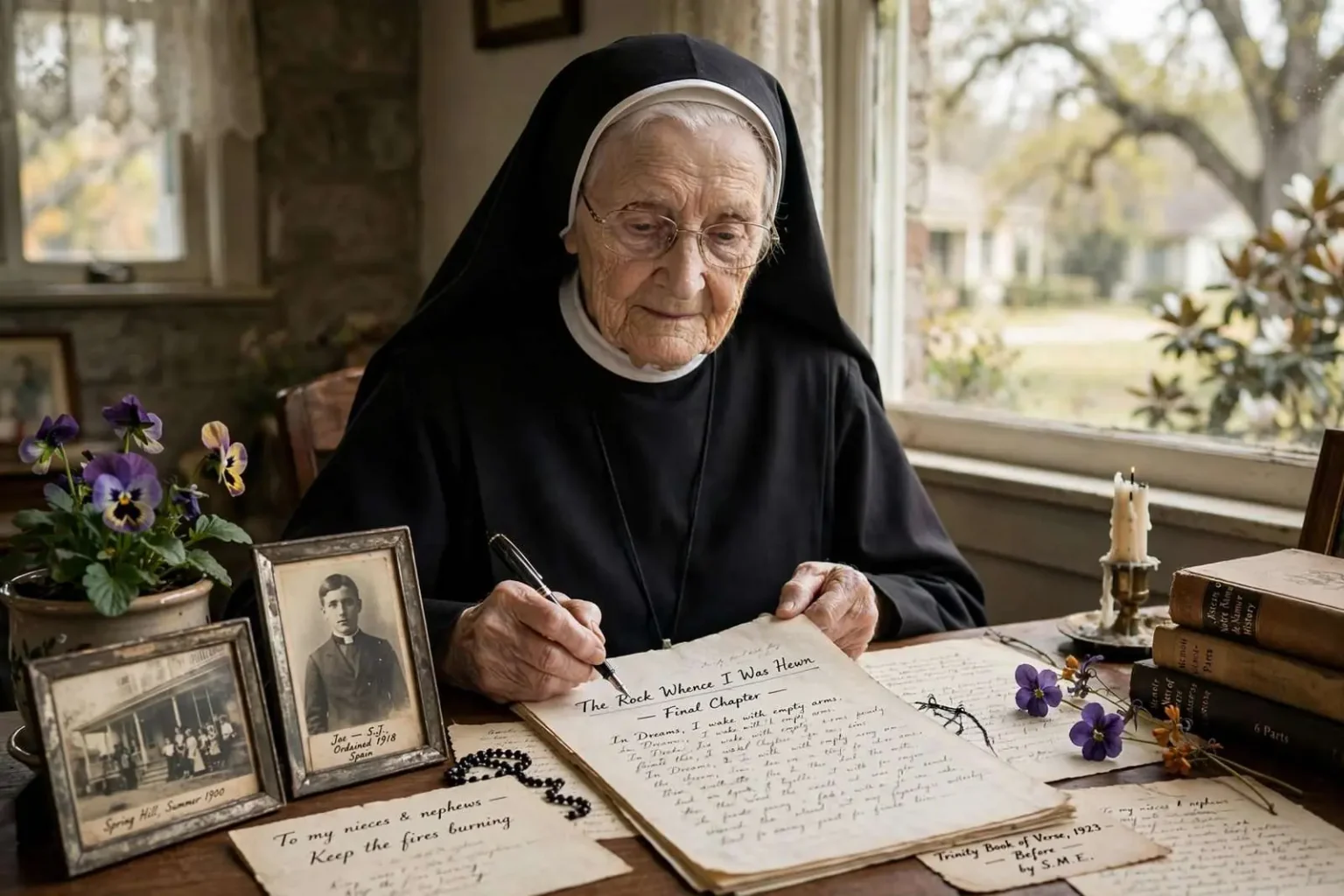
The serialized memoir of Sister Marie Emilie, S.N.D. — born Elizabeth Zoe Walsh in Mobile in 1892 — reached its conclusion in early April 2005 with a chapter that moved briskly from a Spring Hill summer to a convent in the North, and ended, as she intended, with poetry.
Titled “The Rock Whence I Was Hewn,” the six-part memoir was written for her family and addressed directly to her nieces and nephews. Its final installment is less a narrative than a handing-over: an elderly woman assembling the pieces she wanted the next generation to keep.
Summers, births and a fan of tissue paper
The chapter opened in the summer of 1900, when the family went out to Spring Hill as usual and her niece Emily Roe was born on Aug. 13.
She remembered Grandfather Roe walking up the drive with a black bag and, hours later, passing her on a swing with the news: “There is a little girl in that house up there.” Because her mother traveled often, she spent many summers with the Roe family across the road. Two images stayed with her.
The first was Grandfather Roe’s long, solemn blessings over meals, so unlike the brief Catholic grace she knew. The second she recorded without comment: in summer, a small Black boy stood at the table with a long pole hung with strips of colored tissue paper, slowly fanning the diners while they ate.
She called it plainly “a remnant of some far back before the Civil War practice,” and noted that window screens and electric fans came later. It is a passage a modern reader cannot pass over lightly, and it belongs in any honest account of what these households were.
The memoir does not interrogate it. It simply records it, and that record is part of what makes the document useful.
Vocations and losses
Her brother Joe graduated from Spring Hill College in 1903. Their father wanted him to become a doctor and a partner to his friend Dr. Mastin, and Joe dutifully enrolled at the University of Pennsylvania to study medicine. He came home after term exams and announced he was joining the Jesuits — a blow, she wrote, to a father who had imagined a physician son.
Two years later, Zoe was sent to high school at the Visitation Convent, where boarding was required and, by her own account, unwelcome; she had never liked going near a convent. She graduated in 1910.
In 1909 her brother Will, newly out of college, died suddenly of peritonitis — the first great tragedy of the family’s life, she wrote, and one that marked her parents permanently. The year 1918 concentrated everything at once.
Her mother died. Her brother Joe was ordained in Spain.
And she entered the convent, joining the Sisters of Notre Dame de Namur. She did not return to Mobile for twelve years, and did not come back for a proper visit until 1935, at her father’s request.
Her father died in 1937.
The poems
Rather than close with events, Sister Emilie chose to close with verse, appending poems she had written from the convent.
They are the emotional center of the chapter, and they explain, better than any summary, what she meant by “the rock whence I was hewn.”
“In Dreams,” written for her mother after she entered the convent at the Summit, describes waking with empty arms — a homesick young nun’s grief set down without ornament.
“Before” (1923), published in the Trinity Book of Verse, catalogs violets, night winds, orange blossoms and mockingbirds at the family place called Tracy, each stanza turning on the same refrain: “But, Mother dearest, you were there before.”
“Pansies,” a birthday poem for her sister June, who grew them by the boxful in her yard on Ann Street.
“To My Father” (1937) and “Miracles,” the latter written for her Jesuit brother.
A charge to the living
The memoir’s last pages are given over to her mother, called “Nanny” by the family, whom she describes as the fixed center of the house.
Coming home from school, the children called up the stairs — “Mother, are you here?” — and the answer, “I’m upstairs,” turned an upstairs room into the family’s living room. Each child in turn demanded a private conversation with her, and the contents of those conversations, she admitted, were rarely important.
The point was simply to be alone with her. She noted that the Roe grandchildren, living next door, were allowed to come for midday dinner only by invitation, which produced a ritual of seven-in-the-morning telephone calls from whichever child reached the phone first.
“I know that life today is very different,” she wrote, “that families don’t get together in quite the same way.” Her closing instruction was direct: keep the fires of the family burning, and see that the younger people know something of their grandparents. She signed the memoir “Aunt Zoe,” the youngest and last of her parents’ children.
Taken as a whole, the memoir stands as an unusually intimate record of Mobile between roughly 1895 and 1918 — the Spring Hill summers, the parlor weddings, the epidemics, the schools and the hierarchies — written by someone who left the city young, and who therefore remembered it with unusual clarity.
About Her Order
The Sisters of Notre Dame de Namur, the order Zoe Walsh joined in 1918, was founded in France in 1804 by St. Julie Billiart and is devoted mainly to teaching. In 1897 the sisters founded Trinity College in Washington, D.C., whose Trinity Book of Verse published her poem “Before.”