University of South Alabama Spring Hill
Restaurateur Mead Miller Enters the Race for Mobile’s Open Council Seat
Picklefish co-owner Mead Miller announced his candidacy for Mobile City Council District 7 in June 2005, the only council district with no incumbent seeking re-election.
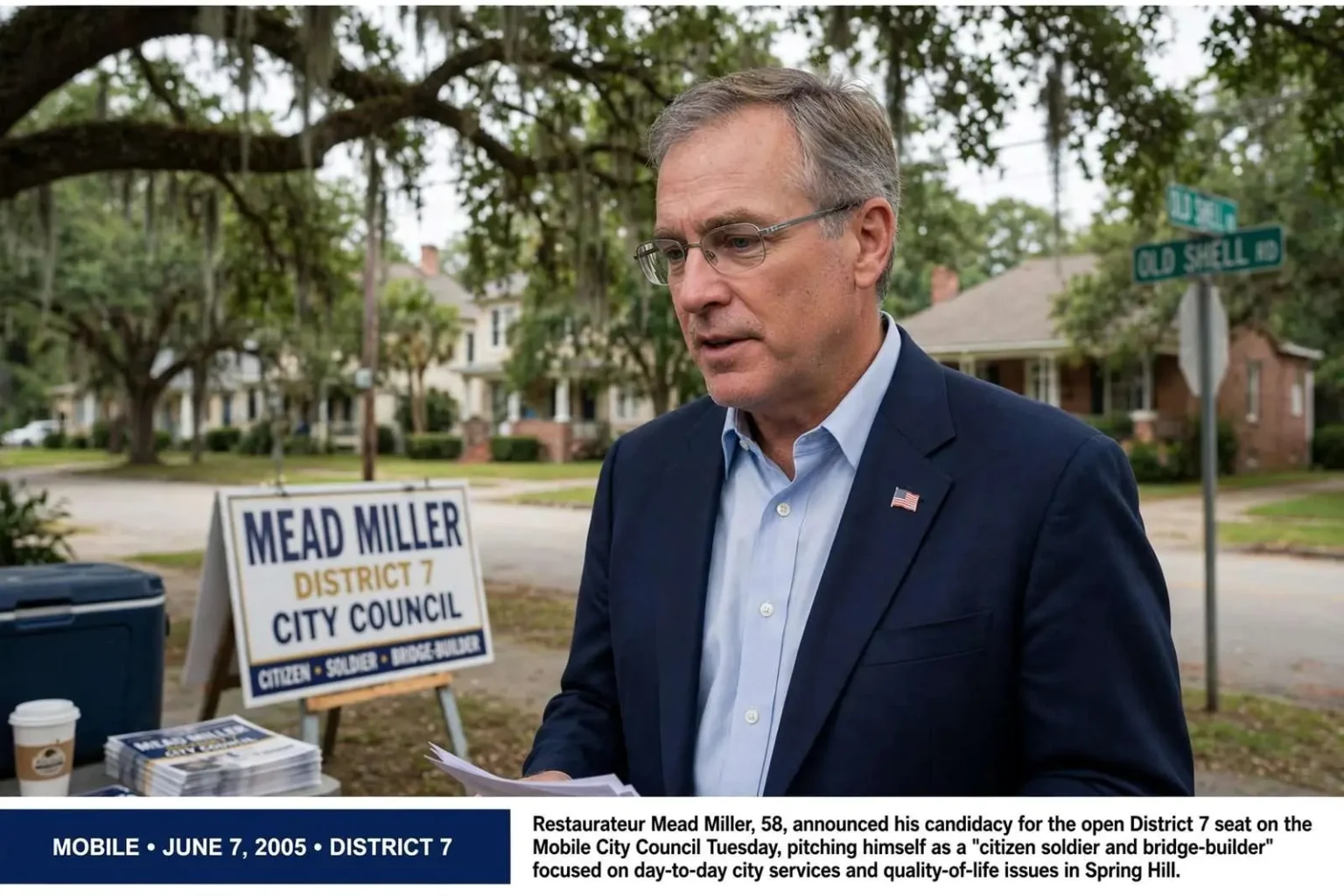
MOBILE — Restaurateur Mead Miller announced his candidacy for the District 7 seat on the Mobile City Council on Tuesday, June 7, 2005, following the council’s regular weekly meeting — entering the only council race in the city with no incumbent in it.
“I’m excited about the challenge of representing District Seven,” Miller said. “I want to see that the things that need to be fixed get fixed. I want to focus on day to day quality of life and city-service issues in my district as well as responsible long-term planning for positive growth throughout our community.”
The announcement put a longtime Mobile businessman into a race that had been waiting for one. With every other council incumbent seeking re-election in the Aug. 23, 2005, municipal election, District 7 — in northwest Mobile — was the sole open seat on the seven-member council, and it was open only because its councilman had his eye on a bigger job.
Why the Seat Was Open
District 7 was vacant because its councilman, John Peavy, was running for mayor. Peavy had won the seat in a special election in September 2004, filling the unexpired term of Stephen Nodine, who had been appointed to the Mobile County Commission.
The seat’s recent history made it unusual in more ways than one. Nodine’s departure for the county commission had already forced one special election, Peavy’s mayoral bid now promised another change, and the district’s voters would go into the August election having been represented by three different council members in barely more than a year. Stability, in other words, was itself a campaign issue.
Miller, 58, had been weighing a run for several weeks. He had lived in midtown, in District 2, and moved to establish residency in District 7 in order to qualify — taking a house at 3655 Old Shell Road in the Spring Hill section.
He described his intended role in terms deliberately at odds with the usual campaign vocabulary.
“I am looking at my potential role on the Council as a citizen soldier and bridge-builder — not as some business-as-usual politico,” he said before making his final decision.
The Candidate
A native of Washington, D.C., and a graduate of St. Albans School there, Miller earned a bachelor’s degree at Tulane University in New Orleans and a master’s at the University of Texas at Austin.
He spent several years in the motorcycle industry as a magazine editor and as a state and federal legislative specialist before moving to Mobile in 1976. He worked as a petroleum and crude oil executive with Marion Corporation before buying his first Mobile business in 1985, and had been a local business owner ever since.
The restaurant business gave his campaign its most concrete credential. Restaurateurs deal daily with the exact machinery of city government that most voters only encounter when something breaks — permitting, inspections, licensing, public works — and Miller’s promise to focus on “day to day quality of life and city-service issues” drew directly on that experience. He had, by his own account, spent two decades working with City Hall from the customer’s side of the counter.
The move from midtown to Spring Hill, meanwhile, gave him a story to tell about the district he hopes to represent: a candidate who wanted the job enough to uproot a household and re-establish his life inside the district’s lines, rather than waiting for an open seat in his own. Residency requirements for council districts are strict, and the house on Old Shell Road was the price of admission.
The District and Its Politics
District 7 takes in some of the most recognizable ground in Mobile: the Spring Hill neighborhood, leafy and historic along Old Shell Road; the commercial corridors that run west toward the city’s expanding suburbs; and a stretch of the city where municipal politics has traditionally been dominated by quality-of-life concerns — drainage, traffic, parks, public safety and the pace of growth. It is the kind of district where council service is measured in potholes filled and storm drains cleared as much as in policy votes.
The seat Miller seeks is one of seven on the Mobile City Council, each member elected from a district under the mayor-council form of government Mobile adopted in 1985. Council members leg work both a citywide legislative agenda and a district caseload, fielding constituent complaints about everything from garbage pickup to zoning variances. The council also controls the city budget alongside the mayor, which makes each seat a node in every major civic debate — and in 2005, those debates included the city’s growth westward, its aging infrastructure and the competition with neighboring communities for development.
The Aug. 23 municipal election frames the race. Mobile’s municipal elections are nominally nonpartisan, so the contest will be decided at the ballot box in August unless no candidate clears the threshold, in which case the top finishers head to a runoff. With no incumbent defending the seat, the field is open, and every candidate starts from the same place: name recognition to be built, ward by ward.
The Open-Seat Math
Miller’s entry highlights what made the 2005 cycle unusual. In a typical Mobile municipal year, the council races are referendums on incumbents — some challenged, some unopposed, most re-elected. In 2005, six of the seven incumbents were seeking new terms, and the seventh had traded his council seat for a mayoral campaign, leaving District 7 as the one place where voters were guaranteed a new face no matter the outcome.
Peavy’s mayoral run added a wrinkle. Depending on how his campaign fared, the district could end up with a special election to fill the remainder of his unexpired term on top of the regular cycle — a prospect that made the district’s representation the subject of arithmetic as much as politics. Peavy himself had been through exactly that: his September 2004 special election win came after Nodine’s appointment to the Mobile County Commission left the seat unfilled mid-term.
For Miller, the open field is both opportunity and obligation. A first-time candidate with deep business roots but no electoral record, he must introduce himself to a district whose longtime voters remember its council members as fixtures — and do it in a compressed summer campaign between the June announcement and the August vote.
His framing of the job suggests how he plans to do it. The “citizen soldier and bridge-builder” language positions him against the professional-politician archetype, an appeal aimed at voters tired of the ordinary vocabulary of campaigns. The promise to fix “the things that need to be fixed” is deliberately unglamorous — the platform of a man who has spent twenty years in the service business and believes that government, like a restaurant, succeeds or fails on the daily experience of the people who walk through the door.
The Aug. 23 election will tell whether District 7’s voters agree. What is already certain is that the city’s only open council seat will have a new occupant this fall, and that a Spring Hill newcomer with a restaurateur’s eye for service intends to be in the running for it.
What He Brings to the Race
Miller’s biography, told in sequence, sketches a career that has moved between industries but rarely left the civic mainstream. The Washington upbringing and St. Albans education placed him early among people who treated public affairs as a normal subject of conversation; the motorcycle-industry years — editing a magazine, working as a legislative specialist in both state and federal arenas — gave him a working knowledge of how laws and regulations get made; and the move to Mobile in 1976 began the chapter that has defined him locally ever since.
The petroleum years with Marion Corporation put him inside an industry with deep Mobile roots, tied to the port and the energy economy of the Gulf. Buying his first business in 1985 switched his attention to the retail streets of the city itself, where payroll, property and customer service became his daily business. That combination — boardroom and counter, citywide issues and storefront realities — is the profile of a businessman-candidate, a type Mobile voters have historically been willing to elect.
For now, the field is his to introduce himself to. The district’s households along Old Shell Road and the corridors west of it will spend the summer hearing from the candidates for the seat, and Miller’s first argument is already on the record: fix what needs fixing, mind the daily quality of life, and plan responsibly for the growth that is coming. It is a businessman’s platform for a business-minded district — and, he is betting, a winning one when the votes are counted in late August.