Mobile’s $18.5 Million Hole: Every Option on the Table, and None of Them Painless
Facing an $18.5 million shortfall, Mobile officials weighed pay cuts, a sales tax increase, a garbage collection fee and layoffs. Each carried a political price nobody wanted to pay.
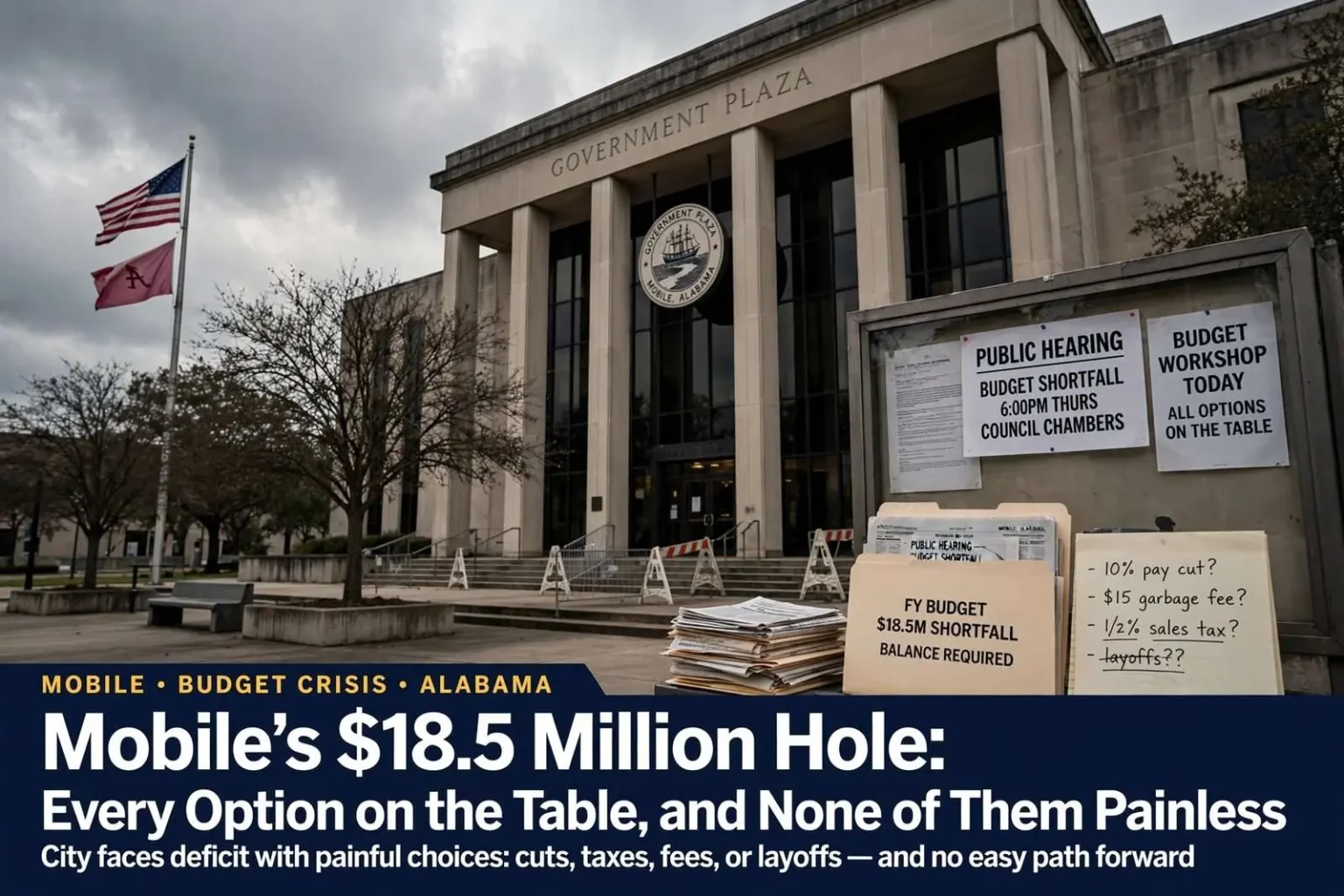
Mobile’s leaders have plenty of options for closing an $18.5 million gap between what the city expects to collect this year and what it expects to spend. The trouble is that none of them is good. They can cut. They can shift and adjust. They can tax, charge or assess. They can lay people off. Or they can attempt some combination. What they cannot do is nothing: by law, revenues and expenditures have to meet.
The legal requirement is not a suggestion. Alabama’s municipal code requires cities to adopt balanced budgets and forbids spending beyond actual revenue, so Mobile’s council cannot simply carry the deficit forward and hope. The mayor submits a spending plan, the seven council members amend and adopt it, and when revenue falls short mid-year the city is obligated to reconcile the books — which is why the debate over how to do it has consumed Government Plaza and spilled into neighborhood meetings across the city.
The gap itself did not appear out of nowhere. Mobile’s general fund leans heavily on sales tax collections and shared state revenues, and the recession had cut into both just as the city’s personnel costs — salaries, benefits and retirement obligations for a workforce of thousands — kept climbing. An $18.5 million shortfall in a budget of roughly this size is not a rounding error; it is the kind of number that demands either new money or a permanently smaller city government, and few councils anywhere enjoy choosing between the two.
Where things stand
Mayor Sam Jones has proposed a 10-percent across-the-board pay cut for city employees, a step that would fall hardest on the roughly 2,500 people who work for the city. Employees have made it plain they regard the plan as solving a citywide problem on their backs. Jones, Mobile’s first African-American mayor, elected in 2005 after a career in the city’s engineering and public works bureaucracy, had entered office promising fiscal modernization — but the recession turned his tenure’s central challenge into triage rather than reform, and the pay cut proposal put him at odds with the workforce he had spent decades working beside.
Councilman William Carroll, who has taken a leading role in the finance discussions, has floated an alternative: a monthly garbage collection fee, beginning around $15, phased over 18 months. “All things are possible,” Carroll says. Carroll, a veteran councilman whose district covers much of the city’s core, has framed the choice as between an honest, dedicated revenue stream and a patchwork of cuts that degrade services citywide — but he has also been careful not to commit, since a fee of that size touches every household and invites every objection the fee option carries.
Not all things, however, are likely. City departments have already absorbed significant cuts, and officials say a mandatory reserve of about $4 million can be shifted, reducing the practical hole to roughly $14.4 million. Even after that easing, the remaining sum dwarfs what trimmed travel budgets and frozen hiring can produce. The council’s real choice is between a structural reduction in the workforce — layoffs and permanent service changes — and a new recurring revenue source, and each side of that divide has its own arithmetic and its own politics.
The sales tax option
In the South, the sales tax has long been the preferred instrument, for the simple reason that everyone pays it and no one receives a bill in the mail. A one-percent increase in Mobile has generated roughly $30 million a year in the recent past. A half-percent increase would raise something in the neighborhood of $15 million — very nearly the size of the gap.
Those figures explain why the half-cent is the option that keeps resurfacing. It is large enough, in a normal year, to close the hole almost exactly, it spreads across the entire sales base rather than concentrating on any single group, and it can be presented as temporary. Attach a three-year sunset to a half-cent increase and the political arithmetic gets easier still: the tax would expire just before the 2013 municipal elections, and a future council could take up the question again in 2014, after voters have had three years to see whether the city managed the money responsibly.
The complication is that Mobile’s sales tax collections are already trending downward with the recession. Raising the rate on a shrinking base is not a reliable way to hit a revenue target, and it invites the oldest objection in public finance: if you want less of something, tax it. Every percentage point added to a municipal rate also widens the gap between in-city and out-city prices, pushing border-area shoppers to Saraland, Spanish Fort, Daphne or the county’s unincorporated commercial strips — a drift that erodes exactly the base the tax depends on and leaves merchants inside the city limits competing at a structural disadvantage.
The garbage fee option
A fee for a service has an intuitive fairness to it. Other municipalities charge one, and Mobile itself briefly did in the mid-1990s, imposing the fee as a temporary measure and — to the surprise of the cynics — actually withdrawing it on schedule. That history cuts both ways: it proves the city can create and retire such a fee cleanly, and it proves residents remember being charged for a service they had previously received as part of the general tax base.
The drawbacks are real. What was once included in the price of citizenship becomes a line item. Unlike a small bump in the sales tax, a monthly fee reminds people of itself every 30 days, arriving on the same bill month after month regardless of how the city’s fortunes swing. Not everyone would pay: blanket exemptions would apply to specific census tracts, and residents outside them could apply individually, a process that would inevitably attract accusations of political favoritism — and in Mobile, where council districts map onto old patterns of race and income, an exemption map drawn around census tracts would be scrutinized line by line.
The Mobile Area Water and Sewer System would likely be asked to collect the fee, which raises its own questions — including whether MAWSS could legally cut off a customer’s water for refusing to pay a garbage charge. MAWSS is a separate public utility with its own board and its own rate structure, and bundling a city fee onto a water bill entangles the two governments in ways neither has fully worked through publicly. There is also a legal constraint that a fee cannot exceed the actual cost of the service. Fifteen years ago the fee and the cost of twice-a-week collection were set at about $4. Pickup is now once a week. Aligning a $15 fee with an honest accounting of cost would require some creativity.
Trash, income tax and other long shots
Mobile is unusual, perhaps singular, in offering twice-monthly bulk trash pickup at no extra charge — a service the city reportedly began after Hurricane Frederic in 1979 and never stopped. Frederic, the September hurricane that raked the central Gulf Coast and left the region buried in storm debris, taught Mobile the value of a standing bulk-collection capacity, and the twice-monthly schedule became a municipal habit that outlived its reason by decades. A fee could be attached to it, but collection would be harder and evasion more common, with the predictable result piling up along the roadsides. Bulky items are precisely the ones residents will dump rather than pay to discard, and enforcement costs can swallow the fee’s proceeds.
A municipal income tax would scratch an old itch: taxing people who work in Mobile but live in Semmes, Saraland, south Mobile County or across the bay on the Eastern Shore. Birmingham has one, applying to wages earned within its limits regardless of where the worker lives, and the argument in Mobile is the mirror of Birmingham’s: a city whose daytime population far exceeds its residential population is providing police, fire, streets and parks to tens of thousands of commuters who pay nothing toward them. But the objection returns with force. The last thing Mobile needs less of is jobs — and a tax on working in the city, imposed in the middle of a recession, would land on the employers and employees the city most wants to keep and attract.
The likeliest outcome
Elected officials, as a class, are not great risk-takers. The smart money says the council will eventually — after a great deal of wailing, gnashing and public agonizing — settle on a new revenue source rather than deep cuts, and that the instrument will be a half-percent sales tax increase carrying a sunset provision. The garbage fee is the runner-up. Had this crisis arrived a year earlier, with a municipal election months away, the calculus would have looked very different. Layoffs would have been the front-runner, because a council facing voters would rather cut invisible payroll than hand every household a visible bill, and timing has as much to do with Mobile’s budget choices as any fiscal theory.
What the choice means for residents is straightforward whichever instrument wins. A half-cent sales tax costs a household in proportion to what it buys; a $15 monthly fee costs it the same regardless of income; layoffs cost it in slower police response, shuttered facilities and dimmer streets. The council’s debate, stripped of its procedural noise, is a referendum on which form of pain Mobile prefers — and on whether the city treats the current shortfall as a one-year emergency or a permanent reset in what residents can expect their government to do.
Which leaves the question nobody at City Hall wants to answer out loud: must revenue be found to meet expenditures, or could expenditures be managed to fit revenue? The city has answered that question in practice for years — by growing spending faster than population and inflation, and by assuming each year’s collections would outpace the last. The $18.5 million hole has now forced the question into the open, and whichever way Mobile answers it, the answer will shape the city’s budget politics for years beyond the current crisis.